Best Code Review Tools for Distributed Teams in 2026: 8 Tools Compared
Find the best code review tools for distributed teams, from GitHub and GitLab to AI reviewers like CodeRabbit and Graphite, with pricing compared in 2026.
- Editor's choice
 GitHub Pull Requests
Most GitHub teams
Starts atFreeVisit github.comFull review - Great alternative
 GitLab Merge Requests
GitLab teams and DevOps pipelines
Starts atFreeVisit about.gitlab.comFull review - Also consider
 Bitbucket Pull Requests
Atlassian shops
Starts atFreeVisit bitbucket.orgFull review
TL;DR:
- Most distributed teams should start with the review tools built into GitHub or GitLab, then add an AI reviewer only if reviews are the bottleneck.
- CodeRabbit is the easiest AI add-on for teams that want faster first reviews without changing how they work.
- Graphite suits teams that want small, stacked pull requests and a faster merge queue across time zones.
- Gerrit remains a strong choice for large, regulated teams that need strict control over every change.
- AI reviewers save the most time when pull requests are already small and well described, not when they are large and vague.
Quick comparison
| Tool | Best for | Starts at | Free plan? | |
|---|---|---|---|---|
| GitHub Pull Requests | Most GitHub teams | Free | Yes | Visit |
| GitLab Merge Requests | GitLab teams and DevOps pipelines | Free | Yes | Visit |
| Bitbucket Pull Requests | Atlassian shops | Free | Yes | Visit |
 Gerrit | Large, controlled codebases | Free | Yes | Visit |
 CodeRabbit | AI first reviews | $24 per developer per month | Yes | Visit |
 Graphite | Stacked pull requests | $20 per user per month | Yes | Visit |
 Greptile | Full codebase context | $30 per seat per month | Yes | Visit |
 Reviewable | Detailed, threaded reviews on GitHub | See website | Yes | Visit |
The best code review tools for distributed teams
Distributed review is mostly an async problem. Teammates in other time zones need clear context, small changes and a review that does not wait for someone to wake up. These tools handle that in different ways.
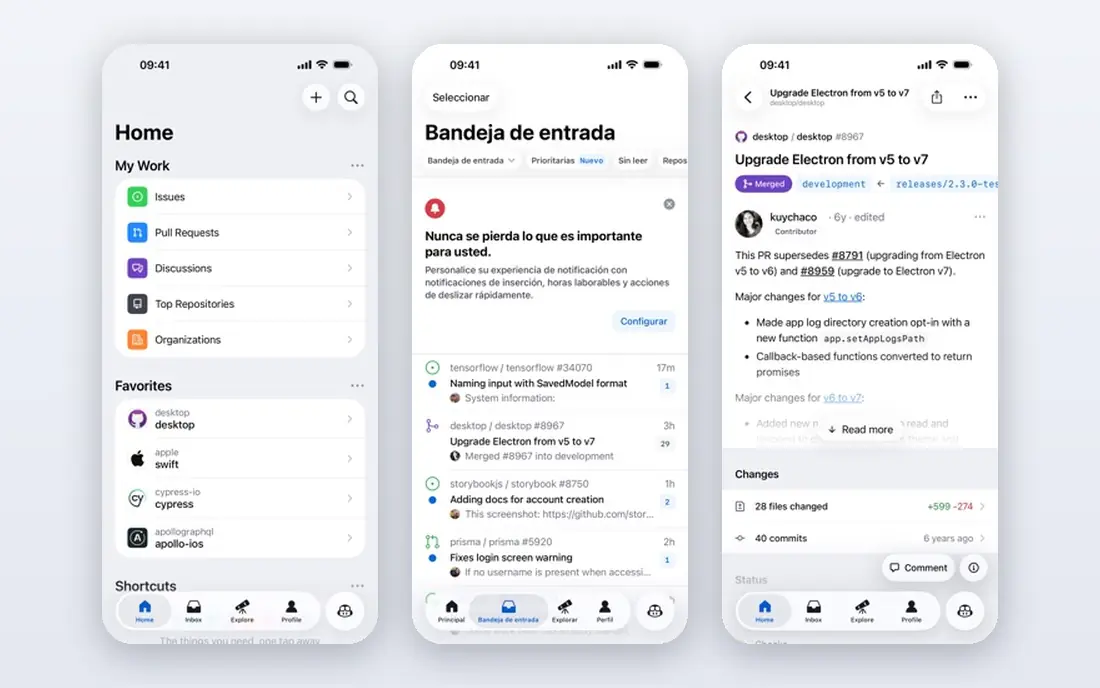
GitHub pull requests are the default for a reason. Reviewers can comment on exact lines, request changes, approve with conditions and require checks before a merge, all in the same place where the code lives. Code owners rules route reviews to the right people automatically, which matters when no one is online at the same time.
The limits show up at scale. Large pull requests are hard to review well, and GitHub does not natively stack small changes the way Graphite does. Teams that hit those limits usually keep GitHub as the base and add a tool from this list, rather than replacing it.
- Built into the platform most teams already use
- Code owners and required reviews
- Large integration ecosystem
- No stacked pull requests built in
- Advanced review insights need add-ons

GitLab merge requests suit teams that want review tied closely to pipelines and security checks. A reviewer can see test results, security findings and deployment status without switching tools, which cuts down on back-and-forth across time zones. Approval rules let you require specific reviewers for sensitive areas of the code.
The trade-off is weight. GitLab does a great deal, and smaller teams may find the interface busier than GitHub. Paid tiers add AI-assisted review, so budget for those if that is part of your plan.
- Review, CI and security scanning in one platform
- Approval rules
- Good self-hosting option
- Interface can feel heavy
- Some AI review features need a paid tier
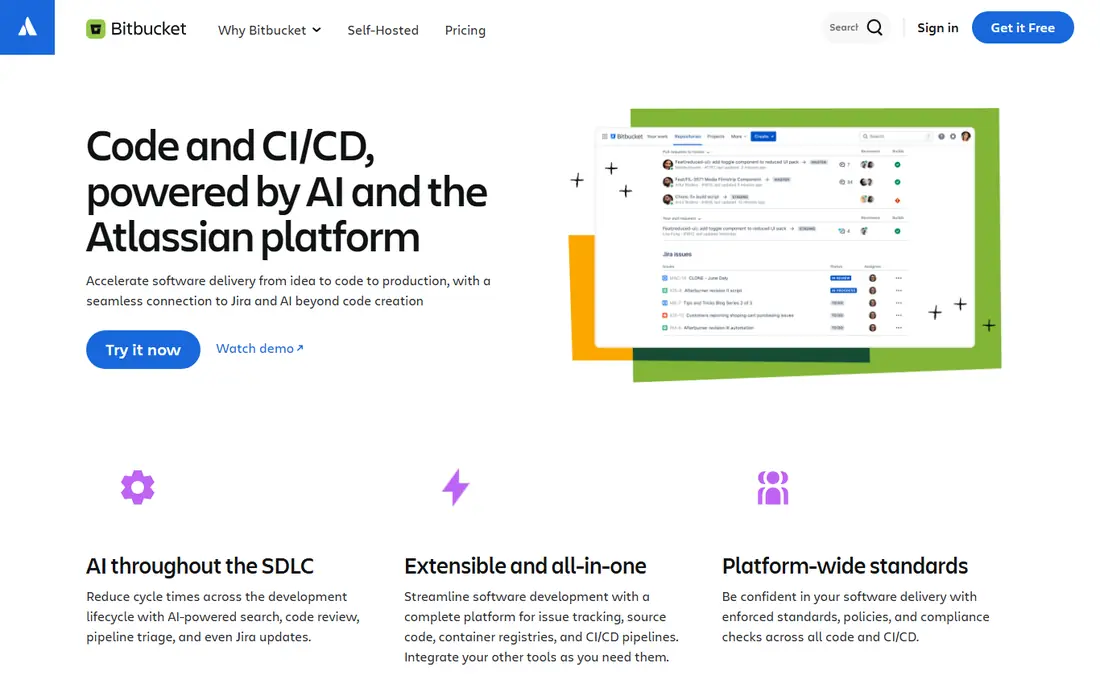
Bitbucket makes most sense if your team already plans work in Jira and documents it in Confluence. Pull requests link directly to issues, so a reviewer in another time zone can see the ticket, the branch and the discussion without hunting across tools. The review flow itself is simple and easy to teach.
It is not the best choice if you want the widest range of AI reviewers or integrations, because GitHub has a larger ecosystem there. For Atlassian-centered teams, though, that trade is often worth it for the tighter workflow.
- Tight Jira integration
- Simple pull request flow
- Good for teams already on Atlassian
- Smaller third-party ecosystem than GitHub
- AI review options are thinner
Gerrit takes a different approach, reviewing patch sets rather than branches, and it gives administrators very precise control over who can approve what. That control is why large projects and regulated teams still use it. Every change goes through a clear, auditable review path, and reviewers can work through revisions one patch at a time.
Newcomers often find Gerrit harder to learn, and its web interface is less polished than modern rivals. It also needs hosting and care, so it fits teams with platform support better than a small startup that wants a tool running in five minutes.
- Fine-grained access control
- Patch-set based review
- Proven at very large scale
- Steeper learning curve
- Interface feels dated compared with GitHub
CodeRabbit drops into your existing pull request flow and reviews code before a human opens it. It summarizes changes, flags bugs and style problems, and suggests fixes that authors can apply quickly. For distributed teams, that first pass matters, because it means a teammate does not wake up to a pull request with no context at all.
The honest catch is noise. AI reviewers sometimes comment on things that do not matter, and teams need to tune the settings and give feedback to keep the signal high. Start on a few repositories, measure how often reviewers act on the comments, and only then roll it out widely.
- Fast AI summaries and line comments
- Works with GitHub and GitLab
- One-click fixes for many issues
- Can produce noisy or low-value comments
- Per-developer pricing adds up on large teams
Graphite changes how teams ship code by breaking a large change into a stack of small, reviewable pull requests. Each piece can be reviewed and merged in order, which keeps reviews short and reduces the merge conflicts that plague distributed teams. Its merge queue then lands approved changes safely.
That benefit comes with a workflow change. Everyone has to learn stacking, and the tool works with GitHub, not GitLab or Bitbucket. If your team is willing to adopt that habit, reviews get faster. If not, a lighter AI reviewer may be a better fit.
- Stacked changes keep reviews small
- Merge queue reduces conflicts
- AI review included on team plans
- GitHub only
- Teams must learn the stacking workflow
Greptile stands out by looking beyond the changed lines. It pulls in related code from across the repository, so its reviews can catch problems that a diff-only reviewer would miss, such as a change that breaks a caller elsewhere. That is especially useful in large monorepos where no single reviewer knows every corner.
Pricing is the main drawback, and review allowances mean heavy teams should check the limits before committing. For teams with complex codebases and senior reviewers stretched thin, the extra context can still be worth the cost.
- Reviews with context from across the codebase
- Good for large monorepos
- Detailed summaries
- Higher per-seat price
- Usage limits apply after a set number of reviews
Reviewable is a focused tool for teams that find GitHub reviews hard to follow on large changes. It organizes discussions by file, shows what has been reviewed and what is still open, and makes it easier for a reviewer in another time zone to pick up exactly where the last person left off. That visibility reduces duplicate questions and lost comments.
It does not replace GitHub, it sits on top of it, so teams get a second interface to learn. For small pull requests the extra layer may be overkill, but for long, complex reviews it can bring welcome order.
- Clear discussion threads per file
- Good handling of large pull requests
- Keeps review state visible
- GitHub only
- Adds another interface on top of GitHub
How we picked these
We compared official feature pages, pricing pages and documentation for each tool, and we favored products that support async review, clear reviewer assignment and integration with common Git hosts. A tool made the list only if it is actively maintained and works for teams spread across time zones in October 2026. We weighed workflow fit, AI review quality controls, pricing transparency and how much process change each tool demands.
How to choose for a distributed team
Keep pull requests small first
No tool fixes a 1,000-line pull request. Agree on a size limit, require a short description that explains why the change exists, and ask authors to link the ticket or design note. Small changes make every tool on this list work better.
Decide what you want AI to do
Some teams want AI to catch bugs before humans look. Others want summaries and context only. Those are different jobs, and the settings, noise level and price will differ. Run a short trial, count how many AI comments reviewers actually act on, and keep the tool only if that number is solid.
Protect reviewer time across time zones
Set response expectations that respect working hours, use code owners so reviews route correctly, and avoid requiring a reviewer who is asleep to unblock a merge. A merge queue or a second reviewer in another region can keep work moving without asking anyone to work nights.
FAQ
What is the best code review tool for a distributed team starting out?
Start with GitHub Pull Requests or GitLab Merge Requests, depending on where your code already lives. Add CodeRabbit if slow first reviews are your main bottleneck, and add Graphite only if large pull requests are the recurring problem.
Do AI code reviewers replace human reviewers?
No. AI reviewers catch routine issues and add context, but humans still need to judge design, trade-offs and risk. Treat AI output as a first pass, and keep human approval required for merging to main branches.
How do stacked pull requests help distributed teams?
Stacking splits a large change into small pieces that can be reviewed one at a time, in order. Reviewers can approve early pieces while later ones are still being written, which shortens the wait across time zones.
Should every pull request need two reviewers?
Not always. Two reviewers help for sensitive or risky code, but they slow ordinary changes. Many teams require one reviewer for routine work and two, or a code owner, for security, payments or core infrastructure changes.
Is Gerrit still worth learning in 2026?
For most small teams, no, because GitHub or GitLab will be faster to adopt. For very large or regulated codebases that need strict approval control, Gerrit remains a proven and credible choice.