Best Cloud-Based HR Platforms in 2026: 9 Systems Compared
Compare the best cloud-based HR platforms in 2026, from BambooHR and Gusto to Rippling, Workday and Deel, with pricing, features and fit guidance for teams.
- Editor's choice
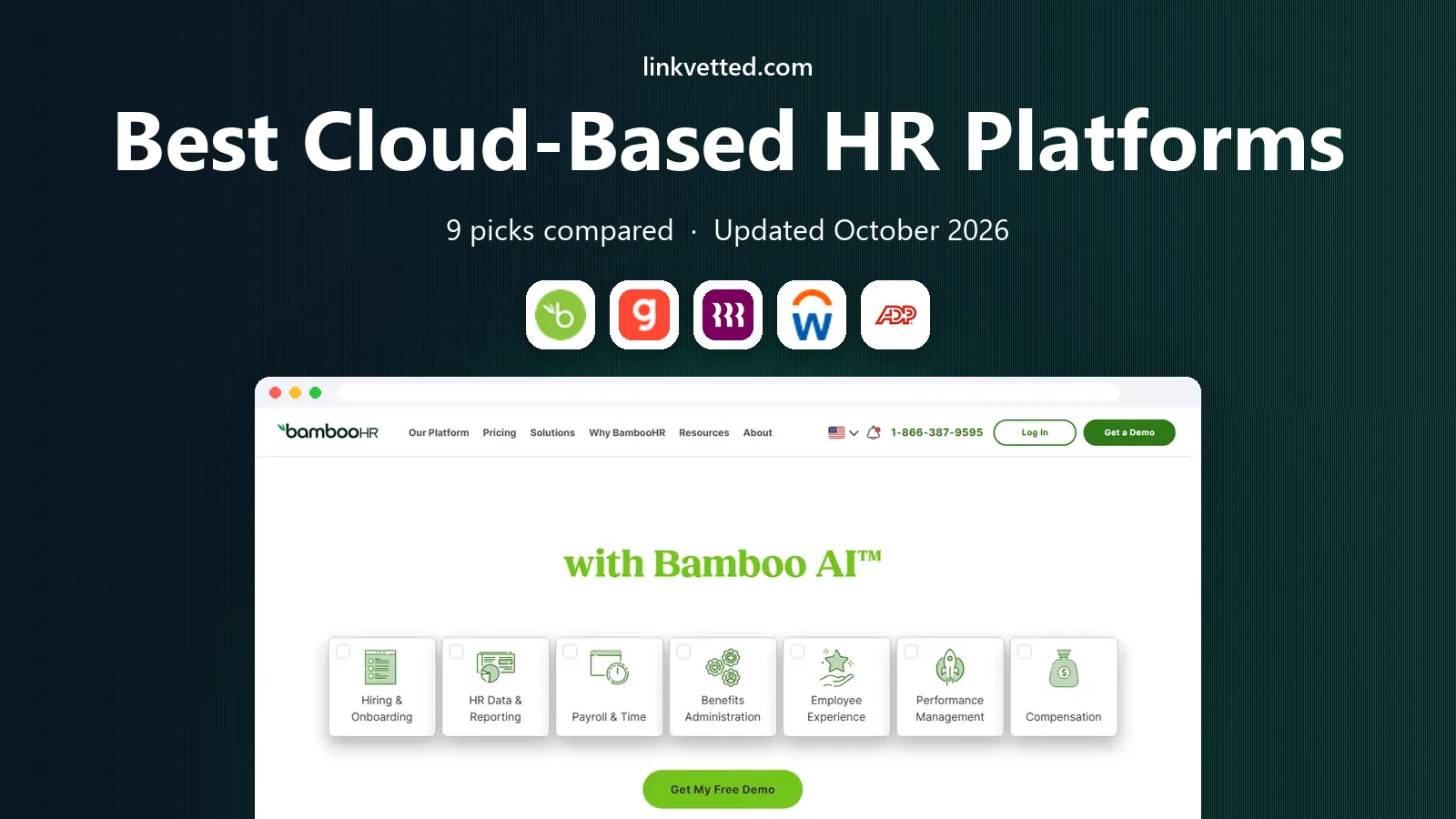
 BambooHR
Growing companies that want simple, friendly HR
Starts atSee websiteVisit bamboohr.comFull review - Great alternative
 Gusto
Small businesses that need payroll first
Starts at$49 per month plus $6 per personVisit gusto.comFull review - Also consider
 Rippling
Tech teams wanting HR, IT and payroll together
Starts at$8 per employee per month plus base feeVisit rippling.comFull review
TL;DR:
- BambooHR is our pick for growing US companies that want an easy HR system without payroll complexity, while Gusto is the simplest pick for small teams that need payroll first.
- Rippling suits tech-forward companies that want HR, IT and payroll in one system, though module pricing can add up fast.
- Workday and ADP Workforce Now suit large employers with complex compliance, global payroll or finance integration needs.
- Deel is the strongest choice for hiring across borders, while HiBob suits mid-size companies with distributed teams and a culture focus.
- Always price the full bundle, including payroll, benefits and add-ons, since the headline per-person price rarely matches the invoice.
Quick comparison
| Tool | Best for | Starts at | Free plan? | |
|---|---|---|---|---|
| BambooHR | Growing companies that want simple, friendly HR | See website | Free trial | Visit |
| Gusto | Small businesses that need payroll first | $49 per month plus $6 per person | Free trial | Visit |
| Rippling | Tech teams wanting HR, IT and payroll together | $8 per employee per month plus base fee | Free trial | Visit |
 Workday | Large enterprises with complex HR and finance needs | See website | No | Visit |
 ADP Workforce Now | Mid-size and large employers wanting a proven payroll partner | See website | No | Visit |
 Paylocity | Mid-size companies wanting payroll plus engagement | See website | No | Visit |
 HiBob | Mid-size companies with distributed, culture-focused teams | See website | No | Visit |
 Deel | Companies hiring employees and contractors abroad | See website | Free trial | Visit |
 TriNet | Small teams that want a PEO to handle HR burden | See website | No | Visit |
The best cloud-based hr platforms
Cloud HR platforms hold employee records, time off, onboarding, performance and often payroll in one online system. We compared official pricing pages, feature coverage and public reviews to build a list that spans small teams to global enterprises. Prices change and many vendors quote, so confirm your total before signing.

BambooHR is the HR system we recommend most often to companies between roughly 25 and 500 people. The interface is clear, employees can update their own details and request time off without HR hand-holding, and onboarding checklists keep new hires from falling through cracks. Implementation is usually measured in weeks, not months.
The limits are payroll and global reach. Payroll is an add-on with its own cost, and it covers US employees, so international hiring needs a partner or a second system. If your team is US-based and you want HR done well without enterprise weight, BambooHR is a strong default.
- Easy to use with strong employee self-service
- Good onboarding and time-off workflows
- Solid reporting for a mid-size HR team
- Pricing is quote-based and payroll is a separate add-on
- US payroll only, so global teams need partners

Gusto is the easiest on-ramp for a small business that needs to pay people correctly. Payroll, tax filings, benefits enrollment and contractor payments live in one place, and the Simple plan at $49 per month plus $6 per person covers single-state payroll for a small team. Setup is genuinely fast compared with enterprise systems.
As teams grow past 50 people or across many states, Gusto's HR tools feel lighter than dedicated HR platforms. Performance management and advanced reporting exist on higher tiers, but they are not the product's core strength. Start with Gusto for payroll simplicity, and move up when HR complexity demands it.
- Simple payroll with automatic tax filing
- Benefits and 401(k) bundling
- Easy setup for teams with no HR staff
- HR depth is thinner than BambooHR or HiBob
- Multi-state and advanced compliance needs push you to higher tiers

Rippling is the most ambitious platform here, and for tech-forward companies it delivers. When a hire starts, Rippling can create accounts, assign a laptop, enroll in payroll and grant app access in one workflow. When someone leaves, it reverses the process, which closes a real security gap that manual offboarding often leaves open.
The price deserves care. The HR starting point of $8 per person per month plus a base fee is only the beginning, and payroll, IT and global modules add cost. Price the exact bundle you need, and compare it against BambooHR plus separate IT tools before committing.
- Unifies HR, payroll, IT device management and spend
- Automates onboarding and offboarding across apps
- Global hiring through Rippling Global
- Module stacking can push the total well above the headline price
- Setup needs more planning than Gusto
Workday is the enterprise standard for a reason. Large, often public companies use it to run HR, payroll and finance on one system of record, with controls and audit trails that satisfy regulators and auditors. Global payroll coverage and workforce planning tools suit multinationals with complex structures.
For everyone else, Workday is overkill. Implementations are long, consulting costs are high, and small teams will use a fraction of what they pay for. Choose Workday when scale, compliance and finance integration genuinely require it, not as an aspiration purchase.
- Deep HR, payroll, talent and finance integration
- Strong global compliance and audit trails
- AI-assisted workforce planning
- Quote-only pricing with long implementations, often six to nine months
- Far more system than a small company needs
ADP Workforce Now
Best for: Mid-size and large employers wanting a proven payroll partner
ADP Workforce Now is the safe, proven choice for employers that prioritize payroll accuracy and compliance. ADP has processed payroll for decades, and its tax and multi-state coverage is deep. HR, benefits, time tracking and talent modules round out a full platform for mid-size and large employers.
The system can feel heavy for a 20-person company, and pricing is quoted rather than published. Companies in the 100 to 1,000 range with multi-state payroll are the sweet spot, especially those that want a vendor with a long compliance history.
- Long track record in payroll and tax compliance
- Broad HR, benefits and time modules
- Strong multi-state support
- Quote-only pricing
- Interface and module choices can feel complex for small teams
Paylocity combines payroll, HR and workforce management with a stronger focus on employee communication and engagement than most payroll-first rivals. Community feeds, recognition and surveys sit alongside core HR, which helps multi-location employers keep distributed teams connected.
Pricing is quoted, and published estimates place it above budget tools, so get a full written quote. The platform rewards companies that use its engagement features, not just its payroll. If you only need payroll, Gusto costs less.
- Payroll and HR in one system with strong reporting
- Employee engagement and communication tools
- Good for multi-location teams
- Quote-only pricing
- Implementation and training take real effort at scale
HiBob, known as Bob, suits companies that think of HR as a people product, not a back-office chore. The interface is modern, reporting is strong, and features for performance, engagement and time off fit distributed teams well. Multi-country support is better than most US-focused rivals.
Payroll is the gap to check. HiBob partners for payroll in many countries rather than running it natively everywhere, so confirm coverage for your locations. If HR experience and analytics matter more than native payroll, HiBob is a leading choice.
- Modern interface with strong people analytics
- Good for multi-country teams
- Performance, surveys and time off in one place
- Payroll is handled through partners rather than natively in every country
- Quote-only pricing
Deel solves a problem other platforms on this list mostly avoid: hiring legally in a country where you have no entity. Its employer-of-record service employs staff on your behalf, handles local payroll, taxes and benefits, and keeps you compliant with local labor law. Contractor payments and global payroll round out the offer.
That service costs real money per person, so Deel is not a budget HR tool for a domestic team. For a company hiring its first employees in three new countries, though, it is often faster and cheaper than setting up entities, and that is the calculation that matters.
- Employer-of-record coverage in many countries
- Global payroll and contractor payments
- Compliance handled locally by Deel entities
- Employer-of-record pricing is high per person
- US-only teams gain little from its global strength
TriNet, which also operates the Zenefits platform, is a professional employer organization rather than pure software. It co-employs your staff, which lets a small company offer competitive benefits and lean on TriNet for compliance, payroll taxes and HR advice. For founders with no HR staff, that support is worth a premium.
The premium is real, and control is shared by design. Companies that want to run HR themselves should pick BambooHR or Gusto instead. Companies that want HR handled for them, with benefits they could not negotiate alone, should price TriNet seriously.
- PEO model bundles HR, payroll, benefits and compliance support
- Access to large-group benefits for small teams
- Dedicated HR guidance
- PEO pricing is higher per person than software-only tools
- Less control than running HR yourself
How we picked these
We compared official pricing and feature pages, plus public reviews, for cloud platforms that are actively sold and supported in 2026. We favored systems with clear HR depth, reliable payroll or a credible partner model, and a real customer base, and we covered small, mid-size, enterprise and global use cases rather than ranking on price alone.
How to choose the right HR platform
Start with headcount and geography. A US team under 50 people usually fits Gusto or BambooHR, a team of 100 to 1,000 fits BambooHR, Paylocity or ADP, and a global team needs Deel or a global payroll partner. Geography decides more than features do.
Next, price the bundle, not the headline. Add payroll, benefits administration, time tracking and any per-person add-ons, then compare monthly totals at your actual headcount. Ask for implementation costs and contract length in writing, since both hide in enterprise quotes.
Implementation advice that saves pain
Clean your employee data before migration, since bad data in a new system causes months of corrections. Run payroll in parallel for at least one cycle, and train managers before launch, not after. The platform matters less than the data and the rollout plan.
FAQ
What is the best cloud-based HR platform for small businesses?
Gusto is simplest for payroll-first small teams, while BambooHR suits growing teams that want stronger HR tools. Both offer trials, so test with your real workflows before choosing.
How much does HR software cost per employee?
Published starting points range from $6 per person on Gusto's Simple plan to $8 on Rippling's HR tier, plus base fees, while enterprise platforms are quote-only. Add payroll and benefits modules for the true total.
Is BambooHR or Rippling better?
BambooHR is simpler and more HR-focused, while Rippling adds IT management and a broader platform. Choose BambooHR for HR simplicity and Rippling when IT automation matters too.
Can these platforms handle global payroll?
Deel leads for global hiring through employer-of-record services. Workday and ADP cover global payroll for larger employers, while BambooHR and Gusto focus mainly on US payroll.
What is a PEO, and do I need one?
A professional employer organization co-employs your staff and handles payroll, benefits and compliance for you. It suits small teams without HR staff, but costs more per person than software alone.
How long does HR software implementation take?
Small teams can go live in days to weeks on Gusto or BambooHR. Mid-size platforms take weeks to a few months, and Workday implementations often run six to nine months.