Best Cap Table Management Software in 2026: 8 Tools Compared
Compare the best cap table management software in 2026, from Carta and Pulley to Eqvista and Ledgy, with pricing, 409A, and stage fit. See our top pick.
- Editor's choice
 Carta
Series A and later stages
Starts atSee websiteVisit carta.comFull review - Great alternative
 Pulley
Seed-stage founders
Starts at$1,200 per yearVisit pulley.comFull review - Also consider
 Eqvista
Budget-conscious startups
Starts atFreeVisit eqvista.comFull review
TL;DR:
- Cap table software tracks who owns what, plus options, SAFEs, and valuations, so founders stop managing equity in sheets.
- Pulley suits seed-stage founders who want clear pricing and fast setup, while Carta suits Series A and later stages.
- Eqvista suits budget-conscious founders, with a free tier for up to 20 stakeholders.
- Ledgy suits European and international teams with complex compliance needs.
- This is not financial or legal advice; confirm equity decisions with your lawyer and accountant before you issue shares.
Quick comparison
| Tool | Best for | Starts at | Free plan? | |
|---|---|---|---|---|
| Carta | Series A and later stages | See website | Yes | Visit |
| Pulley | Seed-stage founders | $1,200 per year | Yes | Visit |
| Eqvista | Budget-conscious startups | Free | Yes | Visit |
 Ledgy | European and international teams | See website | No | Visit |
 Shareworks | Public and late-stage companies | See website | No | Visit |
 Cake Equity | Pre-seed simplicity | See website | No | Visit |
 Qapita | International equity and ESOPs | See website | No | Visit |
 Vestberry | Investor and portfolio tracking | See website | No | Visit |
The best cap table management software
Cap table software keeps ownership, option grants, SAFEs, and valuations in one auditable place. It matters most at fundraising, hiring, and exit, when errors in a sheet can cost time and trust.

Carta is the default many investors expect, and that familiarity is a real advantage. Its Launch tier is free for companies with fewer than 25 stakeholders, and paid plans add 409A valuations, ASC 820 reporting, and investor tools. Lawyers and funds know its reports, which smooths due diligence.
Pricing is the catch. Published guides put paid Carta plans in a wide range, and total cost depends on stage, stakeholder count, and add-ons such as 409A. Pre-seed founders may find it more than they need. For Series A and beyond, Carta remains the safest, most recognised pick.
- Market leader for venture-backed firms
- 409A and compliance tools
- Investor reporting lawyers and funds know well
- Pricing rises with stage and stakeholders
- Paid plans need a sales conversation
- Can feel heavy for pre-seed firms

Pulley is the founder-friendly rival to Carta, and it is our pick for seed-stage firms. The Startup plan costs $1,200 per year for up to 25 stakeholders and covers cap table management, SAFE issuance, modelling, and concierge onboarding. That clarity makes budgeting easy, which is rare in this market.
Growth plans add 409A, electronic exercises, and board approvals at a higher price, and Enterprise pricing is quote based. Larger, later-stage firms may still prefer Carta for investor reporting depth. For a seed founder who wants a clean cap table and a fast start, Pulley is hard to beat.
- Clear Startup pricing
- Fast onboarding
- Strong fundraise modelling and SAFE tools
- Growth and Enterprise tiers cost more
- Larger firms may need Carta-level reporting
- Add-ons affect the total
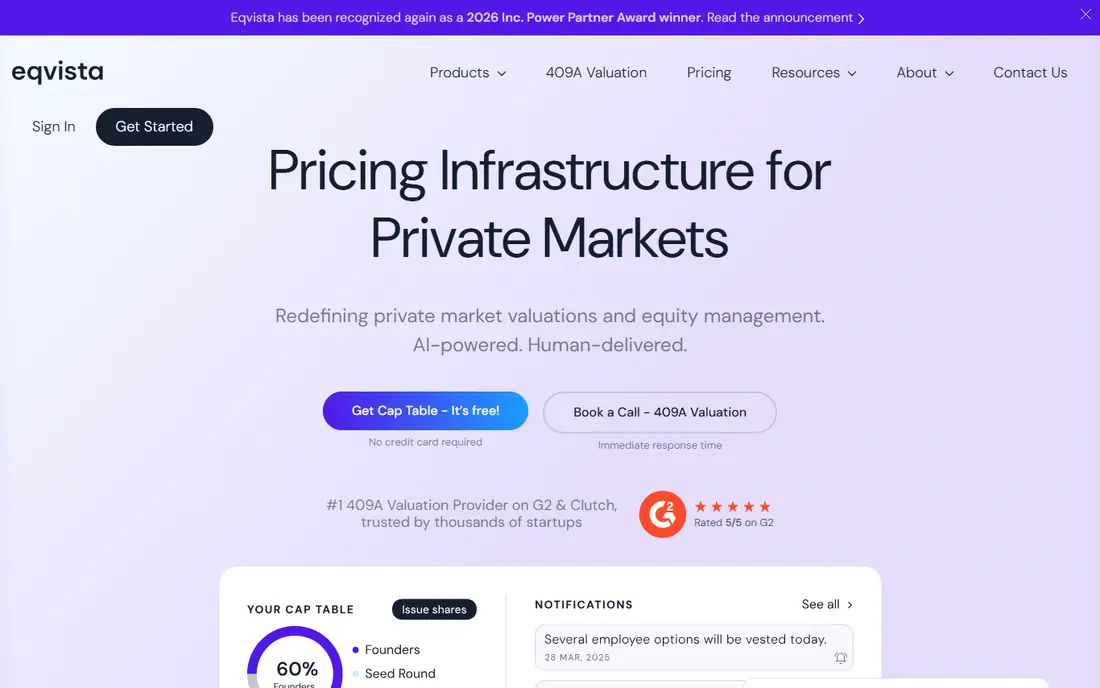
Eqvista suits founders who need a real cap table without a large bill. The free tier covers up to 20 stakeholders, and paid plans use per-stakeholder pricing, with 409A bundles that undercut many rivals. Migration help and support are also strengths for small teams moving off sheets.
It is less well known than Carta, which can matter if an investor asks for a specific report format. Enterprise depth is also thinner. For pre-seed and seed firms on a tight budget, Eqvista offers the best value in this list, and it scales to later stages for many firms.
- Free tier for up to 20 stakeholders
- 409A bundles at a lower price than rivals
- Fast support and migration help
- Smaller brand than Carta
- Advanced enterprise features are thinner
- Pricing rises per stakeholder on paid tiers
Ledgy is built for European and international equity, with compliance, employee portals, and secondary tools that US-first tools handle less well. It suits firms with staff in several countries, complex option plans, and a need for local compliance. The interface is clean, and investor reporting is solid.
Entry pricing is higher than Pulley or Eqvista, and US-only firms may not need its EU depth. Pricing is quote based, so ask for a figure tied to your stakeholder count. For international teams, Ledgy is the most focused pick here.
- Strong EU compliance and employee portals
- Secondary trading tools
- Good for international teams
- Higher entry price than US seed tools
- EU focus may be less relevant for US-only firms
- Quote-based pricing
Shareworks, from Morgan Stanley, suits post-IPO and late-stage firms with global equity plans. It handles public listings, payroll, settlements, and complex reporting that startup tools do not need to cover. For a public company, that depth and backing matter.
Startups should look elsewhere. Cost, minimums, and setup complexity make it a poor fit for seed firms. If your firm is public or close to it, and you need global equity administration at scale, Shareworks belongs on the shortlist.
- Morgan Stanley backing
- Strong for public companies and global equity
- Payroll and settlement tools
- High cost and minimums
- Complex setup for startups
- Overkill for seed firms
Cake Equity suits pre-seed founders who want a simple cap table without learning a large platform. The interface is clean, the focus is on getting ownership right early, and compliance basics are covered. It is a good step up from a sheet for a very early firm.
Depth is the limit. Later-stage modelling, valuations, and investor reporting are thinner than on Carta or Pulley, and pricing is not clearly published. For a first cap table, Cake is a fair pick. For a firm about to raise a priced round, Pulley or Carta will serve better.
- Simple interface for early firms
- Compliance focus
- Good for small, early cap tables
- Pricing not clearly published
- Feature depth thinner than Carta or Pulley
- Mainly suited to early stages
Qapita suits firms with international teams and employee stock plans that span countries. It covers cap tables, ESOP management, and valuations, with a focus on Asia and global compliance. For a firm hiring across borders, that breadth helps avoid a patchwork of local tools.
US venture familiarity is lower than Carta, so some investors may ask for extra reports. Pricing is quote based, and complex plans need careful setup. If your team is international and ESOP-heavy, Qapita is worth a demo. If you are US-only and venture-backed, Carta or Pulley will feel more familiar.
- Strong for ESOPs and international teams
- Cap table plus valuation tools
- Good for Asia and global firms
- Quote-based pricing
- Less US venture familiarity than Carta
- Setup needs care for complex plans
Vestberry is a good pick when the main user is an investor or fund manager tracking a portfolio, rather than a single founder. It gives clean cap table views, portfolio reporting, and stakeholder communication in one place. For funds that need to see many companies at once, that view is the point.
Founders who need deep modelling and 409A tools may prefer Pulley or Carta. Pricing is not published, and US startup presence is smaller. For investor-side tracking and portfolio reporting, Vestberry is a strong, focused option.
- Clean portfolio and cap table views
- Good for investors and fund managers
- Reporting for stakeholders
- Less founder-focused than Pulley
- Pricing not published
- Smaller US startup presence
How we picked these
We compared official product pages, pricing pages, and public reviews for cap table tools active in October 2026. We required real cap table management, including ownership tracking, option grants, and SAFE handling, not just a valuation calculator. We favoured tools with clear stage fit, current pricing or a clear free tier, and a real customer base.
We did not invent prices where vendors publish none. Carta paid pricing is quote based, so we marked it as See website and noted the free Launch tier. This article is general information only, not legal, tax, or financial advice, and equity decisions should be checked with qualified advisers.
How to choose a cap table tool by stage
Pre-seed founders should start free or cheap: Carta Launch, Eqvista, or Cake Equity, depending on stakeholder count. Seed founders who want clear pricing and modelling should test Pulley first. Series A and later firms should test Carta, and international firms should add Ledgy or Qapita to the shortlist.
Before you commit, import your real cap table and check three things: option grants, SAFEs, and a priced-round model. Ask how 409A is priced, how stakeholder overages work, and what happens to your data if you leave. A clean import and a clear renewal price matter more than a polished demo.
FAQ
What is cap table management software?
It is software that tracks who owns a company, including founders, investors, employees with options, and SAFE holders. It records share classes, grants, vesting, and valuations, and it produces reports for fundraising, board meetings, and due diligence. It replaces error-prone sheets with an auditable record.
Is Carta or Pulley better for a seed startup?
Pulley is usually better for seed firms because its Startup pricing is clear at $1,200 per year for up to 25 stakeholders, and setup is fast. Carta is better from Series A onward, when investor reporting, 409A, and compliance depth matter more. Many founders start on Pulley or a free tier and move to Carta later.
How much does cap table software cost?
Costs range from free for small stakeholder counts to thousands per year for seed firms, and far more for later-stage firms. Carta and Shareworks use quote-based pricing, while Pulley lists $1,200 per year for its Startup plan. Always ask about stakeholder overages, 409A fees, and renewal increases.
Do I need cap table software before raising money?
You need an accurate cap table before raising, but it does not have to be in paid software at pre-seed stage. A free tier or a well-kept sheet can work for a very small cap table. Once you have options, SAFEs, or outside investors, dedicated software reduces errors and speeds up due diligence.
What is a 409A valuation, and do I need one?
A 409A valuation sets the fair market value of common stock for option grants, and it is usually needed before you issue options to employees. Many cap table tools offer 409A as an add-on or bundle. Ask your lawyer when you need one, since timing and price vary by stage and provider.