Best Blockchain Platforms for Enterprise Use in 2026: 8 Platforms Compared
best blockchain platforms for enterprise use compared: permissioned, public and managed options for supply chain and finance in 2026. for teams in 2026.
- Editor's choice
 Hyperledger Fabric
Permissioned enterprise networks
Starts atFreeVisit hyperledger.orgFull review - Great alternative
 Ethereum
Public smart contract platform
Starts atFreeVisit ethereum.orgFull review - Also consider
 Corda
Privacy-focused business networks
Starts atSee websiteVisit corda.netFull review
TL;DR:
- Hyperledger Fabric and Corda lead for permissioned enterprise networks where privacy, identity and governance matter most.
- Ethereum, Polygon and Avalanche suit tokenisation and public-facing apps where ecosystem depth and liquidity matter.
- Amazon Managed Blockchain reduces node operations for Fabric and Ethereum networks, but teams still own app and governance work.
- Start with a narrow pilot, such as traceability or settlement, and prove governance before expanding to many partners.
Quick comparison
| Tool | Best for | Starts at | Free plan? | |
|---|---|---|---|---|
| Hyperledger Fabric | Permissioned enterprise networks | Free | Yes | Visit |
| Ethereum | Public smart contract platform | Free | Yes | Visit |
| Corda | Privacy-focused business networks | See website | No | Visit |
 Polygon | Ethereum-compatible scaling | Free | Yes | Visit |
 Avalanche | Fast enterprise and subnet networks | See website | Yes | Visit |
 Stellar | Payments and asset issuance | Free | Yes | Visit |
 Consensys Quorum | Private Ethereum for enterprises | Free | Yes | Visit |
 Amazon Managed Blockchain | Managed Fabric and Ethereum networks | See website | No | Visit |
The best blockchain platforms for enterprise use
We compared official feature pages, pricing pages, app listings and public reviews to shortlist these 8 options for best blockchain platforms for enterprise use. Our pick for most people is the first option in the list, but the best choice depends on your team size, budget and daily workflow, so read the trade-offs for each option before you decide.
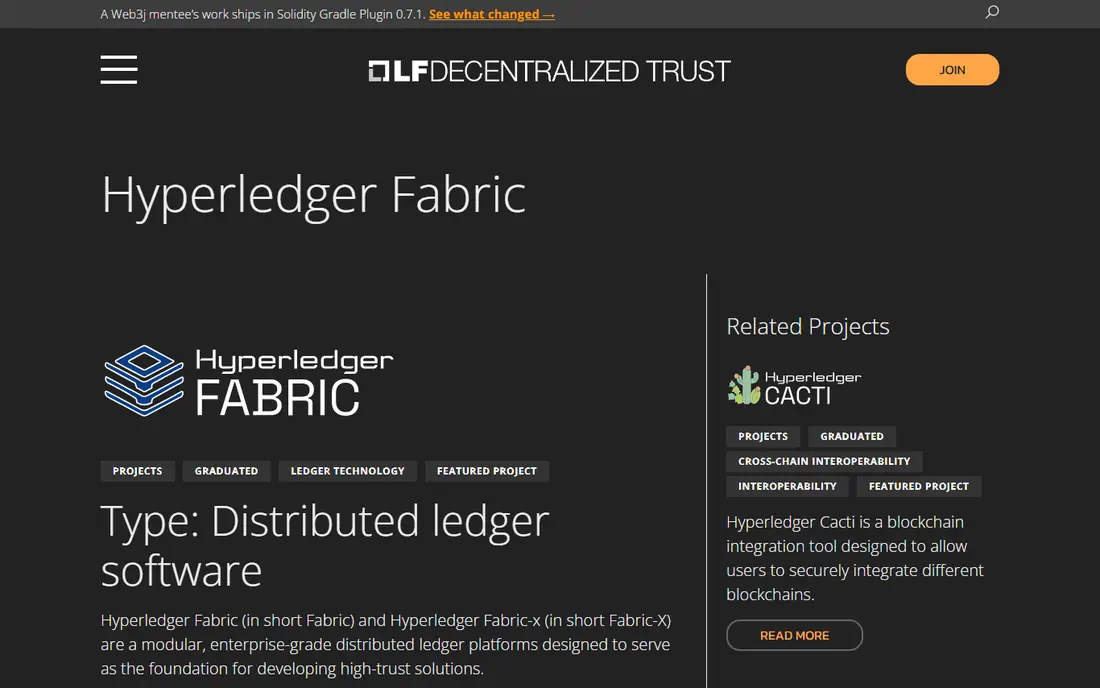
Hyperledger Fabric is the default permissioned choice for many enterprise networks because it separates channels, identities and smart contracts in a way that suits business consortia. Members can share data selectively, which matters for supply chain and finance networks where not every partner should see every transaction. Its modular design supports different consensus and database options.
The cost is operational skill. Running Fabric nodes, identities and channels needs experienced engineers, and there is no native cryptocurrency model for teams that want one. For a governed multi-party network, though, Fabric offers control that public chains do not.
- Channel privacy
- Modular design
- Strong enterprise adoption
- Needs skilled operations
- No native token model

Ethereum remains the reference public platform for smart contracts, tokens and decentralised apps. Its ecosystem of wallets, tools, libraries and standards is unmatched, which speeds up development and hiring. For tokenisation and customer-facing assets, that depth is a real advantage.
Public transaction costs vary with network demand, and privacy needs extra design, such as private layers or off-chain data handling. Enterprises should also plan for smart contract audits. For open, ecosystem-rich use cases, Ethereum is still the benchmark.
- Largest developer ecosystem
- Rich tooling
- Token standards
- Public gas costs vary
- Privacy needs extra design

Corda suits finance, insurance and legal networks where transaction privacy is a core requirement. Only parties to a transaction see its details, which fits regulated workflows better than a fully shared ledger. Its focus on business contracts and identity helps regulated consortia.
The developer pool is smaller than Ethereum, and enterprise pricing is quoted rather than published. Teams should check hiring and support options early. For privacy-sensitive business networks, Corda is a strong specialist choice.
- Transaction privacy by design
- Legal and finance focus
- Enterprise support
- Smaller developer pool than Ethereum
- Enterprise pricing is quoted
Polygon helps enterprises use Ethereum-compatible apps at lower cost and higher throughput. Existing Ethereum tools and contracts often transfer with little change, which shortens development. Its ecosystem covers payments, gaming and tokenisation, giving teams many reference apps.
Choosing among Polygon networks adds complexity, and bridge or security design needs care for asset movement. Teams should pick one network for a pilot and document its trust assumptions. For cost-sensitive Ethereum apps, Polygon is a practical scaling path.
- Low-cost transactions
- Ethereum compatibility
- Large app ecosystem
- Network choice adds complexity
- Bridge and security design needed
Avalanche suits enterprises that want fast finality and custom networks through subnets. A subnet can carry its own rules and validators while staying connected to the wider network, which helps regulated or partner-specific use cases. Ethereum-compatible contracts ease migration for many teams.
Its ecosystem is smaller than Ethereum, and subnet operations still need skilled engineers. Teams should test throughput and cost under realistic load before committing. For custom, high-speed enterprise networks, Avalanche offers a flexible model.
- High throughput
- Custom subnets
- Ethereum-compatible contracts
- Ecosystem smaller than Ethereum
- Subnet operations need skill
Stellar focuses on payments, remittances and asset issuance, with fast settlement and low transaction costs. Built-in asset features suit banks, fintechs and payment firms that want to issue or move value without building a full smart contract system. Its finance focus keeps the design practical.
Smart contract depth is narrower than Ethereum, so complex app logic may need another platform. The ecosystem is also finance-led rather than general-purpose. For payment and asset use cases, Stellar offers speed and simplicity.
- Fast low-cost payments
- Built-in asset issuance
- Finance focus
- Smart contract depth is narrower than Ethereum
- Ecosystem is finance-led
Consensys Quorum gives enterprises an Ethereum-compatible private network with privacy and permissioning features. Teams can reuse Ethereum tools and skills while controlling who joins and what data is shared. That mix suits banks and consortia that want Ethereum familiarity without public exposure.
Support and roadmap planning matter, since enterprise users should confirm current Consensys offerings and support terms. Operations still need skilled staff. For private Ethereum networks, Quorum remains a credible option to evaluate.
- Ethereum compatibility with privacy
- Enterprise tooling
- Permissioned networks
- Needs enterprise support planning
- Project direction should be checked
Amazon Managed Blockchain reduces the operational burden of running Fabric or Ethereum networks by handling node provisioning, scaling and patching. AWS integration helps teams that already use AWS for storage, identity and monitoring. It suits enterprises that want managed infrastructure without building a node team.
Managed hosting does not remove governance, application or audit work, and AWS costs still need modelling. Teams should also weigh lock-in against self-hosting. For AWS-centred enterprises, it offers a faster path to a production network.
- Managed node operations
- AWS integration
- Scalable networks
- AWS lock-in and costs
- Teams still own governance and apps
How we picked these
We started with the topic and the products that genuinely fit it, then checked official vendor pages for features, pricing and access rules. We removed products that were discontinued, that did not fit the topic, or whose official homepage could not be verified. We compared strengths and weaknesses from documentation, pricing pages and public user feedback, and we favoured products with clear safety, privacy and support practices where those mattered.
We did not claim hands-on testing we did not do. Instead, we compared what vendors publish, what reviewers report and what pricing pages show in October 2026. Where a vendor does not publish a price, we wrote See website rather than guessing a number. That approach keeps the comparison honest, even when it means less detail for quote-based enterprise tools.
Before you shortlist, note the limits of any comparison. Vendor pages show best-case features, and public reviews skew toward very happy or very unhappy users. That is why we weigh official pricing and documentation most heavily, use reviews only for recurring themes, and flag quote-based pricing instead of inventing a figure. If a feature matters to your workflow, confirm it in a trial or demo with your own data and your own team, since a checklist match does not always mean a good daily fit.
How to choose an enterprise blockchain platform
Decide first whether you need a permissioned network, a public chain or a mix. Permissioned networks give control over members, privacy and governance, which suits supply chain and interbank use. Public chains give openness, ecosystem tools and token liquidity, which suits customer-facing assets. Many enterprises use both for different processes.
Check identity, privacy, throughput and integration needs. Channel or privacy features, smart contract languages and existing ERP or system links all affect delivery time. Budget for governance, node operations, security audits and ongoing support, not just development. A pilot with two or three partners will reveal governance friction faster than a large design document.
Before you pay, run a short trial with real work and real users, not just a demo dataset. Set a clear success measure, such as time saved, tickets deflected, errors found or conversion improved, and review it after two to four weeks. Check onboarding help, support response times and export options, since switching later is often more costly than the first subscription. If two options look close, choose the one your team actually enjoys using, because adoption decides whether the tool delivers value.
FAQ
What is the difference between permissioned and public blockchains?
Permissioned blockchains limit who can join, validate and read data, which suits regulated business networks. Public blockchains let anyone join and read data, which suits open assets and apps. Enterprises often use permissioned networks for partner processes and public chains for customer assets.
Is Hyperledger Fabric free?
Hyperledger Fabric is open-source software, so there is no licence fee for the code itself. Running a network still costs for infrastructure, operations, support and application development, whether you self-host or use a managed service.
Do enterprises still use Ethereum?
Yes, especially for tokenisation, settlement and apps that benefit from its large developer ecosystem and tooling. Enterprises often use private or layer-2 versions, or managed services, to control privacy and costs while keeping Ethereum compatibility.
How long does an enterprise blockchain pilot take?
A narrow pilot with a few partners can take weeks to a few months, depending on governance and integration needs. A production network with many members, legal agreements and system links takes longer, so start narrow and expand in stages.
What are the main risks?
Governance disputes, privacy leaks, smart contract bugs and unclear legal status for tokens are common risks. Mitigate them with audits, clear member agreements, privacy design and staged rollouts, and avoid putting sensitive personal data directly on a shared ledger.