Best Birding Apps in 2026: 8 Apps Compared
The best birding apps for 2026, from free ID tools like Merlin and eBird to field guides, sound ID and community lists for birders of all levels. today.

- Editor's choice
 Merlin Bird ID
Identifying birds by photo or sound
Starts atFreeVisit merlin.allaboutbirds.orgFull review - Great alternative
 eBird
Recording sightings and finding hotspots
Starts atFreeVisit ebird.orgFull review - Also consider
 Audubon Bird Guide
North American species profiles
Starts atFreeVisit audubon.orgFull review
TL;DR:
- Merlin Bird ID is the best free starting point, with photo ID, sound ID and a step by step helper.
- eBird pairs with Merlin for lists, hotspots and citizen science, and it is also free.
- BirdNET adds sound identification with a research focus, useful when Merlin is unsure.
- Paid guides such as Sibley Birds and iBird Pro suit serious birders who want detailed art and offline depth.
Quick comparison
| Tool | Best for | Starts at | Free plan? | |
|---|---|---|---|---|
| Merlin Bird ID | Identifying birds by photo or sound | Free | Yes | Visit |
| eBird | Recording sightings and finding hotspots | Free | Yes | Visit |
| Audubon Bird Guide | North American species profiles | Free | Yes | Visit |
 BirdNET | Identifying birds by sound alone | Free | Yes | Visit |
 iNaturalist | Identifying birds and other nature | Free | Yes | Visit |
 Birda | Social birding and challenges | Free | Yes | Visit |
 Sibley Birds | Serious field guide study | $19.99 | No | Visit |
 iBird Pro | Detailed photo based guide | See website | Free trial | Visit |
The best birding apps
We compared official app pages, Cornell Lab pages and app store listings for birding apps live in October 2026. Our pick for most people is Merlin plus eBird, since both are free and cover identification and record keeping. Together they handle the two jobs every birder needs, naming a bird and keeping a reliable record of where and when it was seen.

Merlin Bird ID, from the Cornell Lab of Ornithology, is the app we suggest first. Point the camera at a bird, record a song, or answer a few questions about size, color and behavior, and Merlin suggests likely species for your location and season. Regional bird packs let it work offline on a walk with no signal.
The honest catch is that no ID app is always right. Merlin can confuse similar species, especially in poor light or with background noise, so confirm a surprising result with a guide or a second view. Used with that care, Merlin turns a casual walk into a learning session.
- Photo ID, Sound ID and step by step ID
- Regional bird packs for offline use
- Free
- ID suggestions can be wrong, so check them
- Needs bird packs for offline use

eBird is also from Cornell Lab, and it is the record book that pairs with Merlin. Submit a checklist of what you saw, where and for how long, and eBird builds your life list and shows nearby hotspots. Your sightings also feed research on bird distribution and migration, which gives the hobby a wider purpose.
eBird is not built to identify a mystery bird from a photo. Its strength is logging and exploring, so use Merlin first for an ID, then log it in eBird. Take care with counts and locations, since researchers rely on accurate checklists.
- Free checklists
- Hotspot maps
- Data feeds real research
- Less of an ID tool on its own
- Checklist quality matters for science
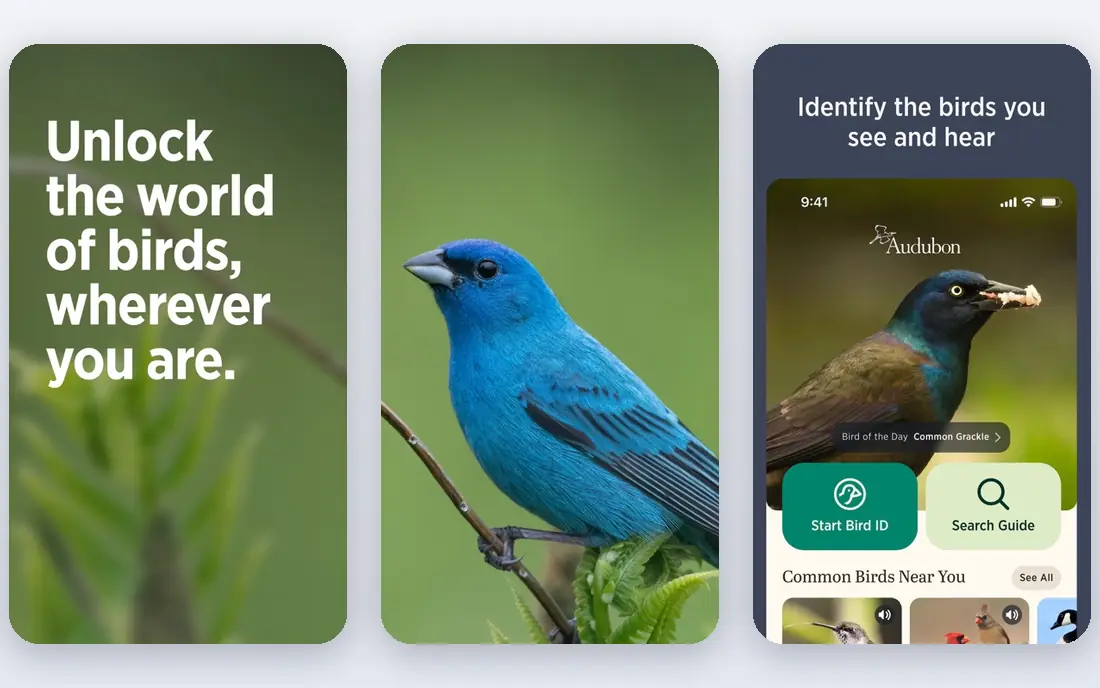
The Audubon Bird Guide, from the National Audubon Society, is a free field guide for more than 800 North American species. Each profile includes photos, sounds, range maps and notes on habitat, behavior and conservation status. That depth makes it a good second reference after Merlin.
Its focus is North America, so travelers elsewhere will need a regional guide. Community features have also been rebuilt over time, so the social side may feel thinner than in some apps. As a reference guide, though, Audubon remains strong and free.
- Detailed profiles for many North American species
- Photos, sounds and range maps
- Free
- North America focus
- Community features have changed over time
BirdNET, developed with Cornell Lab and Chemnitz University of Technology, identifies birds from sound recordings. Record a song or call, and BirdNET suggests species, which is useful when a bird is hidden in a hedge or high in a tree. It also supports citizen science by collecting sound data.
Background noise is the main limit. Wind, traffic and other birds can confuse a recording, so record close and quiet when you can. BirdNET works best as a second opinion next to Merlin, not as a sole source for a rare record.
- Sound ID built for research
- Works on phone recordings
- Free
- Needs a clear recording
- Species coverage varies by region
iNaturalist covers more than birds, which is both its strength and its limit for birding. Upload a photo, get a suggested ID, and the community can confirm or correct it. For a birder who also likes plants, insects and fungi, that breadth is a real plus.
For a pure bird ID question, Merlin is faster and more focused. iNaturalist shines when you want a record of all nature on a walk, or when a bird photo needs a human second look. It is free, and its observations also support research.
- Community ID help for many species
- Photo based suggestions
- Free
- Bird ID is less focused than Merlin
- Community confirmation can take time
Birda adds a social layer to birding, with life lists, challenges and a feed where birders share sightings. That community feel helps new birders stay motivated, and challenges give a reason to visit a new reserve or try a dawn walk. It also offers ID help for photos and descriptions.
The user base is smaller than eBird, so hotspot data may be thinner in some areas. Birders who prefer quiet solo walks may also prefer eBird alone. For those who enjoy sharing and friendly competition, Birda is a fun addition.
- Life lists and challenges
- Social feed
- Photo and text ID help
- Smaller user base than eBird
- Social features may not suit every birder
Sibley Birds, based on David Allen Sibley printed guides, uses illustrations rather than photos. Many experts prefer art for showing field marks, since a drawing can highlight the exact feature that separates two similar species. Side by side comparison tools help with tricky pairs such as gulls or warblers.
The price is a one time purchase of about $19.99 in app stores, which is fair for a full guide but more than free apps. It also lacks the live ID features of Merlin, so it works best as a study and reference tool rather than a first ID app. For serious birders, it is worth the cost.
- David Sibley illustrations
- Side by side comparisons
- Range and abundance data
- One time price is higher than free apps
- IOS focused history
iBird Pro covers many North American species with professional photos, range maps and a large sound library. Its search by size, color, habitat and other attributes helps narrow a mystery bird, and it works offline once downloaded. A free trial lets you test the full app before paying.
Recent versions moved toward a subscription model, so check the current price in your app store before you commit. The interface also feels older than Merlin or Audubon. If you prefer photos over illustrations and want a deep offline guide, iBird Pro still earns a place.
- Many North American species with photos
- Songs and calls
- Search by attributes
- Subscription model in recent versions
- Interface feels older than rivals
How we picked these
We compared official Cornell Lab pages, Audubon pages, developer sites and app store listings for birding apps live in October 2026. We favored apps with current updates, clear species coverage and a real user base, and we mixed free ID tools with paid guides so beginners and experts both find a fit.
We did not run a head to head accuracy test for this roundup. Our comparison rests on published features, coverage and public reviews, and we note where an ID should be confirmed before it is logged as a rare record.
Birding app tips for the field
Download before you leave
Download Merlin bird packs, guide data and offline maps on home Wi-Fi. A reserve with no signal is the worst place to learn that your guide needs a download. Also charge your phone fully and bring a power bank, since sound ID and photo ID use battery faster than a simple checklist, especially on a long walk in cold or hot weather.
Use sound with care
Avoid playing recorded calls near nesting birds or in protected areas, and follow local rules. A short, quiet check is different from repeated playback that can stress a bird.
Confirm before you log
If an app suggests a rare species, look for field marks, listen again and check the range map. Logging a wrong rare bird creates noise in citizen science data, so a careful second check helps everyone.
FAQ
What is the best birding app for beginners?
Merlin Bird ID is the best starting point for most beginners. It is free, it covers photo and sound ID, and it pairs well with eBird for logging sightings.
Is Merlin Bird ID really free?
Yes. Merlin Bird ID is free on iOS and Android, with no paywall for core ID features. Regional bird packs are also free to download.
What is the best app for birding by sound?
Merlin Sound ID and BirdNET are both strong. Merlin is easier for daily use, while BirdNET offers a research focused sound tool that works well as a second opinion.
Do birding apps work offline?
Merlin works offline once you download a bird pack, and paid guides such as Sibley Birds and iBird Pro work offline after purchase. eBird can save checklists offline and submit them when you reconnect.
Should I use eBird or Birda?
Use eBird for the largest hotspot data and citizen science impact, and add Birda if you want challenges and a social feed. Many birders use both, with eBird as the main record book.