Best Bidding Software for Construction in 2026: 8 Tools Compared
Compare the best bidding software for construction for invitations, bid leveling, and subcontractor networks. We checked pricing, features, and fit today.
- Editor's choice
 Procore Bid Management
Procore project teams
Starts atSee websiteVisit procore.comFull review - Great alternative
 BuildingConnected
Large GC bid networks
Starts atSee websiteVisit buildingconnected.comFull review - Also consider
 SmartBid
Mid size GC invitations
Starts atSee websiteVisit smartbid.coFull review
TL;DR:
- BuildingConnected suits mid to large general contractors that need a deep subcontractor network and prequalification tools.
- Procore Bid Management suits teams already standardized on Procore for project management.
- SmartBid and PipelineSuite suit mid size bid teams that mainly need invitations, leveling, and a plan room.
- ConstructConnect suits contractors who also want project leads and a large bid network.
- Pricing is often quote based or tiered, so get a written quote for your team size and bid volume before you choose.
Quick comparison
| Tool | Best for | Starts at | Free plan? | |
|---|---|---|---|---|
| Procore Bid Management | Procore project teams | See website | No | Visit |
| BuildingConnected | Large GC bid networks | See website | Free trial | Visit |
| SmartBid | Mid size GC invitations | See website | Free trial | Visit |
 ConstructConnect | Leads plus bid management | See website | Free trial | Visit |
 Buildertrend | Residential GC bidding | See website | Free trial | Visit |
 JobTread | Residential estimates and bids | See website | Free trial | Visit |
 PipelineSuite | Focused bid leveling | See website | Free trial | Visit |
 BidNet Direct | Public sector bids | See website | Free trial | Visit |
The best bidding software for construction
Construction bidding has two sides: general contractors inviting and leveling subcontractor bids, and subcontractors preparing and submitting bids. The tools below cover both, but each leans toward one side, so match the tool to your role first.

Procore Bid Management suits general contractors already running projects on Procore. Bid invitations, bid forms, a bid board, and leveling tools sit alongside drawings, RFIs, and project records, so bid data does not live in a separate silo. Subcontractors can respond, ask questions, and submit documents in one place, which reduces email chasing. That integration is the main reason Procore users add bid management rather than buying a standalone tool.
The drawback is scope and price. Procore pricing is quote based and tied in part to annual construction volume, so small teams should get a written quote before assuming a fit. Teams that do not use Procore for project management will get less value from bid tools alone. For Procore shops, however, the combined workflow is hard to beat.
- Bid invitations and leveling inside Procore
- Subcontractor network and bid board
- Ties to project management
- Best value requires Procore adoption
- Pricing is quote based
- Smaller teams may find the full platform heavy
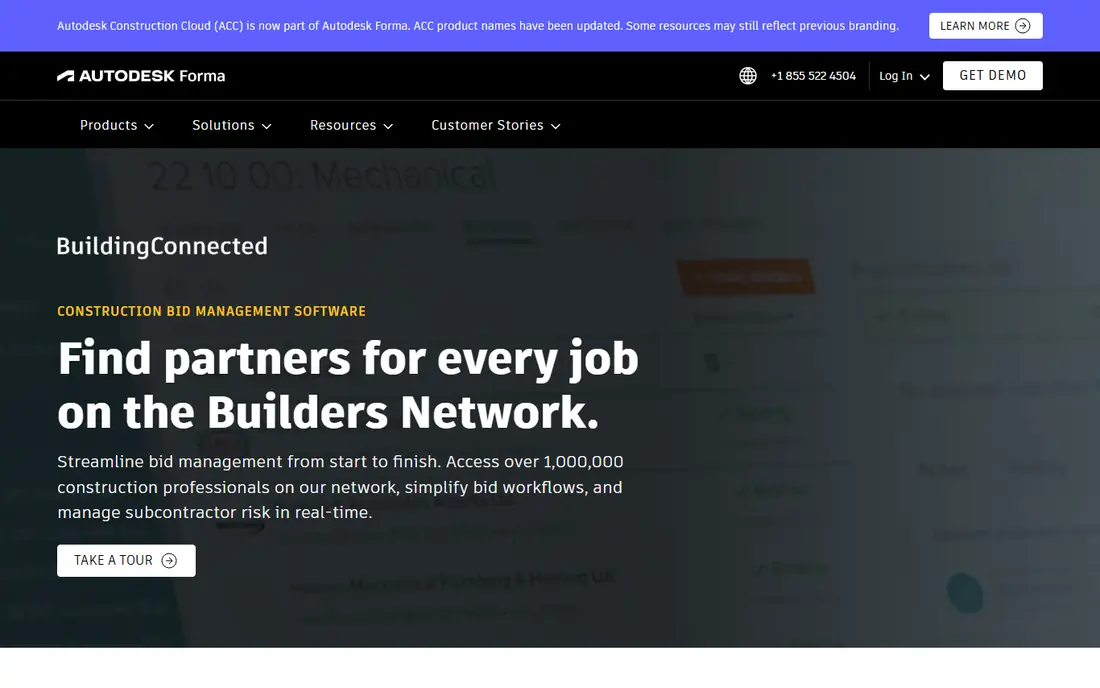
BuildingConnected, part of Autodesk, is a leading choice for mid to large general contractors that need reach. The subcontractor network lets teams filter by trade, location, and capacity, while TradeTapp adds prequalification, financial benchmarking, and safety history. Bid boards centralize invitations, deadlines, and assignments, and leveling sheets compare bids side by side to spot scope gaps. That combination helps large bid teams manage dozens of trades on one project.
Pricing needs careful checking. Marketplace listings have shown figures from $399 per month to $3,600 per year, while other sources describe quote based plans, so confirm a current written quote for your account size. Users also note a weaker mobile experience and limited reporting templates. For desk based bid teams with large networks, BuildingConnected remains a strong pick.
- Large subcontractor network
- TradeTapp prequalification
- Bid board and leveling tools
- Pricing varies widely by source
- Mobile experience is weaker
- Reporting templates are limited
SmartBid suits mid size general contractors that want a focused bidding tool without a full project platform. It handles bid invitations, subcontractor tracking, bid leveling, and plan room access in a clear workflow. Teams can send invitations from their own email domain, track responses, and compare bids without juggling spreadsheets and inboxes. That focus keeps training time short for estimators and project managers.
The limits are scale and integrations. SmartBid does not replace project management, accounting, or estimating software, so larger teams may need outside tools for those jobs. Pricing listings have varied, with some guides citing around $1,200 per year and others citing monthly figures, so get a current quote. For bid invitation teams, SmartBid offers a clean and practical fit.
- Focused bid invitation workflow
- Bid leveling and subcontractor tracking
- Plan room and document control
- Pricing is not fully public
- Smaller feature set than full project platforms
- Integrations are limited
ConstructConnect combines project leads with bid management, which suits contractors who need both work and bid tools. General contractors can invite subcontractors and manage bids, while subcontractors can find projects, track invitations, and respond from the same network. The data network covers commercial, residential, and public projects across the US, which helps teams plan pipelines beyond a single bid.
The full platform can feel broad, and pricing varies by product, region, and team size, with guides citing figures from $200 per month upward. Teams that only need bid invitations may find a focused tool cheaper. Teams that win work through leads and need a bid network in the same place will get more value from ConstructConnect.
- Large project lead database
- Bid invitations and management
- Data network for GCs and subs
- Pricing varies by product and region
- Full platform can feel broad
- Smaller teams may pay for leads they do not use
Buildertrend is a top construction bidding software choice for residential general contractors and remodelers. It covers estimates, bid requests, client selections, change orders, scheduling, and billing in one system, with a client portal that keeps homeowners informed. That breadth suits builders who manage the full job from estimate to completion, not just the bid phase. Subcontractors can respond to bid requests and track job details in the same system.
The price is higher than a focused bid tool, with recent guides citing figures from around $499 per month for some plans, so small builders should confirm current pricing. Commercial subcontractor networks are weaker than BuildingConnected or ConstructConnect. For residential builders who want one system for bidding and project delivery, Buildertrend is a strong fit.
- Estimates, bids, client selection, and project tracking in one system
- Client portal
- Good fit for residential builders
- Monthly cost is high for small builders
- Commercial bid networks are weaker
- Setup takes time
JobTread suits residential contractors who want estimates and bids tied directly to job costs. Estimators build budgets, send bid requests, compare responses, and turn winning bids into job costs without re entering data. Pay applications, including AIA style forms, help with owner billing, and integrations with accounting tools keep books current. Recent guides cite plans from around $159 to $199 per month, though you should confirm current pricing.
JobTread is less focused on large commercial subcontractor networks than BuildingConnected, so commercial GCs with deep bid boards may prefer that route. Some advanced features sit on higher tiers, and new users need time to learn the estimating workflow. For residential builders who want bidding, costing, and billing in one place, JobTread is a practical choice.
- Estimates, budgets, and bids in one workflow
- Job costing and pay applications
- Clear pricing tiers
- Less suited to large commercial bid networks
- Some features need higher tiers
- Learning curve for new users
PipelineSuite is a focused bid tool for teams that mainly need to send invitations, level bids, and run a plan room. Bid tabulation sheets compare multiple bids side by side and flag scope gaps, while the plan room lets subcontractors download files as a single zip. Invitations can be sent from your own email address, which helps deliverability and open rates. That focus keeps the workflow clear for estimators.
Pricing is per user, with listings around $499 per user per month, so costs rise quickly as estimators are added. The mobile app is also criticized by some users, and integrations focus on Procore, Stack, and eSUB rather than a wide stack. Small bid teams with a few estimators will get the most value, while large teams should model per user costs carefully.
- Strong bid tabulation and leveling
- Plan room with zip downloads
- Invitations from your own email
- Per user pricing can rise with team size
- Mobile app is criticized
- Integrations are narrower than rivals
BidNet Direct suits contractors who pursue government and public sector work. It provides bid notifications, RFP listings, and response tools for agencies, schools, and local governments, helping vendors find public opportunities they might miss. Vendor profiles and alerts keep teams aware of deadlines, which matter in public bidding where late submissions are often rejected. Guides cite pricing from around $100 per month upward, varying by region and plan.
BidNet Direct is not a full bid leveling or project management platform, and it is less useful for private commercial bidding. Teams that mix public and private work may pair BidNet Direct with a commercial bid tool such as BuildingConnected or SmartBid. For public sector focus, BidNet Direct fills a specific and valuable gap.
- Public bid notifications and RFP responses
- Government and agency bid coverage
- Vendor profiles
- Less suited to private commercial bidding
- Pricing varies by region
- Not a full project platform
How we picked these
We compared official product pages, marketplace pricing guides, and public reviews for construction bidding tools still active in October 2026. We favored tools with real bid invitation, leveling, or network features, and clear paths for general contractors or subcontractors. We left out pure estimating tools with no bid workflow and tools with dead homepages. Prices vary by team size and region, so confirm a written quote and test invitations with real subcontractors before you buy.
How to run a better bid process
Start with a clear scope, drawings, and deadline for every trade, since vague scopes produce bids that cannot be compared. Use a bid board to track invitations, responses, and follow ups, and level bids on the same scope before price talks. Prequalify subcontractors for insurance, safety, and capacity, especially on large or public jobs. A good tool helps, but a clear scope and a level comparison sheet do more to prevent change orders later.
Subcontractor networks and prequalification
A large network helps only if you can filter it by trade, location, and past performance. Use prequalification data, safety history, and financial benchmarks where available, and keep your own notes on reliability and communication. Invite enough bidders for competition, but not so many that good subcontractors stop responding. Respect subcontractor time with clear documents, single point contacts, and prompt answers to questions.
FAQ
What is the best construction bidding software for general contractors?
BuildingConnected suits large general contractors with deep network needs, while SmartBid and PipelineSuite suit mid size teams focused on invitations and leveling. Procore Bid Management suits teams already on Procore. The best choice depends on bid volume, network needs, and whether you already use a project platform.
What are the top construction bidding software options for subcontractors?
Subcontractors benefit most from networks that bring invitations to them, such as BuildingConnected and ConstructConnect. BidNet Direct suits subcontractors pursuing public work. Subcontractors should also check that bid tools let them respond, ask questions, and download plans without creating extra accounts where possible.
How much does construction bidding software cost?
Costs vary widely, from focused tools around $1,200 per year to per user plans around $499 per user per month, and quote based enterprise platforms. BuildingConnected pricing listings vary, so a written quote is essential. Model cost by estimators, bid volume, and network needs, not just the headline price.
Can small contractors use bidding software?
Yes. SmartBid, JobTread, and Buildertrend offer paths for small and mid size contractors, while BidNet Direct suits small vendors pursuing public work. Start with invitations, leveling, and a plan room, then add estimating and project tools as volume grows. A trial with a real project is the best test.
Does bidding software replace estimating software?
No, in most cases. Bidding software manages invitations, responses, and leveling, while estimating software builds quantities, costs, and proposals. Some tools combine both, such as JobTread and Buildertrend, but many teams pair a bid tool with a separate estimating or takeoff tool. Check overlap before buying both.