Best B2B Sales Intelligence Tools in 2026: 9 Tools Compared
We compared the best b2b sales intelligence tools for contact data, intent signals and prospecting, with pricing, strengths and honest limits for each.

- Editor's choice
 ZoomInfo
Enterprise data depth and intent
Starts atSee websiteVisit zoominfo.comFull review - Great alternative
 Apollo
All-in-one prospecting plus outreach
Starts at$49 per user per monthVisit apollo.ioFull review - Also consider
 Cognism
EMEA prospecting with compliance focus
Starts atSee websiteVisit cognism.comFull review
TL;DR:
- B2B sales intelligence tools provide contact data, company data, intent signals and enrichment, so sales teams can find the right buyers and personalize outreach.
- Apollo is the best all-in-one for small and mid-size teams, while ZoomInfo and Cognism suit enterprise teams with larger budgets and stricter data needs.
- Credit math decides the real bill: phone numbers often cost more credits than emails, and monthly credit limits matter more than the headline seat price.
- Data quality varies by region and company size, so test accuracy on your own target accounts before signing an annual contract, and check privacy compliance for your markets.
Quick comparison
| Tool | Best for | Starts at | Free plan? | |
|---|---|---|---|---|
| ZoomInfo | Enterprise data depth and intent | See website | Yes | Visit |
| Apollo | All-in-one prospecting plus outreach | $49 per user per month | Yes | Visit |
| Cognism | EMEA prospecting with compliance focus | See website | No | Visit |
 Lusha | Quick LinkedIn contact reveals | $37 per month | Yes | Visit |
 Clearbit | Enrichment for CRM and forms | See website | No | Visit |
 LeadIQ | LinkedIn to CRM prospecting | $15 per month | Yes | Visit |
 SalesIntel | Human-verified US phone data | See website | Free trial (14 days) | Visit |
 RocketReach | Contact lookup across the web | See website | Free trial | Visit |
 6sense | Account intent and ABM scoring | See website | Yes | Visit |
The best b2b sales intelligence tools
We compared official pricing pages, product documentation and public feature pages for the tools below, weighing data coverage, accuracy claims, intent signals, CRM integrations, credit models and compliance features. Sales intelligence is a data business, so we focused on how each tool fits a real prospecting workflow, not just database size claims.
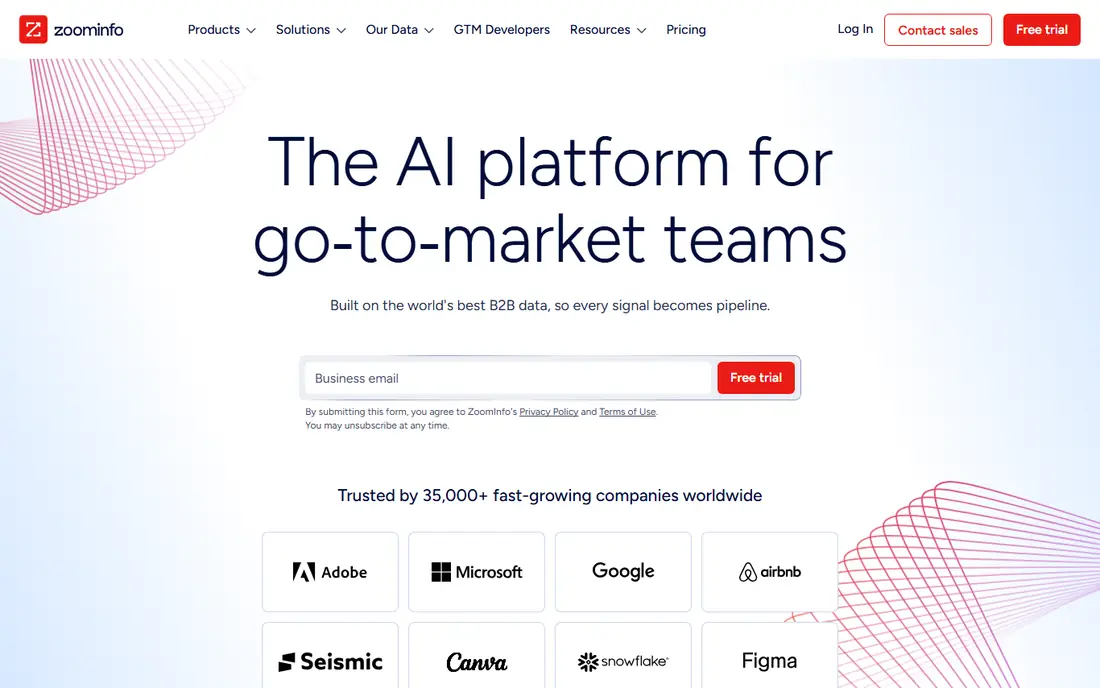
ZoomInfo is the enterprise standard for B2B data, with a large contact and company database, intent signals, website visitor data and conversation intelligence in its wider suite. Revenue teams use it to build target lists, score accounts, find direct dials and sync enriched data to Salesforce or HubSpot. A limited free Lite plan lets individuals test basic lookups before a sales conversation.
Paid pricing is by quote and typically annual, which puts ZoomInfo out of reach for many small teams. Data accuracy is strongest in the US and for larger companies, so international teams should test their own markets. For a mid-market or enterprise team that needs depth, intent and a full go-to-market suite, ZoomInfo is the benchmark.
- Very large US contact and company database
- Intent data and conversation tools
- Strong CRM integrations
- Quote-only paid pricing
- Annual contracts
- Costly for small teams

Apollo combines a large B2B database with email sequences, a dialer, task management and analytics, so a small team can prospect and follow up without buying a separate engagement tool. The free plan offers limited credits, and the paid Basic plan starts at $49 per user per month billed annually, with higher tiers adding more credits and advanced features. That transparency is rare in this category.
Credit math still matters. Phone numbers, exports and advanced filters consume credits faster than simple email lookups, and coverage for very small or local businesses is weaker than for mid-market tech companies. For a startup or mid-size SaaS team that wants data plus outreach in one subscription, Apollo is our default pick.
- Contact data plus sequences and dialer in one tool
- Free plan for small teams
- Published pricing
- Credit limits shape real usage
- Coverage is weaker for some SMB and local segments
- Advanced features need higher tiers
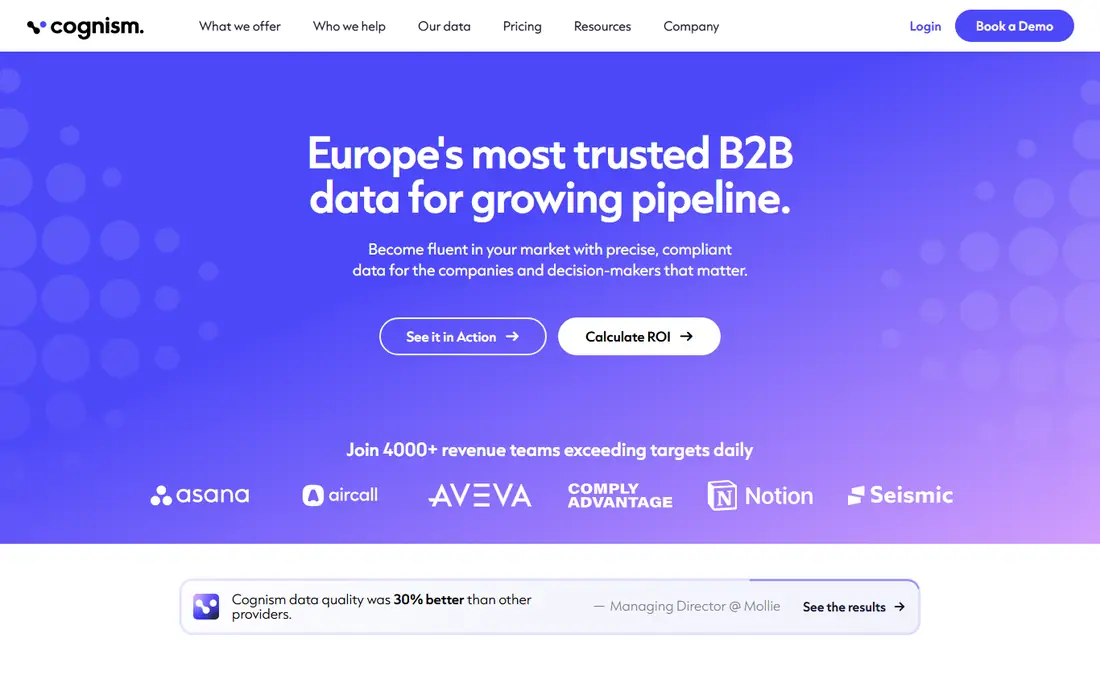
Cognism is built for European prospecting, with phone-verified mobile numbers, called Diamond Data, and compliance tools designed for GDPR and regional do-not-call lists. Teams selling into the UK, Europe and other EMEA markets often find better mobile coverage here than in US-first databases. Intent signals, enrichment and CRM integrations help revenue teams prioritize accounts that show buying activity.
Pricing is by quote and aimed at teams with a real prospecting budget, and US coverage is weaker than ZoomInfo. There is no free plan, only demos and trials through sales. For a team whose pipeline depends on European buyers, Cognism is the compliance-first choice.
- Phone-verified mobile data for Europe
- GDPR-focused compliance tools
- Intent signals and CRM sync
- Quote-only pricing
- Weaker US coverage than ZoomInfo
- Enterprise sales process
Lusha is a contact enrichment tool best known for its browser extension, which reveals emails and phone numbers while you browse LinkedIn or company websites. It suits individual sellers and small teams who prospect one person at a time and want a quick, low-friction lookup. A free plan with limited monthly credits lets you test accuracy before paying, and paid plans start around $37 per month billed annually.
Lusha is less suited to bulk list building than Apollo or ZoomInfo, and heavy users will hit credit limits quickly. Enrichment depth, such as technographics and intent, is also lighter. For a seller who lives on LinkedIn and needs fast, accurate contact reveals, Lusha is a practical, low-cost tool.
- Browser extension for fast LinkedIn lookups
- Free plan with monthly credits
- Buying signals and CRM sync
- Manual workflow for large lists
- Credit limits cap heavy use
- Enrichment depth is lighter than enterprise tools
Clearbit, now part of HubSpot, enriches leads, contacts and companies with firmographic and technographic data as they enter your CRM or forms. Marketing and sales operations teams use it to route leads, score accounts, shorten forms and personalize outreach without manual research. Its data APIs and HubSpot integration make it a strong fit for teams that already run HubSpot.
Clearbit is not primarily a prospecting database, so teams that need to build lists from scratch should pair it with Apollo or ZoomInfo. Pricing is by quote, and the full benefit shows in automated enrichment workflows. For a HubSpot team that wants cleaner, richer CRM data, Clearbit is a strong operations pick.
- Real-time enrichment for leads and forms
- Company data for routing and scoring
- HubSpot-native since acquisition
- Pricing by quote
- Prospecting database is not the main use
- Best value inside HubSpot workflows
LeadIQ helps sales development reps capture contacts from LinkedIn and push them to Outreach, Salesloft, Salesforce or HubSpot with one click. It suits SDR and BDR teams whose day starts on LinkedIn and ends in a sequence tool, and its free plan lets individuals test the workflow before paying. Pro pricing from $15 per month billed annually makes it one of the cheapest entry points here.
Contact accuracy varies, as with all prospecting tools, so verify key accounts before a large campaign. The tool is also LinkedIn-centric, so teams that prospect mainly from websites or lists may prefer Apollo. For a LinkedIn-first SDR team, LeadIQ is a fast, low-cost addition.
- One-click capture from LinkedIn to CRM
- Free plan for light use
- Pro from $15 per month billed annually
- Accuracy varies by contact
- Workflow is LinkedIn-centric
- Bulk features need higher tiers
SalesIntel focuses on human-verified B2B contact data, with an emphasis on direct dials and mobile numbers for US buyers. Teams that rely on phone outreach often value verified numbers over sheer database size, since a wrong number wastes a call and a follow-up. Intent data, technographics and CRM sync help teams prioritize accounts and keep records current.
Pricing is not published as a simple list price, and a 14-day trial is the usual way to test accuracy. US coverage is stronger than international coverage, so global teams should test their regions. For a mid-market US team that prospects by phone, SalesIntel is a credible alternative to ZoomInfo.
- Human-verified contact data with a focus on phones
- Intent and technographic data
- CRM integrations
- Pricing not published as a simple list
- US focus
- Smaller database claims than ZoomInfo
RocketReach indexes contact information from public web sources and lets users search by name, company, title or domain. It suits recruiters, sales teams and founders who need to find a specific person quickly, with bulk lookup and API options for larger workflows. The interface is simple, and a trial lets you test accuracy on your own targets before committing.
Accuracy varies by source, since public web data ages at different rates, so verify high-value contacts before outreach. Pricing varies by plan and volume, and teams should review privacy and compliance rules for their markets. For a team that needs flexible lookup without a full enterprise suite, RocketReach is a useful tool.
- Large contact index from public web sources
- Bulk lookup and API options
- Simple search interface
- Pricing varies by plan
- Accuracy varies by source
- Compliance review needed for your markets
6sense is an account-based marketing and revenue platform that scores accounts by intent signals, buying stage and fit, so teams can focus on accounts most likely to buy. It suits enterprise B2B teams running ABM programs, where marketing and sales agree on a target account list and coordinate ads, email and outreach. A limited free tier lets teams explore basic account data before a sales conversation.
Paid pricing is by quote and aimed at enterprise budgets, and the platform only pays off when marketing and sales actually work from the same account list. It is not a simple contact database, so small teams should start with Apollo or Lusha. For an enterprise ABM team, 6sense is a leading intent and orchestration choice.
- Predictive account intent and buying-stage scoring
- ABM orchestration
- Limited free tier
- Quote-only paid pricing
- Enterprise focus
- Needs marketing and sales alignment to pay off
How we picked these
We compared official pricing pages, product documentation and public feature pages, and we looked for tools that are actively sold in 2026, provide B2B contact or company data, intent signals or enrichment, and serve a distinct prospecting workflow. We included enterprise databases, all-in-one prospecting tools, LinkedIn workflow tools and intent platforms, and we used See website where a vendor does not publish a price. Always check data privacy rules for your markets, and use data only for lawful, consented business outreach.
How to test sales intelligence before you buy
Build a test list of 50 accounts you already know well, including company size, region and industry mix from your real pipeline. Run the same list through each shortlisted tool and score email accuracy, phone accuracy, title accuracy and missing records. That test beats any vendor database size claim.
Credits, contracts and compliance
Ask how credits work for emails, phones, exports and enrichment, what happens when credits run out, and whether unused credits roll over. Check contract length, seat minimums and renewal terms, and ask for GDPR, CCPA and data sourcing documentation. A tool that is cheap per seat but expensive per phone number can cost more than a higher seat price with generous credits.
FAQ
What are the best b2b sales intelligence tools?
ZoomInfo and Cognism lead for enterprise data, Apollo leads for all-in-one prospecting plus outreach, and Lusha and LeadIQ lead for low-cost LinkedIn prospecting. The best b2b sales intelligence platforms depend on your region, budget and whether you need intent, phones or bulk lists.
What is the best sales intelligence tool for B2B startups?
Apollo is usually the best start for a B2B startup, since it combines contact data, sequences and a dialer with a free plan and published pricing from $49 per user per month. Small teams can add Lusha or LeadIQ for LinkedIn lookups without a second large contract.
How much do sales intelligence tools cost?
Costs range from free for Apollo, Lusha, LeadIQ and ZoomInfo Lite, to $15 to $49 per user per month for paid entry plans, and to quote-only annual contracts for ZoomInfo, Cognism and 6sense. Credit limits and phone data often drive the real bill, so test usage before signing.
What is sales intelligence?
Sales intelligence is data and software that helps B2B sales teams find buyers, understand accounts and time outreach. It includes contact and company data, intent signals that show buying activity, technographics, enrichment and workflow tools that push data into a CRM.
Is B2B contact data legal to use?
B2B contact data use is governed by privacy laws such as GDPR in Europe and CCPA in California, plus platform terms and do-not-call rules. Use reputable vendors, honor opt-outs, check regional rules for your markets, and get legal advice for high-volume outreach programs.
How accurate is sales intelligence data?
Accuracy varies by vendor, region, company size and how often data is verified. Enterprise vendors with human verification often do better on phones, while all tools decay over time as people change jobs. Test accuracy on your own target accounts and re-verify high-value contacts before outreach.