Best Asset Performance Management Software in 2026: 8 Tools Compared
Compare the best asset performance management software in 2026, with predictive maintenance, reliability analytics and tools for energy, plants and fleets.
- Editor's choice
 GE Vernova APM
Energy and industrial plants
Starts atSee websiteVisit gevernova.comFull review - Great alternative
 IBM Maximo Application Suite
Integrated asset management
Starts atSee websiteVisit ibm.comFull review - Also consider
 AspenTech APM
Process and refining plants
Starts atSee websiteVisit aspentech.comFull review
TL;DR:
- GE Vernova APM and AspenTech APM lead for energy and process plants with complex rotating equipment.
- IBM Maximo suits firms that want asset management, maintenance and APM analytics in one suite.
- AVEVA APM and Bentley AssetWise suit engineering-heavy firms with large asset models and drawings.
- SAP and IFS suit firms that already run those ERP systems and want asset data tied to operations.
- APM pricing is almost always quote-based, so run a pilot on real asset data before signing.
Quick comparison
| Tool | Best for | Starts at | Free plan? | |
|---|---|---|---|---|
| GE Vernova APM | Energy and industrial plants | See website | No | Visit |
| IBM Maximo Application Suite | Integrated asset management | See website | No | Visit |
| AspenTech APM | Process and refining plants | See website | No | Visit |
 AVEVA APM | Engineering asset models | See website | No | Visit |
 Bentley AssetWise | Infrastructure assets | See website | No | Visit |
 SAP Intelligent Asset Management | SAP operations | See website | No | Visit |
 IFS Cloud EAM | Service and manufacturing | See website | No | Visit |
 Oracle Enterprise Asset Management | Oracle ERP users | See website | No | Visit |
The best asset performance management software
We compared official product pages, use cases and integration options to find the best asset performance management software for energy, manufacturing, utilities and infrastructure teams.
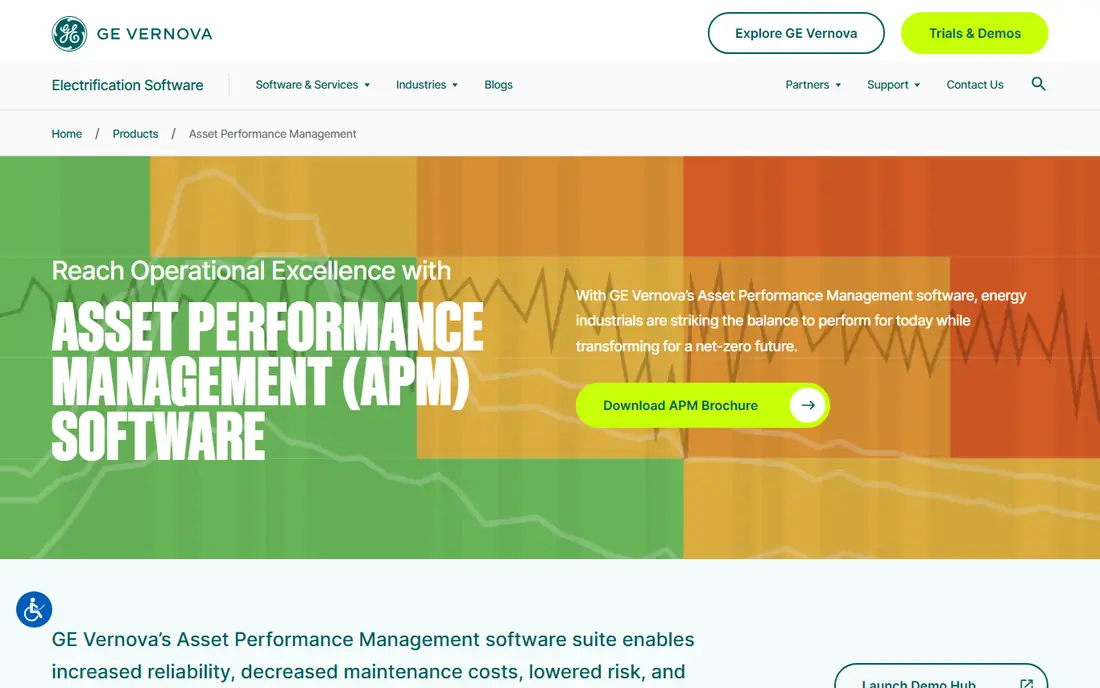
GE Vernova APM, formerly GE Digital APM, is built for power plants, oil and gas sites and heavy industry. It combines asset health, reliability analysis and predictive models to flag equipment at risk before failure. Teams can prioritise work by risk and cost, rather than by calendar alone.
The trade-off is scale and expertise. It suits large asset fleets with critical equipment, and smaller firms may find it more than they need. For energy and industrial operators, it remains a leading APM choice.
- Strong predictive analytics for turbines and rotating equipment
- Reliability centred maintenance tools
- Plant-wide asset health views
- Pricing is quote-based
- Implementation needs specialist expertise
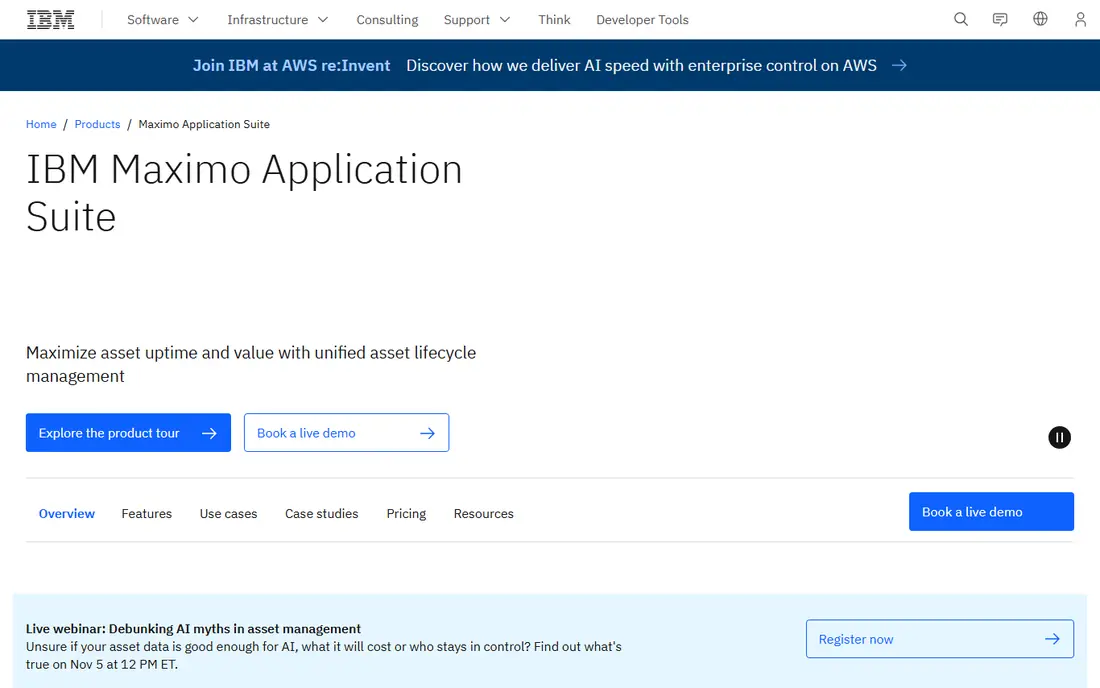
IBM Maximo Application Suite covers the full asset lifecycle, from registration and maintenance to health analytics and predictive models. That breadth suits utilities, transport and manufacturing firms that want one system for work orders, spares and reliability. Mobile tools let technicians update work in the field.
Complexity is the honest catch. Maximo rewards a planned rollout with clean asset data, and firms should budget for training and configuration. When that work is done, it gives a single view of asset performance and cost.
- Asset, work and inventory management in one suite
- APM analytics and health scoring
- Mobile work tools
- Large suite can feel complex
- Licensing needs careful planning
AspenTech APM suits refineries, chemical plants and other process operations where equipment failure can halt production. Its models use historian and sensor data to predict degradation in pumps, compressors and heat exchangers. That focus gives it an edge in process settings.
Firms outside process industries may get less value from its specialised models. For process plants, however, the combination of engineering models and operational data is a clear strength.
- Strong process industry models
- Predictive maintenance for pumps and compressors
- Integration with plant historians
- Best fit is process industries
- Pricing is quote-based
AVEVA APM connects the engineering record of an asset with its live performance. That link helps teams trace a failure back to design, materials or operating conditions, not just to a sensor reading. Energy, marine and process firms with large AVEVA models benefit most.
The catch is data quality. Firms without clean engineering records will need work before APM analytics deliver full value. For engineering-led operators, that investment pays off in clearer root-cause analysis.
- Links engineering data to operational performance
- Asset health and predictive tools
- Strong plant design heritage
- Implementation can be lengthy
- Best value needs good engineering data
Bentley AssetWise suits infrastructure owners who manage bridges, roads, water networks and power distribution assets. It supports inspections, condition ratings and lifecycle planning, with links to engineering models and geographic data. That scope fits public works and utilities well.
Process plant operators may prefer GE Vernova or AspenTech for rotating equipment analytics. For infrastructure fleets, AssetWise offers a practical blend of inspection, maintenance and performance views.
- Strong for roads, rail, water and utilities
- Asset lifecycle and inspection tools
- Engineering model links
- Less focused on process plant APM
- Pricing is quote-based
SAP Intelligent Asset Management brings asset health, predictive maintenance and collaboration into the SAP system many large firms already use. Maintenance planners see asset risk beside work orders, spares and costs, which helps prioritise spending.
The downside is SAP complexity. Firms without SAP skills will need partner help, and the suite suits large enterprises more than small plants. For SAP users, the shared data model is a major advantage.
- Asset health tied to SAP maintenance and operations
- Predictive models
- Enterprise scale
- Needs SAP expertise
- Smaller firms may find it heavy
IFS Cloud EAM suits firms that combine asset ownership with field service and manufacturing. It covers maintenance planning, work execution and asset performance in one cloud system, with mobile tools for technicians. That breadth helps firms that both operate and service equipment.
Buyers focused only on predictive analytics may prefer a specialised APM vendor. For firms that want asset, service and production data together, IFS is a strong contender.
- Enterprise asset management with service and manufacturing links
- Mobile field tools
- Planning and scheduling
- APM analytics are part of a broader suite
- Pricing is quote-based
Oracle Enterprise Asset Management suits firms already running Oracle ERP for finance, procurement and operations. Maintenance work, spares and asset costs sit in the same system as budgets and suppliers, which simplifies reporting. That integration is its main strength.
Specialised predictive models are lighter than in dedicated APM tools, so firms with critical rotating equipment may pair Oracle with a specialist analytics tool. For Oracle shops, it gives a solid and controlled asset base.
- Asset maintenance tied to Oracle ERP
- Work, spares and cost tracking
- Enterprise controls
- APM analytics are less specialised than GE or AspenTech
- Needs Oracle expertise
How we picked these
We compared official product pages, industry focus and integration options for APM and enterprise asset management tools sold in 2026. We did not claim hands-on testing, and we used See website for all prices, since APM vendors price by asset count, users and implementation scope.
How to choose asset performance management software
Start with your most costly failures, not with a feature list. List the assets whose failure stops production, risks safety or creates large repair bills, then check which tools have proven models for those asset types. A tool that excels at turbines may be weak for water networks, and vice versa.
Data and pilot
APM needs clean sensor, historian and maintenance data. Audit data quality before buying, and run a pilot on a small set of critical assets with real failure history. Measure whether the tool flags real risks early, without flooding teams with false alerts.
Integration and ownership
Check links to your ERP, maintenance system, historian and engineering models. Assign an owner for asset data, alert tuning and model updates, since APM value fades when no one maintains it. Budget for training, since technicians and planners must trust and act on the alerts.
Starting with a pilot that proves value
Pick five to ten critical assets for a pilot, and gather at least a year of failure, repair and sensor history where available. Define success before you start: fewer unplanned stops, earlier warnings, or clearer maintenance priorities. Without a clear target, a pilot can look interesting without proving business value.
During the pilot, track false alerts as carefully as true warnings. A model that flags every asset every week will be ignored, while a model that misses a real failure will lose trust. Tune thresholds with maintenance staff, not only with data scientists, since technicians know which warnings match real wear and which are sensor noise.
Review pilot results with finance as well as engineering, so avoided downtime and repair costs are counted in the same terms as software and implementation costs. That joint review makes the full rollout decision easier, and it shows whether APM should expand to more assets or stay focused on the most critical fleet.
Keeping models useful over time
Asset models drift as equipment ages, operating conditions change and sensors are replaced. Schedule a quarterly review of alert accuracy, and retire models that no longer match real failures. Keep a simple log of model changes, so a new engineer can see why thresholds were set. That maintenance habit is what separates a pilot that impresses once from a system that still helps three years later.
FAQ
What is asset performance management software?
APM software monitors asset health, predicts failures and helps teams prioritise maintenance by risk and cost. It uses sensor data, maintenance history and reliability models to flag equipment at risk. The goal is fewer unplanned outages and lower lifetime asset costs.
Which APM tool is best for energy plants?
GE Vernova APM and AspenTech APM lead for energy and process plants with turbines, pumps and compressors. IBM Maximo also suits energy firms that want asset management and APM in one suite. Choose based on your asset types and existing systems.
How much does APM software cost?
APM pricing is quote-based in most cases, depending on asset count, users, data volume and implementation work. Small pilots may cost far less than enterprise rollouts. Ask vendors for a pilot price and a full rollout price before signing.
Do I need APM if I already have a CMMS?
A CMMS manages work orders and maintenance schedules, while APM adds health scoring and failure prediction. Many firms use both, with APM feeding prioritised work into the CMMS. If unplanned failures are rare, a CMMS alone may be enough.
How long does APM implementation take?
Pilots can run in weeks on a small asset set, while enterprise rollouts often take months, depending on data quality and integration scope. Clean historian and maintenance data shortens the timeline. Plan for alert tuning after go-live, since early models need adjustment.
Sources
- https://www.gevernova.com/software/products/asset-performance-management
- https://www.ibm.com/products/maximo
- https://www.aspentech.com/en/products/apm
- https://www.aveva.com/en/products/asset-performance-management/
- https://www.bentley.com
- https://www.sap.com/products/scm/asset-management.html
- https://www.ifs.com
- https://www.oracle.com/erp/enterprise-asset-management/