Best API Integration Platform in 2026: 8 Platforms Compared
Best API integration platform for 2026: compare 8 API integration platforms and tools, prices, and free plans for connecting apps and APIs. Compare prices,
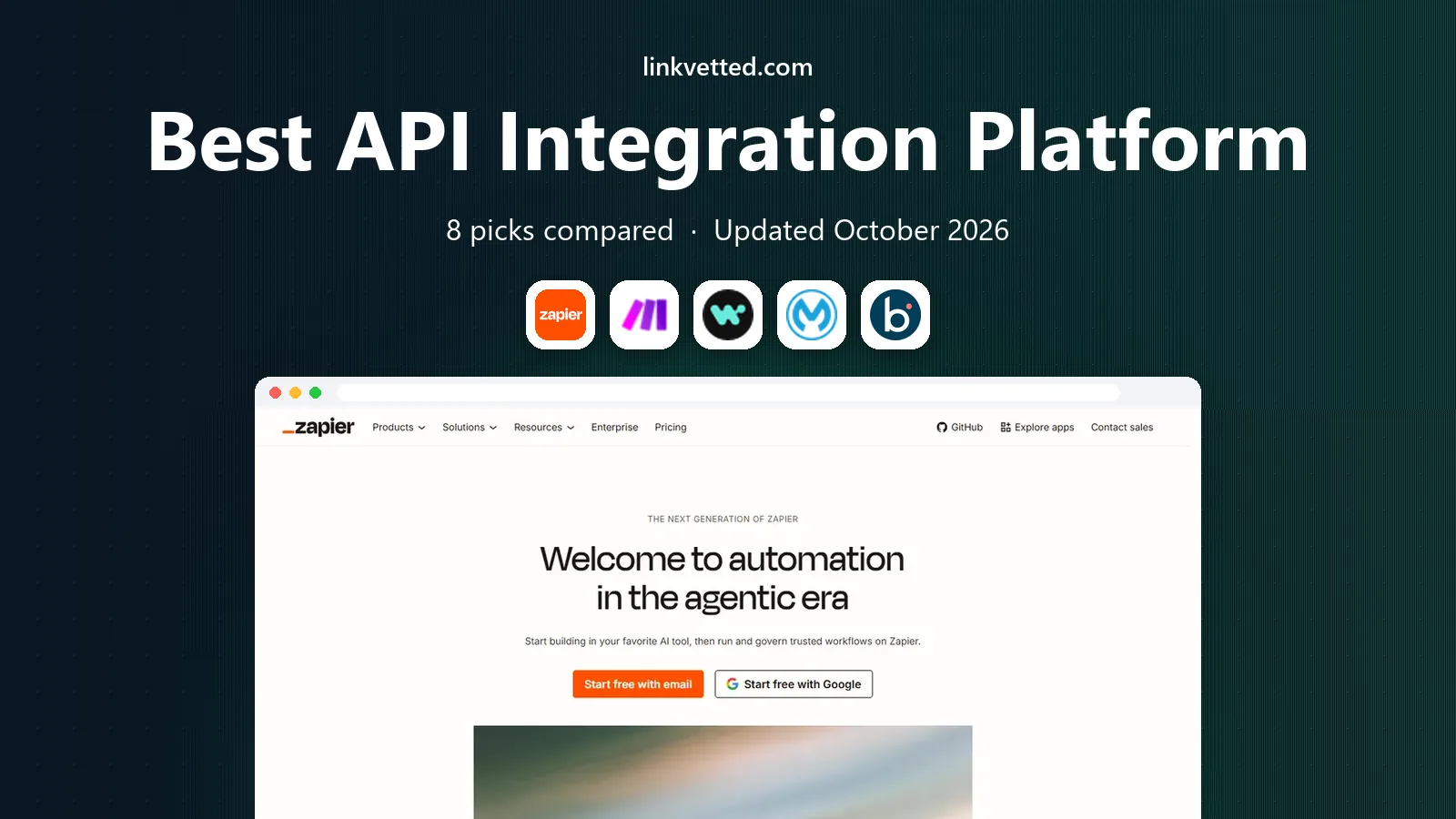
- Editor's choice
 Zapier
non-technical teams automating apps
Starts at$19.99 per monthVisit zapier.comFull review - Great alternative
 Make
visual builders wanting affordable automation
Starts at$9 per monthVisit make.comFull review - Also consider
 Workato
business teams running enterprise automation
Starts atSee websiteVisit workato.comFull review
TL;DR:
- Zapier and Make offer free plans and published prices, while Workato, Celigo, and many enterprise platforms are quote-based.
- Integration platforms split into no-code automation, enterprise iPaaS, and developer-led workflow tools.
- Zapier suits simple automations, MuleSoft suits API-led programs, and n8n suits developer teams.
- Convert one real month of volume into each pricing unit before you compare headline prices.
Quick comparison
| Tool | Best for | Starts at | Free plan? | |
|---|---|---|---|---|
| Zapier | non-technical teams automating apps | $19.99 per month | Yes | Visit |
| Make | visual builders wanting affordable automation | $9 per month | Yes | Visit |
| Workato | business teams running enterprise automation | See website | Free trial | Visit |
 MuleSoft Anypoint Platform | large teams running API-led programs | $2,000 per month | Free trial | Visit |
 Boomi | hybrid enterprise integration teams | $99 per month | Free trial | Visit |
 Celigo | NetSuite and ecommerce mid-market teams | See website | Free trial | Visit |
 Microsoft Power Automate | Microsoft 365 teams | $15 per user per month | Yes | Visit |
 n8n | developer-led teams wanting self-hosting | See website | Yes | Visit |
The best API integration platforms
We compared official feature pages, pricing pages, mobile or web app listings, and public documentation for each option below. The list mixes well known leaders with smaller tools that fit specific needs, so you can shortlist two or three and trial them with real work.

For many buyers, this is the first option worth a close look. Zapier fits non-technical teams automating apps. It stands out for a very large app catalog; easy no-code workflows; a free plan. That combination makes it useful in daily work, not only on a demo page, and it helps explain why so many teams keep returning to it when they compare options side by side.
The test that matters is two real integrations run for a week, checked for errors, retries, and clear logs. The trade-off is task-based pricing can rise fast with volume; complex logic needs workarounds. Before you commit, check the current price of $19.99 per month and the free plan status of Yes on the vendor site, because plan limits and prices change. If the limits fit your team size and workflow, it is a sound shortlist choice.
- A very large app catalog
- Easy no-code workflows
- A free plan
- Task-based pricing can rise fast with volume
- Complex logic needs workarounds

This option earns its place for a clear, practical reason. Make fits visual builders wanting affordable automation. It stands out for a visual scenario builder; credit-based pricing; a free plan. That combination makes it useful in daily work, not only on a demo page, and it helps explain why so many teams keep returning to it when they compare options side by side.
A good integration platform should make a failed sync visible quickly, so support staff can fix it before customers notice. The trade-off is credit use can be hard to predict for new users; enterprise governance is lighter than rivals. Before you commit, check the current price of $9 per month and the free plan status of Yes on the vendor site, because plan limits and prices change. If the limits fit your team size and workflow, it is a sound shortlist choice.
- A visual scenario builder
- Credit-based pricing
- A free plan
- Credit use can be hard to predict for new users
- Enterprise governance is lighter than rivals

If you want a focused tool rather than a sprawling suite, start here. Workato fits business teams running enterprise automation. It stands out for business-friendly recipes; strong enterprise connectors; AI-assisted building. That combination makes it useful in daily work, not only on a demo page, and it helps explain why so many teams keep returning to it when they compare options side by side.
For integration tools, pricing units matter most, so convert one real month of volume into tasks, credits, or messages before you compare. The trade-off is quote-heavy pricing; costs scale with usage and can be hard to forecast. Before you commit, check the current price of See website and the free plan status of Free trial on the vendor site, because plan limits and prices change. If the limits fit your team size and workflow, it is a sound shortlist choice.
- Business-friendly recipes
- Strong enterprise connectors
- AI-assisted building
- Quote-heavy pricing
- Costs scale with usage and can be hard to forecast
This is a strong choice when simplicity matters more than sheer depth. MuleSoft Anypoint Platform fits large teams running API-led programs. It stands out for API design, management, and integration in one platform; deep Salesforce alignment; strong governance. That combination makes it useful in daily work, not only on a demo page, and it helps explain why so many teams keep returning to it when they compare options side by side.
The test that matters is two real integrations run for a week, checked for errors, retries, and clear logs. The trade-off is high starting price; implementation needs specialist skills. Before you commit, check the current price of $2,000 per month and the free plan status of Free trial on the vendor site, because plan limits and prices change. If the limits fit your team size and workflow, it is a sound shortlist choice.
- API design, management, and integration in one platform
- Deep Salesforce alignment
- Strong governance
- High starting price
- Implementation needs specialist skills
Teams that need a dependable everyday option should weigh this one carefully. Boomi fits hybrid enterprise integration teams. It stands out for hybrid cloud and on-premise integration; a large connector library; pay-as-you-go options. That combination makes it useful in daily work, not only on a demo page, and it helps explain why so many teams keep returning to it when they compare options side by side.
A good integration platform should make a failed sync visible quickly, so support staff can fix it before customers notice. The trade-off is subscription tiers are largely quote-based; the platform can feel heavy for small jobs. Before you commit, check the current price of $99 per month and the free plan status of Free trial on the vendor site, because plan limits and prices change. If the limits fit your team size and workflow, it is a sound shortlist choice.
- Hybrid cloud and on-premise integration
- A large connector library
- Pay-as-you-go options
- Subscription tiers are largely quote-based
- The platform can feel heavy for small jobs
This pick suits buyers who want proven tools with wide support. Celigo fits NetSuite and ecommerce mid-market teams. It stands out for prebuilt flows for NetSuite and ecommerce; flat-rate endpoint pricing on some plans; managed integrations. That combination makes it useful in daily work, not only on a demo page, and it helps explain why so many teams keep returning to it when they compare options side by side.
For integration tools, pricing units matter most, so convert one real month of volume into tasks, credits, or messages before you compare. The trade-off is quote-only pricing for many plans; it is less general than Zapier or Make for small automations. Before you commit, check the current price of See website and the free plan status of Free trial on the vendor site, because plan limits and prices change. If the limits fit your team size and workflow, it is a sound shortlist choice.
- Prebuilt flows for NetSuite and ecommerce
- Flat-rate endpoint pricing on some plans
- Managed integrations
- Quote-only pricing for many plans
- It is less general than Zapier or Make for small automations
For a balance of price and features, this one deserves attention. Microsoft Power Automate fits Microsoft 365 teams. It stands out for deep Microsoft 365 and Teams integration; desktop and cloud flows; AI builder features. That combination makes it useful in daily work, not only on a demo page, and it helps explain why so many teams keep returning to it when they compare options side by side.
The test that matters is two real integrations run for a week, checked for errors, retries, and clear logs. The trade-off is it is a weaker fit outside Microsoft 365; premium connectors need paid plans. Before you commit, check the current price of $15 per user per month and the free plan status of Yes on the vendor site, because plan limits and prices change. If the limits fit your team size and workflow, it is a sound shortlist choice.
- Deep Microsoft 365 and Teams integration
- Desktop and cloud flows
- AI builder features
- It is a weaker fit outside Microsoft 365
- Premium connectors need paid plans
This final pick rounds out the list with a different strength. n8n fits developer-led teams wanting self-hosting. It stands out for open source and self-hostable; visual workflows with code options; a large node library. That combination makes it useful in daily work, not only on a demo page, and it helps explain why so many teams keep returning to it when they compare options side by side.
A good integration platform should make a failed sync visible quickly, so support staff can fix it before customers notice. The trade-off is self-hosting needs maintenance; cloud pricing varies by executions and features. Before you commit, check the current price of See website and the free plan status of Yes on the vendor site, because plan limits and prices change. If the limits fit your team size and workflow, it is a sound shortlist choice.
- Open source and self-hostable
- Visual workflows with code options
- A large node library
- Self-hosting needs maintenance
- Cloud pricing varies by executions and features
How we picked these
We compared official vendor pages, pricing pages, and public documentation for API integration platforms that are still sold in 2026. We kept platforms that connect apps and APIs, run workflows, or manage APIs, and we marked quote-only vendors as See website. We weighed connector depth, workflow design, API management, governance, monitoring, and price. We did not claim hands-on testing, and we based the findings on vendor pages and public reviews. Pricing units differ widely, so a task, credit, message, and execution are not the same thing.
How to pick an integration platform
Start with who will build and maintain the integrations. Business teams do well with Zapier, Make, or Workato, because they offer visual builders and prebuilt connectors. IT teams running hybrid systems, governance, and API management need Boomi, MuleSoft, or Celigo. Developer teams that want control and self-hosting should look at n8n. A platform that fits the builder will be maintained, while a platform that only fits IT or only fits business users often stalls after the first project.
What to check before you pay
Volume and pricing units decide the total cost. Zapier counts tasks, Make counts credits, Boomi and MuleSoft use messages or credits, and n8n counts executions. Take one real month of work, such as 1,000 orders synced between two systems, and convert it into each unit before you compare prices. Also check error handling, retries, monitoring, and versioning, because a failed sync that no one notices can cost more than the subscription itself.
How to run a useful trial
Trial the platform with two real integrations, not sample data. Connect your CRM and your accounting tool, or your store and your shipping tool, and run them for a week with real records. Check how errors appear, how easy it is to fix a failed run, and whether logs are clear enough for support staff. If the trial reveals hidden limits on connectors, data volume, or premium features, adjust the budget before you sign a longer contract.
FAQ
What is the best API integration platform?
MuleSoft suits large API-led programs, Boomi suits hybrid enterprise integration, and Workato suits business-led enterprise automation. Zapier suits simple no-code automations, and Make suits visual builders on a budget. The best platform for API integration depends on team skills, governance needs, and volume.
What is the best API integration tool for small teams?
Zapier and Make are strong for small teams because they offer free plans, published prices, and visual builders. n8n suits developer-led small teams that want self-hosting. Start with a free plan and trial one real workflow before you pay.
What is the difference between iPaaS and automation tools?
An iPaaS platform like Boomi, MuleSoft, and Celigo is built for enterprise integration, governance, and hybrid systems. An automation tool like Zapier and Make is built for fast, visual workflows between apps. Some platforms, such as Workato, sit between the two, with business-friendly building and enterprise controls.
How much do API integration platforms cost?
Prices range from free plans on Zapier, Make, and n8n to $15 per user per month for Power Automate, $19.99 per month for Zapier, and $2,000 per month for MuleSoft at the published starting level. Enterprise platforms are often quote-based, so get a quote based on your real monthly volume.
Do I need API management or just integration?
API management suits teams that publish APIs for partners or developers and need design, security, versioning, and analytics. Integration alone suits teams that only need to sync data between existing apps. MuleSoft covers both, while Zapier and Make focus mainly on integration and automation.