Best AI Visibility Tools for AEO: 8 Tools Compared
Our best ai visibility tools for aeo guide compares 8 trackers for ChatGPT, Gemini, and AI search answers, with prompts, engines, coverage, and prices in 2026.
- Editor's choice
 Profound
Enterprise AI visibility depth
Starts at$99 per monthVisit tryprofound.comFull review - Great alternative
 Peec AI
Agencies and multi-brand tracking
Starts at$95 per monthVisit peec.aiFull review - Also consider
 Otterly.AI
Budget AI mention monitoring
Starts at$29 per monthVisit otterly.aiFull review
TL;DR:
- AI visibility tools track whether your brand appears in AI answers, which classic rank trackers do not show.
- Otterly.AI is the lowest priced entry point, while Profound and Scrunch suit larger brands that need depth and action plans.
- Prompt counts, engine coverage, and per-domain pricing decide the real cost far more than the headline monthly price.
- A tool can show visibility, but winning citations still depends on clear, factual, well structured content on your own site.
Quick comparison
| Tool | Best for | Starts at | Free plan? | |
|---|---|---|---|---|
| Profound | Enterprise AI visibility depth | $99 per month | Free trial | Visit |
| Peec AI | Agencies and multi-brand tracking | $95 per month | Free trial | Visit |
| Otterly.AI | Budget AI mention monitoring | $29 per month | Free trial | Visit |
 Scrunch | AI crawler and citation analysis | $250 per month | Free trial | Visit |
 Semrush AI Visibility Toolkit | Existing Semrush users | $99 per month | No | Visit |
 Ahrefs Brand Radar | Brand tracking inside Ahrefs | $199 per month | No | Visit |
 AthenaHQ | Broad engine coverage | $295 per month | Yes | Visit |
 HubSpot AEO | Teams already in HubSpot | $50 per month | Free trial | Visit |
The best ai visibility tools for aeo
Answer engine optimization, often called AEO, is about being cited in AI answers rather than only ranking in a list of links. These tools run prompts across AI platforms, record whether your brand is mentioned or cited, and show which pages and competitors appear instead. We compared them on engine coverage, prompt limits, and how clearly they turn data into next steps.
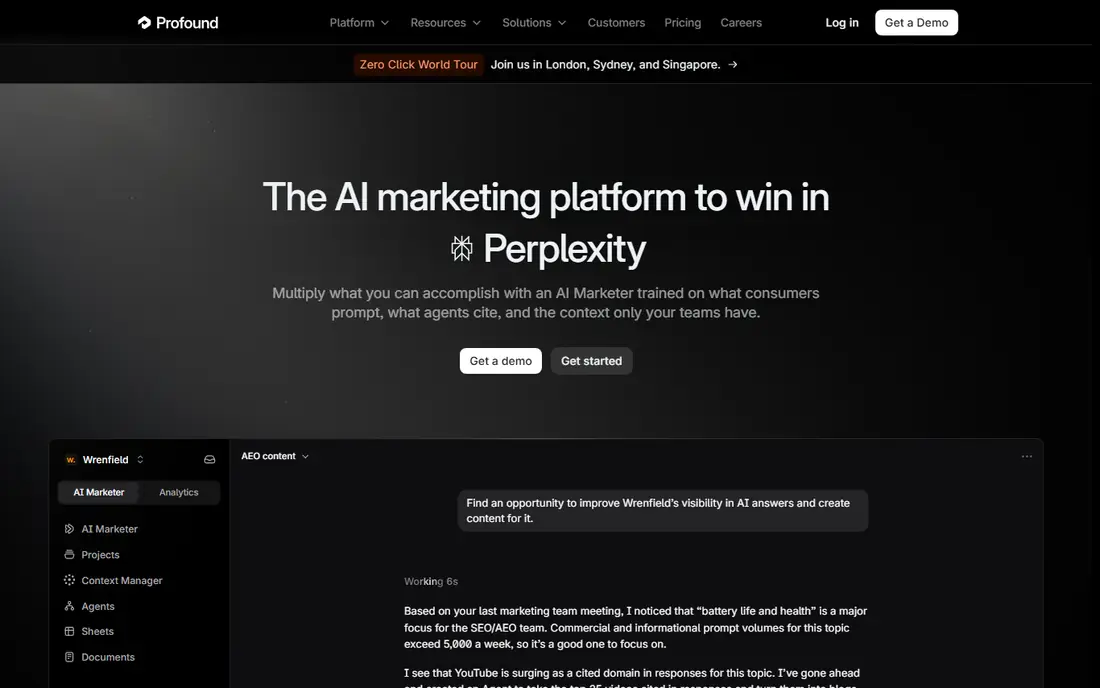
Profound is the most established name in AI visibility for larger brands. It tracks how AI platforms answer prompts about your brand, topics, and competitors, and it adds tools that suggest content and site changes to improve citations. For a brand team that reports AI visibility to leadership, that depth and polish matter. The catch is scope. Lower priced plans may cover fewer engines, and full multi-engine tracking sits on higher plans. Small teams should check exactly which engines and prompts are included before signing. If you need enterprise depth and can pay for it, Profound is a strong lead option.
- Deep prompt and conversation data
- Agent tools for action plans
- Strong enterprise reporting
- Entry plan covers limited engines
- Costs rise quickly for multi-engine tracking

Peec AI suits agencies and multi-brand teams that need to track several clients without juggling separate accounts. Daily prompt runs show how answers change over time, and competitor views make it easier to explain why a rival is cited more often. Its analytics focus on positioning, not just mention counts. Prompt limits are the main constraint. An entry plan with around 50 prompts covers one brand well, but it will not stretch across five clients. Agencies should price the plan they will need in six months, not the plan that fits a single test client today.
- Daily tracking across several models
- Competitor comparisons
- Agency-friendly workspaces
- Entry plan limits prompts and projects
- Pricing rises for agency volumes
Otterly.AI is the best starting point if you want to test AI visibility without a large budget. For 29 dollars a month, you can track a small set of prompts, see where your brand appears, and watch trends over time. Unlimited seats make it easy to share results with a team. The trade-off is depth. Entry prompts are limited, and Otterly.AI gives less guidance on what to fix than Profound or Scrunch. For a solo marketer or a small business, that is often enough to learn whether AI answers matter for your market. Larger teams will likely outgrow it.
- Lowest priced entry here
- Simple prompt tracking
- Unlimited seats on paid plans
- Fewer prompts on entry plan
- Lighter action guidance than larger platforms
Scrunch goes beyond counting mentions. It looks at how AI crawlers read your site, which pages get cited, and where content gaps cause a competitor to win an answer. Its content delivery features aim to give AI platforms a cleaner, machine-readable version of your site. That focus suits content teams that already publish a lot and want to fix the underlying causes of low visibility. Price and complexity are the barriers. At 250 dollars a month on annual billing, Scrunch is not a casual test tool. Teams that only need a weekly mention check should start cheaper. Teams that need to diagnose citation problems will find its analysis more useful than a simple tracker.
- Citation and content analysis
- AI crawler insights
- Content delivery features for AI platforms
- Higher entry price
- More complex than a simple mention tracker
Semrush AI Visibility Toolkit makes sense if your team already uses Semrush for keyword research, audits, and rank tracking. Adding AI visibility to the same dashboard keeps reporting in one place and avoids a second login for basic tracking. It tracks prompts per domain and shows brand mentions across AI platforms. As a standalone AEO tool, it is less deep than Profound or Scrunch, and the per-domain price adds up for agencies with many clients. It also needs a Semrush subscription underneath, so the total cost is higher than the toolkit price alone. For existing Semrush users, though, it is the simplest first step into AEO.
- Sits inside a full SEO suite
- Per-domain tracking
- Useful for teams already paying for Semrush
- Add-on cost per domain
- Prompt count is modest on the entry tier
Ahrefs Brand Radar suits teams that already rely on Ahrefs for backlinks and keyword data and want brand visibility in the same system. It tracks AI mentions by platform, which helps you see whether your brand appears in ChatGPT, Perplexity, or another surface, and how that compares with competitors. Pricing is the main drawback. Entry pricing covers one platform index, and tracking all platforms costs considerably more. Small teams should check whether they need that depth or whether a cheaper dedicated tracker covers their main engines. For Ahrefs-heavy teams, the convenience can still justify the cost.
- Strong brand and web data behind it
- Useful for market research
- Clear platform indexes
- High entry price for one platform
- Full multi-platform tracking costs much more
AthenaHQ stands out for engine breadth and for offering a free Essential plan with a limited credit pool. That free tier lets a team test basic tracking before paying, which few enterprise AEO tools offer. Paid plans add thousands of credits, more engines, and an action center that turns findings into tasks. The paid entry price is high, so AthenaHQ fits mid-size and larger teams rather than solo marketers. Credits also need attention, since each answer costs credits and heavy prompt sets can use them quickly. If broad coverage and a free starting point matter, AthenaHQ is worth a test.
- Covers many engines
- Free Essential plan for basic checks
- Action center for next steps
- High paid entry price
- Credit model needs careful reading
HubSpot AEO is for teams that already run content and CRM work inside HubSpot. It tracks AI visibility for a modest prompt set and connects findings to the content and pages you already manage. The free AI Search Grader gives a quick, no-cost snapshot before you pay. Dedicated tools offer more engines, prompts, and citation analysis, so HubSpot AEO will not satisfy a specialist AEO team. For a HubSpot-based marketing team that wants AEO reporting without a second platform, it is a sensible, lower priced addition.
- Lowest friction inside HubSpot
- Useful for content teams
- Free AI Search Grader for a quick check
- Prompt count is modest
- Less depth than dedicated AEO platforms
How we picked these
We compared official feature pages, pricing pages, and public reviews for tools that track brand visibility in AI answers in October 2026. We favored tools with clear prompt counts, named engines, competitor tracking, and a path from data to action. Price was weighed by prompt and engine coverage, not by headline price alone, since a cheap plan with few prompts can be poor value.
How to use AEO data without overreacting
Pick prompts your buyers actually ask
Start with 20 to 50 prompts that mirror real buyer questions: best options, comparisons, pricing, problems, and how-to tasks in your market. Avoid vanity prompts that only mention your brand name, since those tell you little about new demand. A prompt set built from sales calls, support tickets, and search data will give you findings you can act on.
Fix content, not just scores
When a competitor wins a citation, open the cited page and compare it with yours. Often the winner has clearer facts, a direct answer in the first paragraph, structured headings, and up-to-date details. Fix those content gaps first, then check whether AI answers change over the next few weeks. Chasing a score without fixing content rarely lasts.
Report trends, not single days
AI answers vary by day, wording, and platform, so a single snapshot can mislead. Report weekly or monthly trends, mention share, and citation changes, and note when you changed content. That approach keeps AEO reporting honest and helps a team see whether work is actually moving visibility.
FAQ
What is AEO and how is it different from SEO?
SEO aims to rank pages in search results, while AEO aims to have your brand cited in direct AI answers from tools such as ChatGPT, Gemini, and Perplexity. AEO still depends on good content, but it rewards clear, factual, well structured answers that AI systems can quote. Most teams need both, since search and AI answers now overlap.
Do AI visibility tools work for small businesses?
Yes, if you pick a low priced tool such as Otterly.AI and a focused prompt set. A small business does not need hundreds of prompts to learn whether AI answers mention it or its competitors. Start with core buyer questions, check trends monthly, and expand only when the data guides a content decision.
How many prompts do I need?
A single brand often starts well with 25 to 50 prompts covering core topics, comparisons, and buyer questions. Agencies need more, since prompts multiply across clients. Watch prompt limits closely, because a plan that looks cheap with 25 prompts can become expensive once you add locations, languages, or clients.
Can an AEO tool guarantee citations in ChatGPT or Gemini?
No tool can guarantee citations, since AI platforms choose sources based on their own models and data. A tool can show where you appear, which competitors are cited, and which content gaps may matter. Winning citations still depends on publishing accurate, useful, well structured content and earning links and mentions.
Which engines should I track first?
Start with the engines your buyers actually use, which for most US audiences means ChatGPT, Google AI Overviews or AI Mode, Gemini, and Perplexity. Add Claude or Copilot if your audience uses them for work. Tracking every engine on day one spreads prompts thin, so cover the main surfaces well first.