Best AI Visibility Monitoring Tools in 2026: 8 Tools Compared
Compare the best AI visibility monitoring tools in 2026, with AI search tracking, brand mentions, prompt coverage, and pricing for teams and agencies.

- Editor's choice
 Otterly.AI
Budget AI visibility tracking
Starts at$29 per monthVisit otterly.aiFull review - Great alternative
 Profound
Enterprise AI visibility suite
Starts at$99 per monthVisit tryprofound.comFull review - Also consider
 Peec AI
Multi country brand tracking
Starts at$85 per monthVisit peec.aiFull review
TL;DR:
- Otterly.AI at $29 per month is the cheapest credible entry point for tracking brand mentions across ChatGPT, Perplexity, and Google AI Overviews.
- Profound and Brandlight sit at the enterprise end, with larger prompt volumes and features smaller tools cannot match.
- Peec AI offers strong value for multi country tracking, with daily refreshes and broad engine coverage.
- AI visibility scores are directional trends, not exact measurements, so use them to spot movement over time rather than chasing a single number.
Quick comparison
| Tool | Best for | Starts at | Free plan? | |
|---|---|---|---|---|
| Otterly.AI | Budget AI visibility tracking | $29 per month | Free trial | Visit |
| Profound | Enterprise AI visibility suite | $99 per month | Free trial | Visit |
| Peec AI | Multi country brand tracking | $85 per month | No | Visit |
 Scrunch AI | AI crawler analytics | $250 per month | Free trial | Visit |
 Brandlight | Enterprise brand monitoring | See website | No | Visit |
 AthenaHQ | Attribution and broad engines | Free | Yes | Visit |
 Goodie AI | Small team action lists | $399 per month | No | Visit |
 Semrush AI Toolkit | Existing Semrush customers | $199 per month | No | Visit |
The best AI visibility monitoring tools
AI visibility monitoring tools track how often a brand appears in answers from ChatGPT, Perplexity, Gemini, Google AI Overviews, and other AI systems, and which sources those answers cite. That data helps marketing teams see whether their content is being surfaced, quoted, or ignored. These eight tools cover that job at different prices and scales.
Otterly.AI, based in Austria, is the budget entry point for AI visibility monitoring. At $29 per month, it tracks brand mentions across major AI engines and shows which prompts trigger your brand, which competitors appear, and which sources get cited. That is enough for a small business or solo marketer to spot whether AI answers mention them at all.
The limits show up at scale. Prompt counts on the entry tier are modest, and deeper sentiment, narrative, and citation analysis sit on higher plans or in enterprise tools. For a first AI visibility tool, Otterly gives a clear, affordable view of the basics. Upgrade when you need larger prompt sets, more regions, or client reporting.
- Lowest credible entry price
- Covers ChatGPT, Perplexity, Google AI Overviews, and Copilot
- Simple dashboards
- Entry tier prompt limits
- Lighter sentiment and narrative analysis than enterprise tools

Profound is the category leader by scale, tracking brand mentions across ChatGPT, Perplexity, Google AI Overviews, Copilot, Gemini, and more. Its entry plan starts at $99 per month for ChatGPT focused tracking, with a published $399 per month tier and custom enterprise pricing above that. A free 7 day trial lets teams test the dashboard before committing.
Profound suits large brands and agencies that need high prompt volumes, competitor benchmarking, and real user conversation data. Smaller teams may find the volume and price more than they need, and the most advanced features sit on higher tiers. If AI search is a core channel for your business, Profound is the tool most peers will already know.
- Large scale prompt tracking
- Broad engine coverage
- Agency and enterprise features
- Full enterprise pricing is custom and costly
- Smaller teams may not need the volume
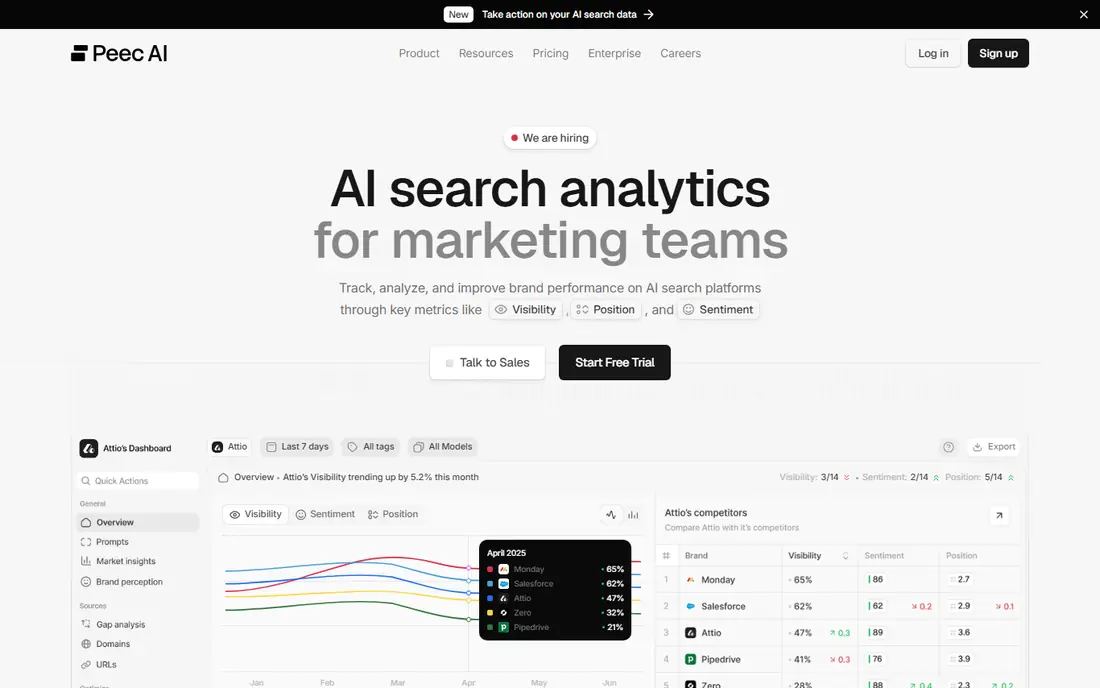
Peec AI, based in Berlin, is built for marketing teams and agencies that need clean daily tracking across countries and regions. Plans start around 85 euros per month, with daily prompt refreshes and broad engine coverage including ChatGPT, Perplexity, Claude, Gemini, and Google AI Overviews. Unlimited seats on plans make it easy to share dashboards with clients or colleagues.
Peec is deliberately monitoring focused, with no built in remediation or content fixing tools. Teams that want a tracker that tells them what AI systems say, clearly and daily, will like it. Teams that want a tool that also rewrites content or fixes source pages will need a second product alongside Peec.
- Daily refreshes
- Multi region tracking
- Unlimited seats on plans
- Clean daily reporting
- Pricing in euros, so dollar cost varies
- Monitoring only, with no remediation tools
Scrunch AI goes beyond mention tracking by adding AI crawler analytics, showing how AI bots visit and read your site, plus an Agent Experience Platform for shaping how agents interact with your content. Core plans start at $250 per month, with enterprise pricing custom and a 7 day trial. That combination suits mid market teams that want both visibility data and technical insight into AI crawlers.
The higher price and the June 2026 acquisition by Sitecore are worth noting. Acquisition can bring resources, but it can also change product direction, pricing, or support. Teams considering Scrunch should ask about the roadmap and contract terms, and confirm that crawler analytics, not just mention counts, is a feature they will actually use.
- AI crawler analytics plus monitoring
- Agent experience platform
- Persona modeling
- Higher entry price
- Acquired by Sitecore in June 2026, so future roadmap may shift
Brandlight is an enterprise AI visibility tool focused on brand sentiment, narrative, and mention tracking for large organizations. It is sold through sales, with custom enterprise pricing and no published entry price, which is common at this end of the market. Its public material points to large brand customers and a roadmap covering ads and commerce visibility.
Because pricing and feature depth are not fully public, Brandlight is hard to compare on paper alone. Enterprise buyers should request a demo with their own brand and prompts, and ask for sample reports, engine coverage, and data refresh rates. For a large brand that needs governance and narrative control, Brandlight is worth a sales conversation. For a small team, the quote only model is a sign to start cheaper.
- Enterprise brand sentiment and narrative tracking
- Strong brand logos
- Ads and commerce roadmap
- Quote only pricing
- Depth not publicly verifiable from the site alone
AthenaHQ stands out for two reasons: a free tier that lets small teams try AI visibility tracking, and attribution features that connect AI visibility to revenue signals, which most tools in this category do not offer. Paid Starter plans start at $295 per month, with enterprise pricing custom. Engine coverage is broad, spanning major chatbots and AI search systems.
The free tier is useful for learning the category, but serious tracking with larger prompt sets and reporting needs a paid plan. AthenaHQ suits self serve teams that want attribution alongside monitoring and are willing to pay mid market prices for it. Teams that only need basic mention counts can start cheaper with Otterly.
- Free tier to start
- Starter plan at $295 per month
- Rare revenue attribution features
- Paid plans are mid market priced
- No bot log analytics on lower tiers
Goodie AI, listed as higoodie, positions itself as a full stack visibility tool for smaller teams, with tracking plus action lists that suggest what to fix. Pricing starts at $399 per month billed yearly, which puts it above budget tools but below full enterprise suites. That price buys a more guided experience than a raw dashboard, with tasks tied to visibility gaps.
The trade off is scale and brand size. Goodie is a smaller vendor than Profound or Semrush, so enterprise buyers may want to check support, data handling, and long term viability. For a small team that wants guidance, not just charts, Goodie offers a middle path between a cheap tracker and an enterprise suite.
- Clear action lists for improving visibility
- SMB friendly positioning
- Broad engine tracking
- Higher entry price at $399 per month billed yearly
- Smaller vendor than Profound or Semrush
Semrush AI Toolkit adds an AI visibility lens to the Semrush SEO platform, which many marketing teams already use. Bundled pricing starts from $199 per month for the Starter tier, with enterprise pricing custom, and it covers major AI engines and Google AI Overviews. For a team already paying for Semrush, adding AI tracking in the same dashboard avoids a second tool and a second login.
Purpose built tools offer deeper sentiment, narrative, and site health analysis, so Semrush is not the deepest AI visibility product on its own. It is the most convenient for Semrush customers who want AI data alongside keyword, traffic, and content data. If you do not already use Semrush, compare its total cost against a standalone tracker before committing.
- Bundled into the Semrush SEO suite
- Single dashboard with SEO data
- Strong brand recognition
- Starter covers one domain
- Lighter sentiment and site health depth than purpose built tools
How we picked these
We compared official pricing pages, engine coverage, and public comparison data for AI visibility tools, focusing on tools that track brand mentions across multiple AI systems with regular refreshes. We favored tools with published pricing or a clear enterprise path, and we included budget, mid market, and enterprise options so teams at different sizes can compare. We left out tools that only track one engine or that publish no verifiable product information.
How to choose an AI visibility monitoring tool
Start with the engines your customers actually use. Most teams need ChatGPT, Perplexity, Gemini, and Google AI Overviews at minimum, with Claude and Copilot as useful extras. Then check prompt volume: a tool that tracks 50 prompts will not show the long tail of questions that drive your niche. Finally, check refresh rate, since weekly data hides fast changes after a product launch or a news event.
Scores, sentiment, and what to do with the data
Treat visibility scores as directional. No tool can give an exact share of AI answers, since prompts, models, and user location all shift results. Use the data to spot trends: which topics trigger your brand, which competitors appear, and which sources get cited. Then fix the source content, product pages, and third party listings that AI systems actually cite, since that is where visibility gains come from.
Budget and agency needs
Small teams should start at $29 to $99 per month and upgrade only when prompt limits block real work. Agencies need multi brand workspaces, white label reporting, and seat policies, which Peec, Profound, and AthenaHQ handle better than budget tools. Before signing an annual plan, run a one month test with your own brand prompts and confirm the reports are clear enough to share with stakeholders.
FAQ
What is the best tool for monitoring AI visibility?
Otterly.AI is the best budget start at $29 per month, Profound is the strongest enterprise suite, and Peec AI is a strong mid market choice for multi country tracking. The best tool depends on your budget, prompt volume, and whether you need agency workspaces or attribution. Start cheap, learn your prompt set, then upgrade.
What are the best AI visibility monitoring platforms for agencies?
Profound, Peec AI, and AthenaHQ offer agency workspaces, multi brand tracking, and reporting features that suit client work. Otterly.AI can work for small agencies with few clients, but prompt limits and reporting depth may block larger portfolios. Compare workspace pricing, not just the headline plan price.
How much do AI visibility tools cost?
Prices run from free tiers and $29 per month at the budget end to $250 to $399 per month in the mid market and custom enterprise pricing above that. Most teams can start at $29 to $99 per month and learn what they need before committing to a larger plan. Confirm whether pricing is monthly or yearly, and in dollars or euros.
Which AI engines should a visibility tool cover?
At minimum, look for ChatGPT, Perplexity, Gemini, and Google AI Overviews, with Claude and Microsoft Copilot as valuable extras. Engine coverage is often gated by price, so check which engines sit on the tier you would actually buy, not just the top tier. A tool that lists an engine on its marketing page but gates it behind enterprise pricing may not cover it for you.
Are AI visibility scores accurate?
Scores are directional, not exact. Models, prompts, regions, and time of day all shift AI answers, so two tools can report different numbers for the same brand. Use scores to track movement over weeks, compare against competitors on the same tool, and find cited sources to improve. Do not treat a single score as a precise market share figure.