Best AI Visibility Competitor Analysis Tool in 2026: 8 Tools Compared
We compared the best ai visibility competitor analysis tool options for tracking brand mentions in AI answers and benchmarking rivals across engines in 2026.
- Editor's choice
 Profound
Enterprise prompt volume and competitor tracking
Starts at$99 per monthVisit tryprofound.comFull review - Great alternative
 Peec AI
Multi-country competitor tracking
Starts at$89 per monthVisit peec.aiFull review - Also consider
 Otterly.ai
Low-cost first competitor read
Starts at$29 per monthVisit otterly.aiFull review
TL;DR:
- The best ai visibility competitor analysis tool tracks your brand and your rivals across the same prompts, engines and time periods.
- Competitor comparison needs share of voice, citation sources and sentiment, not just a count of mentions.
- AI visibility scores are directional trends, not exact measurements, since AI answers change with each run.
- Entry prices run from free or 29 dollars per month to enterprise quotes, so start small and expand prompt coverage as you learn.
- Use competitor data to fix content gaps and citation sources, not to copy rival claims or chase every mention.
Quick comparison
| Tool | Best for | Starts at | Free plan? | |
|---|---|---|---|---|
| Profound | Enterprise prompt volume and competitor tracking | $99 per month | No | Visit |
| Peec AI | Multi-country competitor tracking | $89 per month | No | Visit |
| Otterly.ai | Low-cost first competitor read | $29 per month | No | Visit |
 Scrunch AI | Citation graphs and agent analytics | $250 per month | Free trial | Visit |
 Brandlight | Enterprise brand and competitor narratives | See website | No | Visit |
 AthenaHQ | Free start with competitor attribution | Free | Yes | Visit |
 Evertune | Large-scale brand perception measurement | $800 per month | No | Visit |
 Semrush AI Visibility Toolkit | Competitor tracking inside an SEO suite | See website | Free trial | Visit |
The best ai visibility competitor analysis tool
AI visibility tools track how often a brand is mentioned, cited or recommended in AI answers from ChatGPT, Perplexity, Google AI Overviews, Gemini and other engines. A competitor analysis tool does that for your brand and your rivals side by side, so you can see share of voice, citation sources and topic gaps. The tools below cover that job at different price points.
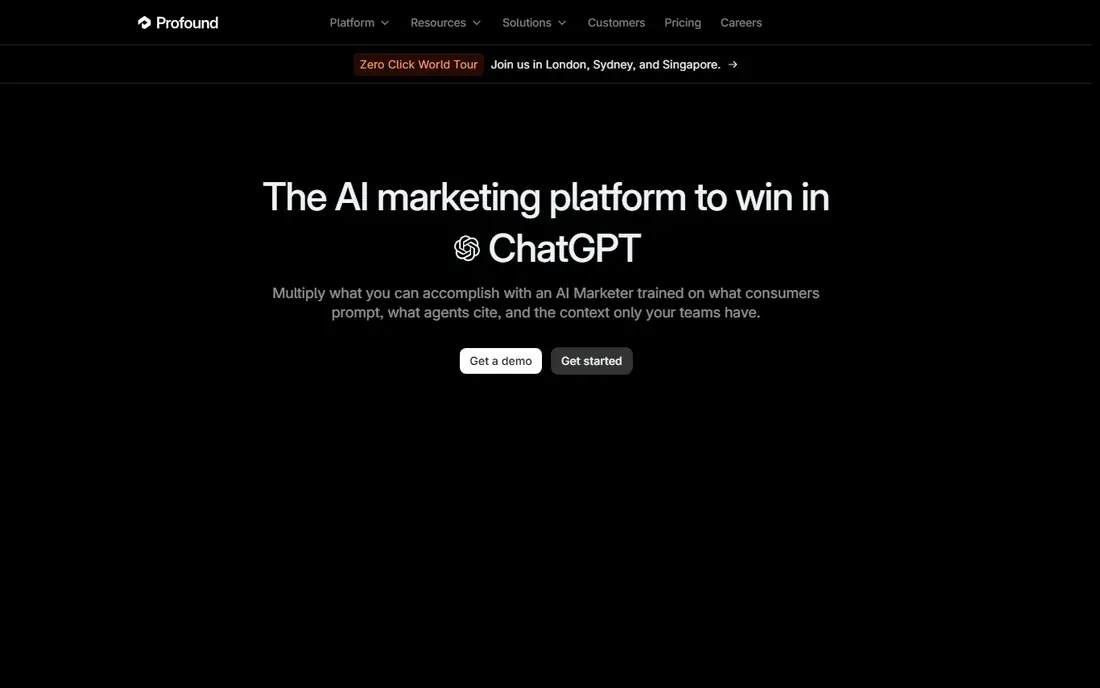
Profound is the category leader for scale. It tracks brand mentions in AI answers across major engines, lets you compare your brand with competitors on the same prompts, and supports high prompt volumes for large brands and agencies. Entry plans start at 99 dollars per month for a limited engine set, with higher tiers and enterprise plans for full coverage.
The trade is cost at scale. Full enterprise coverage is custom priced and can run far above the entry plan, so a small team should check what the entry plan actually includes. For a large brand or agency that needs competitor tracking across many prompts and engines, Profound volume and reporting make it a strong default.
- High prompt volume
- Competitor tracking across engines
- Enterprise reporting
- Enterprise plans are custom priced
- Smaller teams may not need the volume
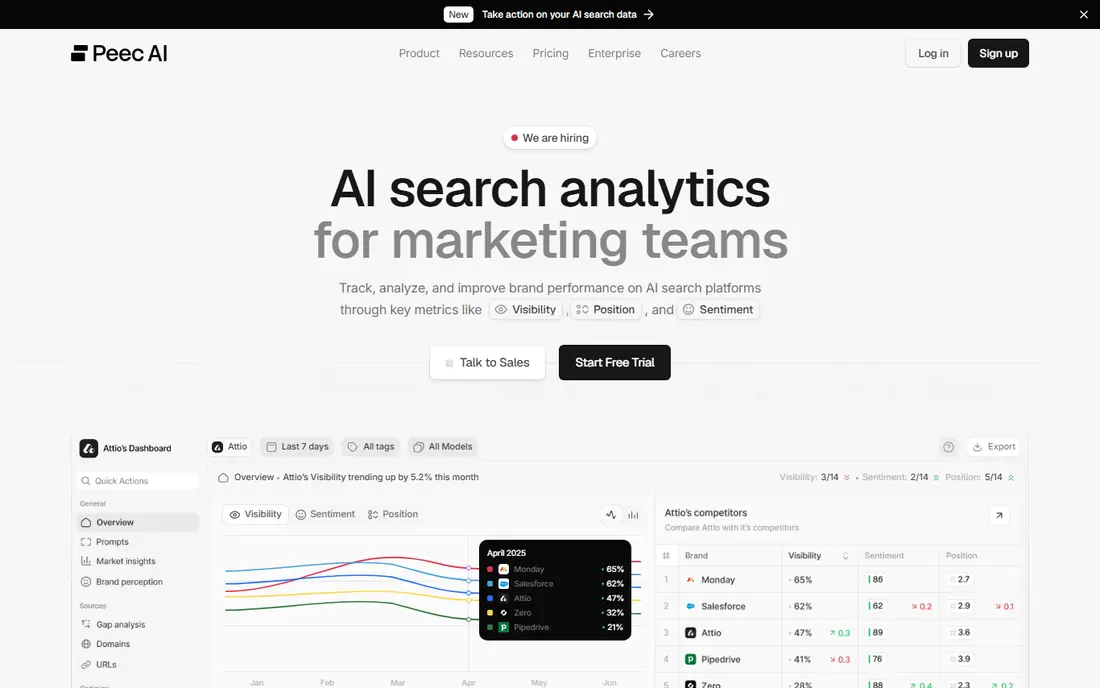
Peec AI, based in Berlin, tracks brand mentions in AI answers with daily refreshes and country-level breakdowns, which suits brands that compete across markets. Competitor comparison shows share of voice and mention trends by country and engine, so a team can see where a rival is stronger and where its own content is missing. Plans start at about 89 euros per month, with unlimited seats.
Peec AI is deliberately monitoring-focused, so it does not fix your site or content for you. That is fine if you have an SEO or content team to act on the data, but a team that wants done-for-you fixes should look elsewhere. For multi-market competitor tracking at a mid-market price, Peec AI is strong value.
- Daily refreshes
- Multi-country and multi-language tracking
- Unlimited seats on plans
- Monitoring focus, with less remediation built in
- Euro pricing varies by exchange rate
Otterly.ai, based in Austria, gives a low-cost first read on AI visibility for your brand and competitors. At 29 dollars per month, it tracks mentions across ChatGPT, Perplexity, Google AI Overviews and Microsoft Copilot, with alerts for changes. That makes it ideal for a solo founder, small agency or small brand that wants to know whether it is named at all before paying for a larger platform.
Depth is lighter than enterprise tools. Sentiment, narrative and citation analysis are less detailed, and prompt sets are smaller. For a first competitor benchmark and a monthly trend line, Otterly.ai is enough. For a large brand that needs deep competitor narratives, an enterprise tool higher on this list will give more.
- Lowest credible entry price
- Simple setup
- Covers major AI engines
- Lighter depth on sentiment and citation analysis
- Smaller prompt sets
Scrunch AI adds two things many trackers lack: citation graph analysis, showing which sources AI answers cite for you and your rivals, and AI crawler analytics, showing how AI agents visit your site. That helps a team see not just who is mentioned, but why: which pages, sources and facts drive citations for each competitor. Plans start at 250 dollars per month, with a trial.
Scrunch AI was acquired by Sitecore in June 2026, so buyers should check the current roadmap and product plans before committing. For a mid-market team that wants citation-level competitor insight and agent analytics, Scrunch AI depth goes beyond simple mention counts.
- Citation graph analysis
- AI crawler analytics
- Agent experience platform
- Acquired by Sitecore in 2026, so roadmap needs checking
- Mid-market price, not entry level
Brandlight tracks brand mentions, sentiment and narratives in AI answers, with competitor benchmarking for enterprise brand and communications teams. It suits companies that care about how AI answers describe them, not just whether they are named, and it offers a managed or partner-led approach for larger orgs. Pricing is by quote, often starting with a paid pilot.
The main limit is transparency. Public pricing and depth are harder to verify than with self-serve tools, so enterprise buyers should ask for a demo on their own brand and rivals before signing. For a large brand team that needs narrative and sentiment competitor analysis with human support, Brandlight is worth a shortlist place.
- Brand sentiment and narrative tracking
- Enterprise reporting
- Competitor benchmarking
- Quote-only pricing
- Depth is harder to verify from public pages
AthenaHQ lets a team start AI visibility tracking for free, then move to paid plans from 295 dollars per month for fuller coverage. It tracks brand and competitor mentions across major engines, adds attribution for traffic and revenue where connected, and gives content recommendations based on gaps. That attribution angle is rare in this category and helps justify the spend to a finance team.
The jump from free to paid is larger than with Otterly.ai or Peec AI, so check what the free tier covers before relying on it. Execution also stays with your team: AthenaHQ points to gaps, but you still need to fix content and citations. For a team that wants to test competitor tracking before budget approval, AthenaHQ free tier is a useful start.
- Free tier to start
- Attribution and content recommendations
- Broad engine coverage
- Paid plans start higher than entry rivals
- Execution stays with your team
Evertune measures brand perception at statistical scale, using large prompt samples to compare your brand with rivals across engines and topics. That sample size makes its share-of-voice and perception trends more stable than a small prompt set, which matters for PR and communications teams reporting to senior leaders. Plans start at 800 dollars per month.
The price puts it out of reach for small teams, and it is measurement-first: it tells you what AI answers say, but fixing content and citations stays with you. For an enterprise brand or PR team that needs defensible competitor measurement, Evertune sample depth is a strong point.
- Large prompt samples
- Statistical brand perception measurement
- Media coverage
- High entry price
- Measurement focus, with execution left to your team
Semrush AI Visibility Toolkit adds AI tracking to the Semrush SEO suite, so teams already using Semrush can see AI mentions alongside search rankings, backlinks and site health. Competitor comparison sits in the same dashboard as SEO competitor data, which helps a team report search and AI visibility together. Pricing is an add-on to Semrush subscriptions, so check the total.
Depth on sentiment, narrative and site health is lighter than purpose-built tools like Brandlight or Evertune. For a Semrush shop that wants AI competitor tracking without a second vendor, the toolkit is a practical consolidation. For a team that needs deep AI narrative analysis, a specialist tool will give more.
- Single dashboard with SEO data
- Strong brand recognition
- Competitor tracking add-on
- Add-on pricing on top of Semrush
- Lighter on sentiment and narrative than specialists
How we picked these
We compared official pricing pages, product documentation and public reviews for AI visibility tools that are still sold in October 2026. We favored tools that track both your brand and competitors across the same prompts and engines, with share-of-voice, citation or sentiment data. Tools that only track one brand, without competitor comparison, were left out, as were tools that had shut down.
How to run a competitor analysis that leads to action
Start with the same prompt set for every brand. Pick the questions your buyers actually ask, across buying, comparison and support topics, and track your brand and three to five rivals on those exact prompts. That shared prompt set is what makes share of voice meaningful; tracking different prompts for each brand gives a misleading comparison.
Read citations, not just mentions
A mention without a citation is weaker than a mention backed by a trusted source. Check which sources AI answers cite for you and for each rival, and look for content gaps: topics where rivals are cited from guides, reviews or documentation that you lack. Fixing those source gaps, by publishing clear, factual pages and earning citations, does more than chasing mention counts.
Treat scores as trends, not exact grades
AI answers change with each run, with model updates and with prompt wording, so a single score is not a precise grade. Track trends over weeks, look for sustained gaps rather than one-day moves, and report direction and citation changes alongside any score. A tool that claims exact AI visibility scores should be treated with care, since no tool in this category can measure AI answers exactly.
FAQ
What is an AI visibility competitor analysis tool?
It is a tool that tracks how often your brand and your competitors are mentioned, cited or recommended in AI answers from engines like ChatGPT, Perplexity and Google AI Overviews. It compares share of voice, citation sources and sentiment across the same prompts, so you can see where rivals are stronger and where your content has gaps.
How much do AI visibility tools cost?
Entry prices run from free tiers and 29 dollars per month for Otterly.ai to 89 euros per month for Peec AI and 250 dollars per month for Scrunch AI. Enterprise tools like Evertune start at 800 dollars per month, while Profound and Brandlight use custom enterprise pricing. Start with a low-cost tool and expand prompt coverage as you learn what matters.
Which AI engines do these tools track?
Most tools track ChatGPT, Perplexity, Google AI Overviews and Gemini, with some also covering Microsoft Copilot and Claude. Engine coverage varies by plan, so check the plan you will actually buy, not just the vendor homepage. A tool that tracks only one engine gives a partial picture of AI visibility.
Are AI visibility scores accurate?
Scores are directional, not exact. AI answers are generated dynamically and change with model updates, prompt wording and sampling, so no tool can give an exact visibility grade. Use scores as trend lines over weeks, and pair them with citation sources and sentiment to understand why a score moved.
How do I improve my brand visibility in AI answers?
Publish clear, factual pages that answer buyer questions directly, with structured data, accurate product facts and credible sources. Earn citations from trusted guides, reviews and documentation, and keep key facts current. Track competitor citations to find topics where rivals are cited and you are not, then close those gaps first.
Can I track competitors without tracking my own brand?
Most tools track both, since competitor share of voice only makes sense against your own baseline. You can usually add rivals as tracked brands in the same project, using the same prompt set. If a tool only tracks one brand, it is a visibility tracker, not a competitor analysis tool.