Best AI Visibility Checking Software in 2026: 8 Tools Compared
Best ai visibility checking software compared: 8 tools that check brand mentions, citations and rankings in AI answers daily, with pricing and limits.
- Editor's choice
 Peec AI
Daily brand checks for teams
Starts at$95 per monthVisit peec.aiFull review - Great alternative
 Profound
Enterprise daily checks
Starts atSee websiteVisit profound.comFull review - Also consider
 Otterly
Low-cost daily checks
Starts at$29 per monthVisit otterly.aiFull review
TL;DR:
- Daily checking matters more than a one-off audit, because AI answers change with model updates and new sources.
- Peec AI and Otterly give small teams a clear daily check without an enterprise contract.
- Profound and AthenaHQ suit teams that need broad engine coverage and a formal checking routine.
- ZipTie adds screenshot-style proof for client reporting, which is useful when a check needs evidence, not just a score.
- Check the same prompts on the same schedule, or week-to-week changes will be hard to trust.
Quick comparison
| Tool | Best for | Starts at | Free plan? | |
|---|---|---|---|---|
| Peec AI | Daily brand checks for teams | $95 per month | Free trial | Visit |
| Profound | Enterprise daily checks | See website | Free trial | Visit |
| Otterly | Low-cost daily checks | $29 per month | Free trial | Visit |
 AthenaHQ | Credit-based multi-model checks | Free | Yes | Visit |
 ZipTie | Evidence-backed AI checks | See website | Free trial | Visit |
 Semrush AI Visibility Toolkit | Checks inside Semrush | $99 per month | Free trial | Visit |
 Ahrefs Brand Radar | Research-backed checks | $199 per month | No | Visit |
 Writesonic GEO | Checking plus content fixes | $79 per month | Free trial | Visit |
The best AI visibility checking software
AI visibility checking software runs the same prompts through AI assistants on a schedule and records how your brand appears. The best tools make that check repeatable: same prompts, same engines, same cadence, so a change in the result reflects a change in the answer, not a change in the method. The tools below all check AI answers, but they differ in prompt limits, engine coverage, proof and price.
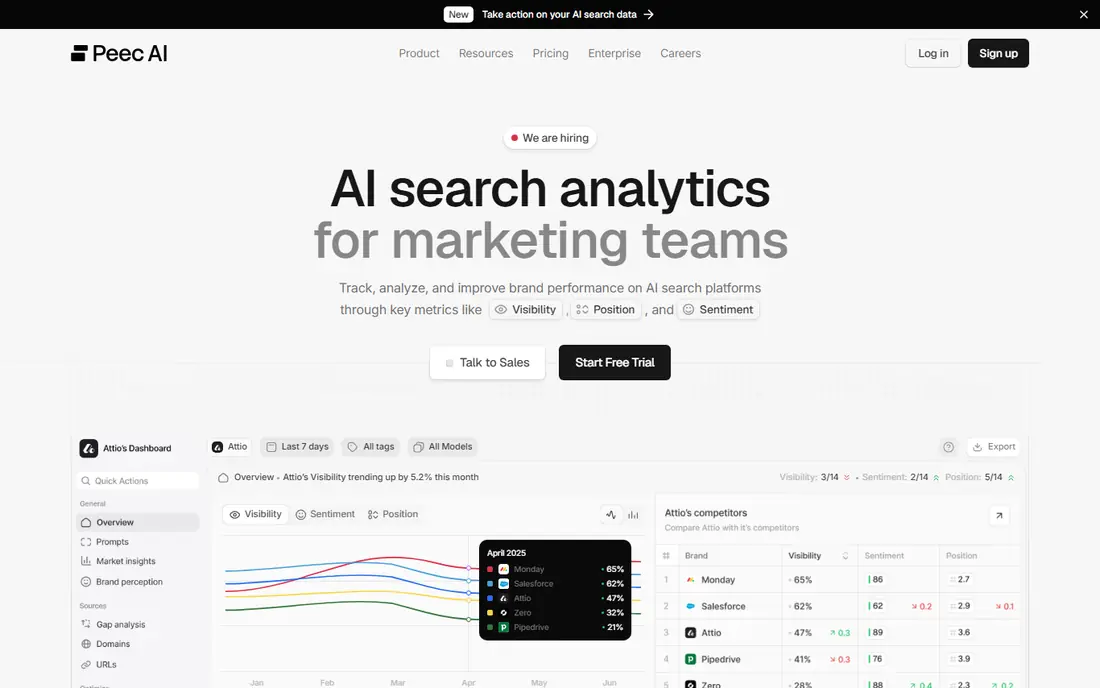
Peec AI works well as a daily checking routine because it is built around prompts, not vanity scores. You set the questions your customers actually ask, choose the models to check, and Peec AI runs them daily, recording mentions, position, sentiment and cited sources. That history is the point of a checker. A single day can be noisy, but a run of daily checks shows a trend, and a trend is what lets you judge a content fix or a competitor move.
Starter pricing in recent listings is $95 per month for 50 prompts daily, with unlimited users, which suits a small marketing team sharing one checking routine. The limit is engine choice on the entry plan, since you pick three models and some engines sit on higher plans. If your audience uses Claude or Grok heavily, confirm the plan that checks them before you buy. For most teams, Peec AI is the most balanced daily checker on this list.
- Daily checks with visibility, position and sentiment
- Unlimited team users
- Competitor checks on the same prompts
- Entry plan covers three models of your choice
- Higher engines are limited to higher plans
Profound suits organisations that need a formal, repeatable check across many engines and brands. Its enterprise plans track up to nine answer engines in recent listings, with citation analysis and competitor benchmarking alongside daily prompt checks. That breadth matters for a large brand, because customers may meet the brand in ChatGPT, Perplexity, Google AI Overviews, Gemini or another engine, and a check that covers only one engine can miss the place where the brand is weakest.
The drawback is that brand pricing is quote-based after a 7-day trial, so you cannot judge cost from a public price alone. Run the trial with your real prompt list and competitors, then ask for a quote tied to that volume and engine set. Profound is overkill for a single small site, but for an enterprise team that must check many brands on a fixed schedule, its coverage and controls justify the formal buying process.
- Broad engine coverage on enterprise plans
- Competitor and citation checks
- Enterprise controls for larger teams
- Brand pricing is quote-based
- Trial engine coverage is narrower than enterprise coverage
Otterly is the simplest daily checker for a small brand. The Lite plan checks 15 prompts daily across ChatGPT, Google AI Overviews, Perplexity and Copilot, with unlimited team members, for $29 per month in recent listings. That is enough to watch your core product questions, your brand name and a few competitor comparisons, and to notice when a mention drops out or a description changes. A free trial lets you test the routine with real prompts before paying.
Fifteen prompts is a tight limit, and it will not cover a large catalogue or a broad content strategy. Gemini, Google AI Mode and Claude are paid add-ons, so the headline price rises if those engines matter to you. Otterly is best as a first checker: learn which prompts are worth watching, build the habit of reviewing results weekly, and upgrade when the prompt list, not the price, becomes the reason to move.
- Daily checks at a low entry price
- Four core engines on Lite
- Unlimited team members
- Only 15 prompts on Lite
- Extra engines are paid add-ons
AthenaHQ checks AI visibility on a credit model, where one credit equals one AI response. That model suits teams that want to test checking before committing, since the free Essential tier includes 300 credits across five engines in recent listings. Starter is listed at $295 per month for 3,600 credits a month across 11 models, with competitor insights and content recommendations, which gives a broad check for a team that needs many models in one place.
The risk is forecasting. Checking 50 prompts across 10 models every day uses far more credits than checking 20 prompts across four models weekly, so you must model your routine before you choose a plan. AthenaHQ is a strong choice when broad model coverage matters and you can plan credit use carefully. If you want a fixed prompt count and a fixed monthly price, a flat prompt plan may be simpler to manage.
- Free tier for a real test
- 11 models on Starter
- Competitor checks and content suggestions
- Credit use depends on prompt and model count
- Starter price is a large jump from free
ZipTie takes a different approach to checking: it emphasises verifiable proof. For agencies and consultants, that matters, because a client report that says a brand appeared in an AI answer is stronger when it includes visual evidence of that answer. ZipTie focuses on AI Overviews, ChatGPT and Perplexity in recent listings, which covers the surfaces many clients ask about first, and it offers unlimited user seats on published plans, so client and team users do not add seat costs.
Pricing has varied across listings, with usage-based and monthly figures both appearing, so we list starting price as See website and recommend checking the current pricing page for the workload you plan to check. The narrower engine list is the main limit. If Claude, Gemini or Copilot checks are essential, pair ZipTie with a broader tracker or choose a different primary checker. Use ZipTie when proof and auditability matter as much as the score itself.
- Screenshot-style evidence for client checks
- Focus on AI Overviews, ChatGPT and Perplexity
- Unlimited user seats on listed plans
- Narrower engine list than broad trackers
- Less focus on content optimisation guidance
Semrush AI Visibility Toolkit is the easiest checker to adopt if your team already uses Semrush. It runs daily prompt checks for a domain across ChatGPT, Google AI, Gemini and Perplexity in recent listings, and it adds an AI site audit that flags pages that may be hard for AI systems to use. Keeping checks inside Semrush also means AI visibility sits next to keyword, backlink and site audit data, which helps a team connect an AI change to a wider SEO picture.
The standalone toolkit is listed at $99 per month per domain billed annually, with 25 tracked prompts, so multi-domain teams face a rising bill and a modest prompt cap. That makes Semrush a good checker for one or two priority domains, not for an agency checking dozens of brands on one plan. Choose it when Semrush is already your daily SEO tool and AI checks are an extension of that work, not a separate program.
- Daily prompt checks in a familiar SEO suite
- AI site audit alongside checks
- Competitor visibility views
- Priced per domain
- Entry prompt count is modest
Ahrefs Brand Radar checks AI visibility with a research advantage: a large index of pre-collected AI prompts lets you study how any brand appears, even before you build your own prompt list. That is useful when you need to benchmark a market, find prompts where rivals appear and you do not, or check a new competitor quickly. Tracked prompts for your own brand add a daily routine on top of that research, and the wider Ahrefs SEO suite provides context on the pages behind the mentions.
Cost is the main obstacle. Recent listings show AI index access from $199 per month for one platform, with custom prompt packages from $50 per month, on top of an Ahrefs plan. That structure rewards teams that already pay for Ahrefs and need deep research, but it is expensive as a simple checker. Confirm what your existing Ahrefs plan includes before you add Brand Radar, and use it when research depth justifies the price.
- Large AI prompt index for research
- Share of voice and competitor checks
- Strong SEO data alongside AI checks
- Full index pricing is high
- Prompt packages add a second cost layer
Writesonic GEO, part of Writesonic, checks brand visibility in AI answers and then connects the result to content work. That link is its main appeal for content teams. A check that shows a lost prompt is useful, but a check that points to an action, such as updating a page or creating a comparison, is easier to turn into work. Recent listings show GEO starting at $79 per month billed annually for 50 prompts, with a free trial, covering ChatGPT, Gemini and Google AI Overviews.
The engine list is narrower than enterprise trackers, and the headline price assumes annual billing, so monthly pricing will differ. Writesonic GEO suits a content team that already writes and updates pages regularly and wants checks and fixes in one workflow. If you only need a checker and your content work happens elsewhere, a dedicated tracker with broader engine coverage may be a better fit.
- AI visibility checks plus an action centre
- Content tools to fix losing prompts
- Suitable for content teams
- Fewer engines than broad enterprise trackers
- Annual billing assumed in headline price
How we picked these
We compared vendor pricing pages and independent October 2026 comparisons of AI visibility tools, and we favoured tools that run repeatable checks on a schedule, with prompt-level results, citation data and competitor views. We included budget, mid-market and enterprise checkers, plus SEO suites and a proof-focused tool, so readers can match the checker to their reporting needs. Prices in this category change often, so confirm engine coverage, prompt limits and billing terms on the vendor site before you buy, and judge a checker by the plan you would actually run.
How to run a reliable AI visibility check
A checker is only as good as its routine. Fix the prompts, engines and schedule first, then let the tool run long enough to show a trend. Changing the method every week makes the results hard to compare, even if the tool itself is accurate.
Lock the prompt list and schedule
Write a prompt list from real customer questions, brand comparisons and category questions, and run it on the same schedule, daily or weekly, without editing it for at least a month. Note any change you do make, so a jump in the data can be traced to a method change or a content change. A stable routine is what turns checks into evidence.
Record mentions, citations and sentiment together
Do not rely on a single visibility percentage. Record if you were mentioned, where you appeared in the answer, which sources were cited, and how the description read. A mention with a wrong claim is not a win, and a citation to a weak page is a fixable problem. Keep a short weekly note of the biggest changes, so a monthly report tells a story instead of listing numbers.
Use checks to drive fixes, then recheck
For each losing prompt, decide on one fix: update a page, add a clear comparison, correct a fact, or earn a citation from a credible source. Apply the fix, wait for the next check cycle, and compare the same prompt again. AI answers can vary from run to run, so look for a sustained change over several checks rather than reacting to a single day.
FAQ
What are the best ai visibility checking tools for a small team?
Otterly and Peec AI are the best ai visibility checking tools for most small teams, because both offer daily checks, clear prompt results and low or mid-range entry prices. Otterly suits a team with about 15 core prompts, while Peec AI suits a team with up to 50 prompts and a need for sentiment and competitor checks. Start with a fixed prompt list, review results weekly, and upgrade only when prompt count or engine coverage limits the check.
What is the best ai visibility checking tool for agencies?
Peec AI suits agencies that need multi-project checks with unlimited users, while ZipTie suits agencies that need evidence-backed checks for client reports. Profound agency plans suit larger agencies with formal client workspace needs. Agencies should compare per-client cost, workspace limits and report exports, since a checker that is cheap for one brand can become costly across many clients.
How often should I check AI visibility?
Daily checks suit brands in competitive categories or during a product launch, while weekly checks suit most small teams with stable content. Daily data shows trends faster, but it also shows more noise, so review daily results in weekly batches rather than reacting to every change. Whatever cadence you choose, keep it consistent, since a change in schedule makes trend comparisons harder.
Can a checker guarantee my brand appears in AI answers?
No checker can guarantee a mention, citation or ranking in an AI answer, because models choose answers from retrieved sources and their own training and ranking logic. A checker can show where you appear, which sources are cited, and how that changes over time, which helps you fix weak pages and missing facts. Treat the checker as a measurement tool, not as a placement service, and be wary of any vendor that promises a guaranteed AI ranking.
What is the difference between AI visibility analysis and AI visibility checking?
Analysis explains why a brand appears or is missing, by breaking results down by prompt, engine, citation and sentiment, while checking is the repeatable routine of running those prompts on a schedule. In practice, most tools do both, but the emphasis differs. Use checking to maintain a reliable trend, and use analysis to decide which prompts, pages and citations to fix next.