Best AI Visibility Analysis Software in 2026: 8 Tools Compared
Best ai visibility analysis software compared: 8 tools that analyse brand mentions, citations and sentiment in AI answers, with pricing and limits today.

- Editor's choice
 Profound
Enterprise AI visibility analysis
Starts atSee websiteVisit profound.comFull review - Great alternative
 Peec AI
Prompt-level analysis for teams
Starts at$95 per monthVisit peec.aiFull review - Also consider
 Otterly
Low-cost AI visibility analysis
Starts at$29 per monthVisit otterly.aiFull review
TL;DR:
- Profound suits enterprise teams that need broad engine coverage, citation analysis and formal controls.
- Peec AI and Otterly are the most approachable starting points for teams that want prompt-level analysis without an enterprise contract.
- Scrunch adds value for technical teams because it also analyses how AI crawlers and agents interact with your site.
- Semrush and Ahrefs make sense only if you already pay for their SEO suites, since their AI tools build on that data.
- Prompt choice, engine coverage and citation sources matter more than a single visibility score when you compare tools.
Quick comparison
| Tool | Best for | Starts at | Free plan? | |
|---|---|---|---|---|
| Profound | Enterprise AI visibility analysis | See website | Free trial | Visit |
| Peec AI | Prompt-level analysis for teams | $95 per month | Free trial | Visit |
| Otterly | Low-cost AI visibility analysis | $29 per month | Free trial | Visit |
 Scrunch AI | Crawler and site analysis | $250 per month | Free trial | Visit |
 Semrush AI Visibility Toolkit | Existing Semrush users | $99 per month | Free trial | Visit |
 Ahrefs Brand Radar | Existing Ahrefs users | $199 per month | No | Visit |
 Brand24 | Social listening plus AI visibility | $99 per month | Free trial | Visit |
 AthenaHQ | Credit-based multi-model analysis | Free | Yes | Visit |
The best AI visibility analysis software
AI visibility analysis software tracks how a brand appears in answers from AI assistants and search features, then breaks that presence down by prompt, engine, citation and sentiment. That analysis matters because a brand can rank well in classic search and still be missing, misdescribed or outranked by a rival in an AI answer. The tools below all analyse AI answers, but they differ in engine coverage, prompt limits and how much they help you fix what they find.

Profound is the enterprise reference point in this category. It tracks brand visibility across AI answer engines, analyses citations and competitor presence, and connects AI crawler activity to analytics through integrations where those are available on the plan. That depth suits large brands that need consistent reporting across regions, teams and campaigns, and that must satisfy security and procurement checks before adopting a new vendor.
The trade-off is access and price. Brands start with a 7-day trial covering a limited set of engines, and paid enterprise pricing is quoted by sales, while an agency plan has been listed separately. That makes Profound hard to judge from a headline price alone, so enterprise buyers should run the trial with their real prompts and competitors, then ask for a quote tied to that exact prompt volume and engine list. For smaller teams, a lower-cost tool will usually give a clearer starting picture.
- Broad engine coverage on enterprise plans
- Citation and competitor analysis
- Formal controls such as SSO and SOC 2 on enterprise tiers
- Brand pricing is quote-based
- Entry trial covers fewer engines than enterprise plans
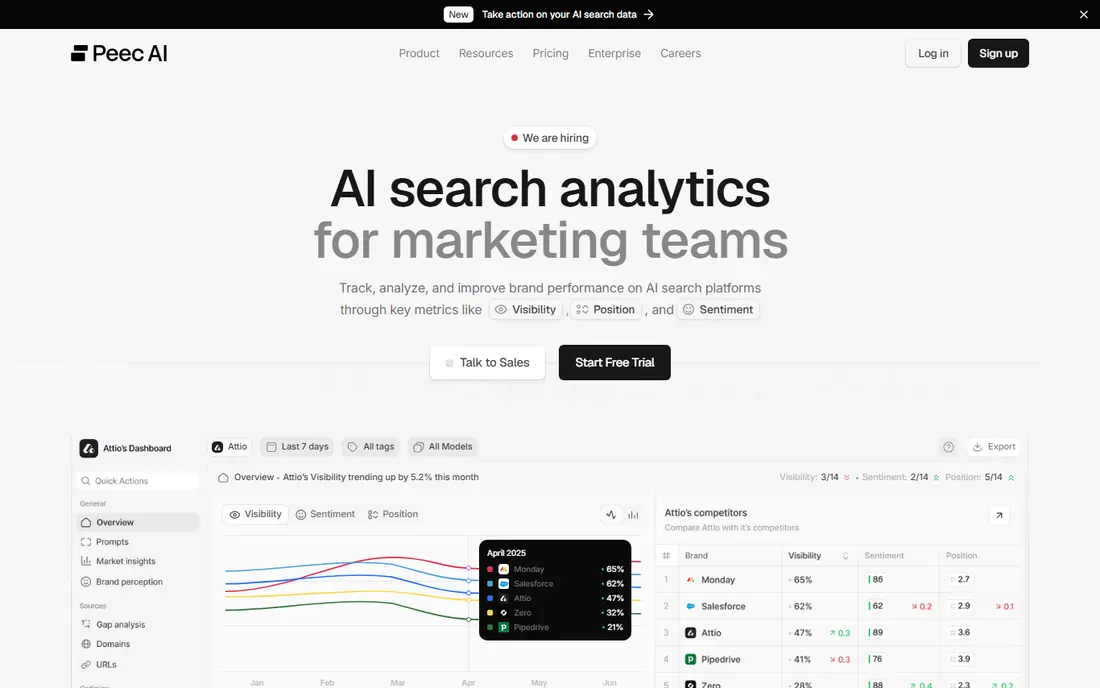
Peec AI is built around prompt-level analysis, which is the right level for most marketing teams. Instead of a single brand score, it shows how often you appear for specific questions, where you rank in the answer, how sentiment reads, and which sources the model cites. That detail turns a vague visibility problem into a concrete list of prompts to fix, and unlimited team users make it easy to share that list across content and SEO staff without paying per seat.
Pricing in recent listings starts at $95 per month for Starter, covering 50 prompts daily on three models of your choice, with higher plans for more prompts and projects. The limit to watch is engine choice. If Claude or Grok matters for your audience, check the plan that includes them before you buy, since entry coverage is narrower than the full engine list. Peec AI is a strong default for teams that want clear, daily analysis without enterprise overhead.
- Daily prompt tracking with sentiment
- Unlimited team users on listed plans
- Competitor and citation analysis
- Entry plan covers a limited set of engines
- Claude and Grok are limited to higher or enterprise plans in recent listings
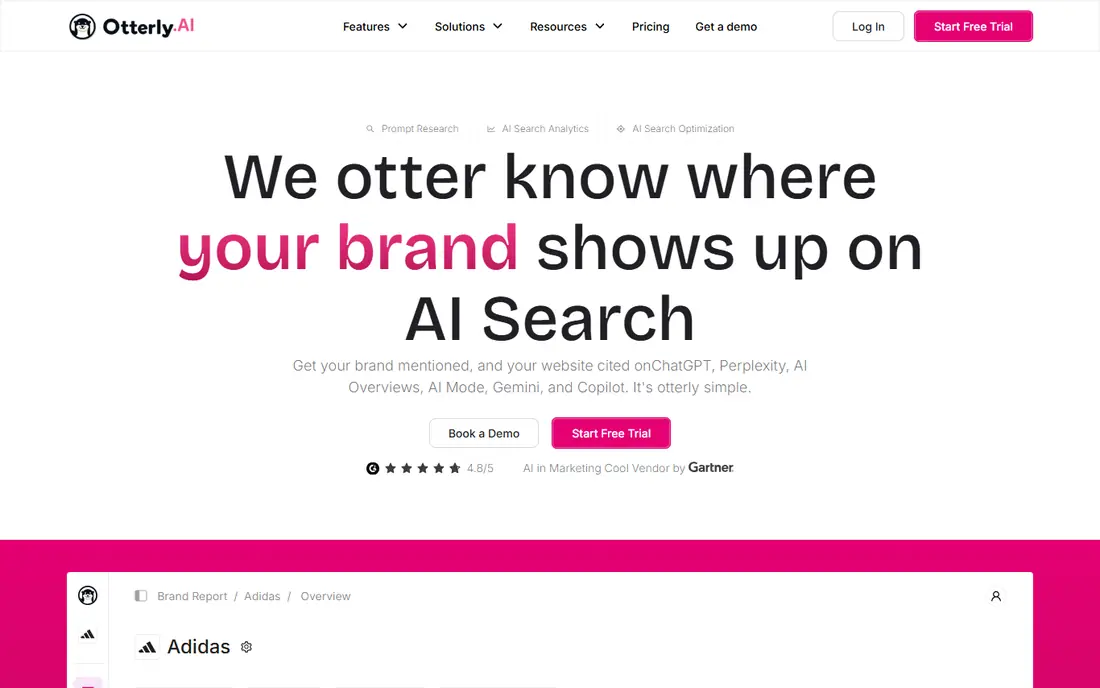
Otterly, also written as Otterly.ai, is the budget entry point for AI visibility analysis. The Lite plan starts at $29 per month in recent listings, covering 15 prompts daily across ChatGPT, Google AI Overviews, Perplexity and Copilot, with unlimited team members. That is enough to answer a basic question for a small brand: are we mentioned, where do we appear, and is that changing week by week. Recommendations and competitor views help turn those answers into next steps without a large contract.
The entry prompt limit is the main constraint. Fifteen prompts will not cover a large product catalogue or many customer questions, and adding Gemini, Google AI Mode or Claude costs extra. Otterly is best as a first tool or a check for a single brand, not as a replacement for a full enterprise tracker. Start here if budget is tight, learn which prompts matter, and upgrade only when the prompt list outgrows the plan.
- Lowest entry price on this list
- Daily tracking on four core engines
- Unlimited team members on listed plans
- Small prompt limit on entry plan
- Gemini, AI Mode and Claude are paid add-ons
Scrunch AI stands out because it analyses more than the final answer. It tracks brand visibility in AI answers and also looks at how AI crawlers and agents interact with your site, which helps technical teams find pages that are hard for AI systems to read, cite or use. That combination suits teams that suspect the problem is not just content, but also site structure, blocking rules or missing context that prevents a page from being cited well.
Core pricing in recent listings starts at $250 per month billed annually, or $300 per month billed monthly, covering 125 prompts on four engines with a 7-day trial. That price puts Scrunch above budget trackers, and some engines are held for enterprise plans, so check coverage for your audience before buying. Choose Scrunch when your team can act on technical findings, not just read a visibility score, because its extra value depends on fixing the site issues it surfaces.
- AI crawler and bot traffic analysis
- Site audits for AI readiness
- Sentiment and competitor analysis
- Higher entry price
- Some engines are limited to enterprise plans
Semrush AI Visibility Toolkit is the natural add-on for teams already using Semrush for SEO. It tracks brand visibility in AI answers for a domain, shows prompt-level results, and pairs that with an AI site audit that flags readiness issues on your pages. For a team that already lives in Semrush dashboards, keeping AI visibility in the same place avoids a second login, a second report format and a second vendor to manage.
Pricing in recent listings is $99 per month per domain billed annually for the standalone toolkit, with 25 tracked prompts, while bundled Semrush One plans include more prompts at higher prices. That per-domain pricing adds up quickly for agencies or multi-brand teams, and 25 prompts will not cover a broad catalogue. Buy the toolkit when Semrush is already your SEO home and one or two domains matter most. Otherwise, a dedicated tracker may give more prompts for the same money.
- Builds on full Semrush SEO data
- Tracks prompts across major AI engines
- AI site audit for readiness
- Priced per domain
- Prompt limit is modest on entry plan
Ahrefs Brand Radar takes a different angle from most trackers. Alongside tracked prompts for your own brand, it offers a large index of pre-collected AI prompts, so you can research how any brand appears in AI answers without building a prompt list from scratch. That research depth suits SEO and brand teams that need market-wide benchmarking, competitor share of voice and citation patterns, not just a dashboard for their own prompts.
Pricing is the main barrier. Recent listings show AI index access from $199 per month for one platform, with custom prompt packages from $50 per month on top of an Ahrefs plan, and higher prices for all models. That structure is powerful but easy to misread, so confirm exactly what is included in your Ahrefs plan before you budget. Choose Brand Radar when you already pay for Ahrefs and need broad AI brand research, not just a simple tracker for one site.
- Large prompt index for brand research
- AI share of voice and competitor benchmarking
- Builds on Ahrefs SEO data
- Full AI index pricing is high
- Custom prompt pricing adds complexity
Brand24 started as a media monitoring and social listening tool, and its AI visibility features now sit alongside that broader monitoring. That combination suits brand and PR teams that need one view of social mentions, news coverage, web mentions and AI answers, rather than a separate tool for each channel. Sentiment analysis, alerts and mention tracking help teams spot a reputation shift early, if it starts on social media or in an AI answer.
The trade-off is focus. Brand24 is not a pure AI visibility tracker, and AI features may carry an add-on cost on top of the base plan, which starts at $99 per month in recent listings, with a 14-day trial available. Pure AI trackers may offer deeper prompt analysis for the same spend. Choose Brand24 when social and news listening already matter to your team and AI visibility is part of a wider reputation job, not the only job.
- Combines social, news and web mentions with AI visibility
- Sentiment and mention alerts
- Useful for reputation work
- AI visibility is an add-on to a listening platform
- Entry pricing plus add-on cost needs checking
AthenaHQ uses a credit model that suits teams that want to test before they pay. One credit equals one AI response, so the cost depends on how many prompts you track, across how many models, and how often you run them. The free Essential tier includes 300 credits, while Starter is listed at $295 per month for 3,600 credits a month across 11 models in recent listings, with content recommendations and competitor insights included on paid plans.
That flexibility is also the risk. A team tracking many prompts across many models can burn credits faster than expected, so you should model your planned prompt count and run frequency before choosing a plan. AthenaHQ is a good fit for teams that want broad model coverage and a real free test, provided they do the credit maths first. For a fixed, predictable prompt list, a flat prompt plan from another vendor may be easier to budget.
- Free tier for testing
- Broad model coverage on paid plans
- Competitor and content recommendations
- Credit model can be hard to forecast
- Paid jump from free tier is large
How we picked these
We compared vendor pricing pages and independent October 2026 comparisons of AI visibility tools, and we favoured tools with clear AI answer tracking, prompt-level results and citation or sentiment analysis. We included enterprise, mid-market and budget tools, plus SEO suites that now offer AI visibility, so readers can compare a dedicated tracker with an add-on to a tool they already pay for. Prices change often in this category, so treat every figure here as a starting point to confirm on the vendor site, and judge tools by the engines and prompts on the plan you would actually buy.
How to analyse AI visibility without fooling yourself
A single score can hide more than it reveals. Good analysis separates mentions, position, citations and sentiment, and it tracks the same prompts over time so a change means something. Set up that discipline before you compare vendors, or every tool will look equally good in a demo.
Choose prompts from real customer questions
Build your prompt list from support questions, sales calls, search queries and product comparisons, not from brand slogans. Include generic category questions where your brand is not named, since those are the answers where rivals often win. A tracker that only watches prompts containing your brand name will miss the most important visibility gap.
Compare engines, citations and competitors together
Check the same prompt across ChatGPT, Perplexity, Google AI Overviews and other engines your audience uses, and note which sources each engine cites. If rivals are cited and you are not, the fix is usually content, structure or authority on the cited pages, not a higher score in the tracker. Track competitors on the same prompts so a rise or fall has context.
Turn findings into content and site fixes
Use the analysis to list prompts you lose, pages that are rarely cited, and claims that are described wrongly. Then fix the source page, add clear facts and comparisons, and check the same prompt again after a reasonable interval. AI answers change with model updates and retrieved sources, so allow time for a fix to show up rather than judging it after one day.
FAQ
What is the best ai visibility analysis software for a small business?
Otterly is a strong small business starting point because its Lite plan is low cost and covers four core engines with daily tracking. Peec AI is the next step up when you need more prompts, sentiment analysis and unlimited team users. A small business should start with 15 to 50 real customer prompts, learn which ones matter, and only move to a higher plan when the prompt list or engine coverage clearly limits the analysis.
What are the best ai visibility analysis tools for agencies?
Peec AI, Profound agency plans and AthenaHQ suit agencies for different reasons. Peec AI offers multi-project tracking with unlimited users, Profound agency plans offer client workspaces, and AthenaHQ offers broad model coverage on a credit model. Agencies should compare per-client cost, workspace limits and reporting options, since a tool that looks cheap for one brand can become expensive across ten clients.
What is the best ai visibility analysis tool for enterprise brands?
Profound is the most common enterprise pick because it offers broad engine coverage, citation analysis, competitor benchmarking and formal controls on enterprise plans. Scrunch is a strong enterprise alternative when technical site analysis matters, and AthenaHQ suits enterprises that want broad model coverage on credits. Enterprise buyers should run a trial with real prompts, confirm security requirements, and get a quote tied to prompt volume and engine list.
How is AI visibility analysis different from classic SEO tracking?
Classic SEO tracking measures rankings and clicks in search results, while AI visibility analysis measures mentions, position, citations and sentiment inside AI-generated answers. A page can rank well in search and still be ignored by an AI answer, or cited badly, so the two views complement each other rather than replace each other. Teams that already track SEO should add AI prompt tracking for their most valuable questions, not abandon search tracking.
Can AI visibility tools improve my ranking in AI answers?
Tools can analyse visibility and suggest fixes, but they cannot force an AI model to cite you. Improvement comes from clearer pages, stronger facts, better structure, credible external mentions and content that directly answers the tracked prompts. Use the tool to find lost prompts and weak citations, fix the underlying pages, and then track the same prompts over time to see if the change holds.