Best AI Tools for SEO Optimization in 2026: 8 Tools Compared
Find the best AI tools for SEO optimization in 2026, including Surfer, Clearscope, Frase, and Semrush, with pricing and clear buying advice for content teams.

- Editor's choice
 Surfer
Live content scoring for writers
Starts at$49 per monthVisit surferseo.comFull review - Great alternative
 Clearscope
Shared editorial teams
Starts at$129 per monthVisit clearscope.ioFull review - Also consider
 Frase
Research to publishing in one tool
Starts at$39 per monthVisit frase.ioFull review
TL;DR:
- Surfer gives the best balance of live scoring and price for most teams.
- Clearscope suits shared editorial teams that value a clean editor and consistent briefs.
- Frase and NeuronWriter cover research to draft at lower prices.
- A high score does not prove a page is accurate, so fact-checking still matters.
Quick comparison
| Tool | Best for | Starts at | Free plan? | |
|---|---|---|---|---|
| Surfer | Live content scoring for writers | $49 per month | Free trial | Visit |
| Clearscope | Shared editorial teams | $129 per month | Free trial | Visit |
| Frase | Research to publishing in one tool | $39 per month | Free trial | Visit |
 Semrush | All-in-one SEO plus AI visibility | $139 per month | Free trial | Visit |
 NeuronWriter | Budget NLP optimization | $19 per month | Free trial | Visit |
 MarketMuse | Site-wide content planning | See website | Yes | Visit |
 Scalenut | Small teams drafting at scale | See website | Free trial | Visit |
 RankIQ | Bloggers chasing low-competition keywords | $49 per month | No | Visit |
The best AI tools for SEO optimization
We compared tools that score drafts, build briefs, and track how pages perform in search and in AI answers. Our pick for most content teams is Surfer, because it gives live scoring inside the editor at a workable price. Clearscope is the calmer, stricter choice for teams that share one editorial standard.

Surfer scores a draft as you write, comparing it with pages that already rank for the same query. That live feedback helps writers spot missing terms, thin sections, and weak structure before they publish. It also builds briefs from the live search results, so a brief reflects what readers actually see, not a stale template.
The catch is how credits work. Lower plans use annual document limits, so a busy month can eat into the yearly allowance faster than expected. Teams that publish often should map their yearly output to the plan, not just the monthly price. For steady, moderate output, it remains a strong default.
- Live editor scoring
- SERP-based briefs
- Google Search Console links
- Annual credits reset yearly, not monthly
- Costs rise with volume
Clearscope keeps the editor simple. Writers see relevant terms, headings, and readability guidance without a wall of extra panels. Because listed plans allow unlimited users, a small editorial team can share one subscription without paying per seat, which helps when editors, freelancers, and reviewers all touch drafts.
The limit to watch is drafts and pages, not seats. A team that publishes a lot can hit those caps even though users are unlimited. Solo writers may also find the entry price steep. It fits best when several people must follow one clear standard for every article.
- Clean editor
- Clear term guidance
- Unlimited users on listed plans
- Draft limits still apply
- Entry price is high for solo writers
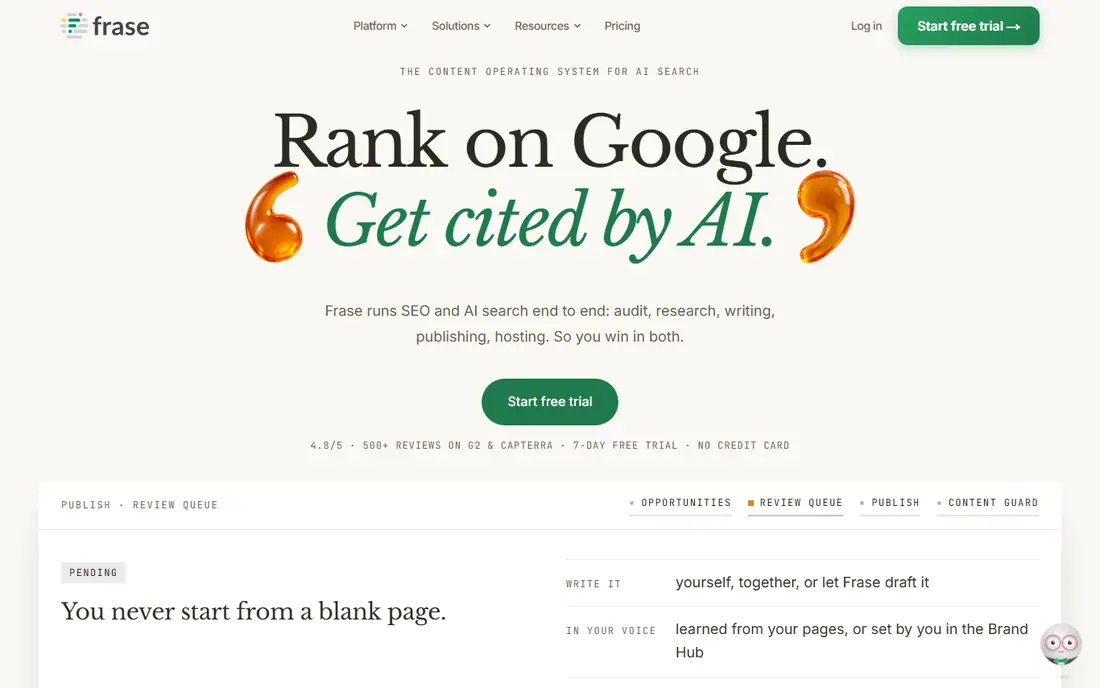
Frase starts with research. It pulls questions, headings, and themes from top pages, then turns that material into a brief and a draft workspace. That flow suits small teams that want one tool for planning, writing, and checking, rather than three separate subscriptions. Its audit view also flags pages that may need updates.
The entry plan is capped at a modest number of articles per month and one seat, so growing teams will need a higher tier. There is a trial, but no standing free plan. If your bottleneck is research and briefs, Frase is a strong value. If you mainly need scoring, compare it with Surfer first.
- Fast SERP research
- Question extraction
- Draft and audit tools
- No standing free plan
- Entry plan caps articles and seats
Semrush is the widest tool here. It covers keyword research, site audits, backlinks, and rank tracking, and its newer plans add tracking for AI search visibility. That breadth helps when one subscription must serve SEO, content, and reporting, and when you want content scores tied to the same keyword data as your audits.
The catch is scope. If you only need to score drafts, a focused tool costs less and feels simpler. Semrush earns its price when your team actually uses research, audits, and tracking each week. Small teams should list which modules they will use before they pay for the full suite.
- Keyword and audit tools
- AI visibility tracking
- Content toolkit
- Broad suite can be costly if you only need content scoring
NeuronWriter is the budget pick that still does the core job well. It analyzes top pages, suggests terms and structure, and scores drafts against that analysis. For solo writers and small blogs, its low entry price makes it easy to keep scoring in the workflow instead of treating it as a luxury.
The trade-off is polish. The interface is plainer than Surfer or Clearscope, and its guidance needs a careful human read. It also helps to already know your target query well, since the tool refines a draft rather than choosing your strategy. For price-first buyers, it is hard to beat.
- Low entry price
- NLP term coverage
- WordPress and Search Console links
- Interface is plainer than leaders
- Smaller brand support network
MarketMuse thinks at the site level. It looks at which topics you already cover, where gaps sit, and which clusters would build authority over time. That view helps larger sites plan months of content, rather than optimizing one page in isolation. A limited free plan lets you test its basic queries before a sales talk.
The catch is buying. Paid tiers are quoted, so small teams cannot compare a simple monthly price. It also overlaps less with day-to-day draft scoring than Surfer or Clearscope. Pick it when planning and prioritization are the real problem, not just polishing a single draft.
- Topic authority planning
- Content inventory views
- Free starter queries
- Paid tiers are quoted
- Less suited to single-page scoring alone
Scalenut combines planning, drafting, and optimization in one flow. Its cruise mode can produce a structured draft from a brief, and its cluster tools help teams map related topics around a core page. For small teams that publish often, having research and drafting in one place saves switching time.
The honest catch is pricing clarity. Published entry prices have varied across reviews, so we list See website rather than a figure we could not confirm on the vendor page at writing time. Test the draft quality on your own topics, since AI drafts still need editing, sourcing, and fact checks.
- Cruise mode drafting
- Topic clusters
- SERP analysis
- Pricing and plan details change often, so confirm before buying
RankIQ is built for bloggers. It finds lower-competition keywords that a newer site can realistically rank for, then grades drafts against those terms. That focus helps when you are choosing what to write next, not just how to polish a page you already planned. Its reports are plain and easy to act on.
The limit is scope. Larger sites with technical SEO, local, or enterprise needs will want a broader suite. There is also no free plan, so use the refund or trial terms carefully and test it on real posts. For independent bloggers, its keyword-first approach is a clear strength.
- Low-competition keyword finder
- Content grading
- Blog-focused reports
- Narrower for large or enterprise sites
- No free plan
How we picked these
We compared official pricing pages, product documentation, and public reviews, and we focused on tools that score or plan content with current search data. We favored tools that are actively sold in October 2026 and that explain draft, page, or query limits in plain terms. We did not claim hands-on testing. Where pricing was unclear or varied across sources, we wrote See website instead of publishing a figure we could not confirm.
Match the tool to your bottleneck, not to the longest feature list
Start by naming the job that slows you down. If drafts miss terms and structure, a scoring editor such as Surfer or Clearscope helps most. If you struggle to choose topics, a planning tool such as MarketMuse or RankIQ helps more. If research takes too long, Frase or Scalenut may save the most time. Next, count your monthly output. Draft caps, page caps, and annual credits matter more than the headline price, so map a typical month to the plan before you buy. Check integrations too, especially Google Search Console, WordPress, and Google Docs, since copying scores by hand wastes the time you just saved. Finally, treat AI text as a draft. Check facts, add original reporting or experience, and cite sources where claims matter. A tool can improve coverage, but it cannot replace judgment about what is true or useful.
FAQ
What is the best AI tool for SEO optimization?
Surfer is our default pick for most content teams because it scores drafts live at a workable price. Clearscope suits teams that need a stricter shared standard, while Frase suits teams that want research and drafting in one tool.
Can AI SEO tools replace keyword research?
No. They refine and score work around a query, but they do not replace judgment about search intent, audience, and competition. Use them with Search Console data and a clear sense of what your readers need.
Do AI SEO tools write the whole article for me?
Some can draft, but drafts still need editing, fact-checking, and original value. Publishing raw AI text risks errors and thin content, and it rarely reflects your experience or reporting.
Is there a free AI SEO optimization tool?
MarketMuse offers a limited free plan with a small monthly query allowance. Most scoring tools use trials rather than free plans, so test them on real drafts during the trial period.
How do I know if an SEO tool is working?
Track rankings, clicks, and impressions in Search Console for pages you optimized, and compare them with similar pages you did not change. Give changes several weeks, since search results move slowly.