Best AI Storyboard Generators Software in 2026: 9 Tools Compared
We compare the best ai storyboard generators software, from Boords and StoryboardHero to LTX Studio, with pricing, character consistency, and export notes.
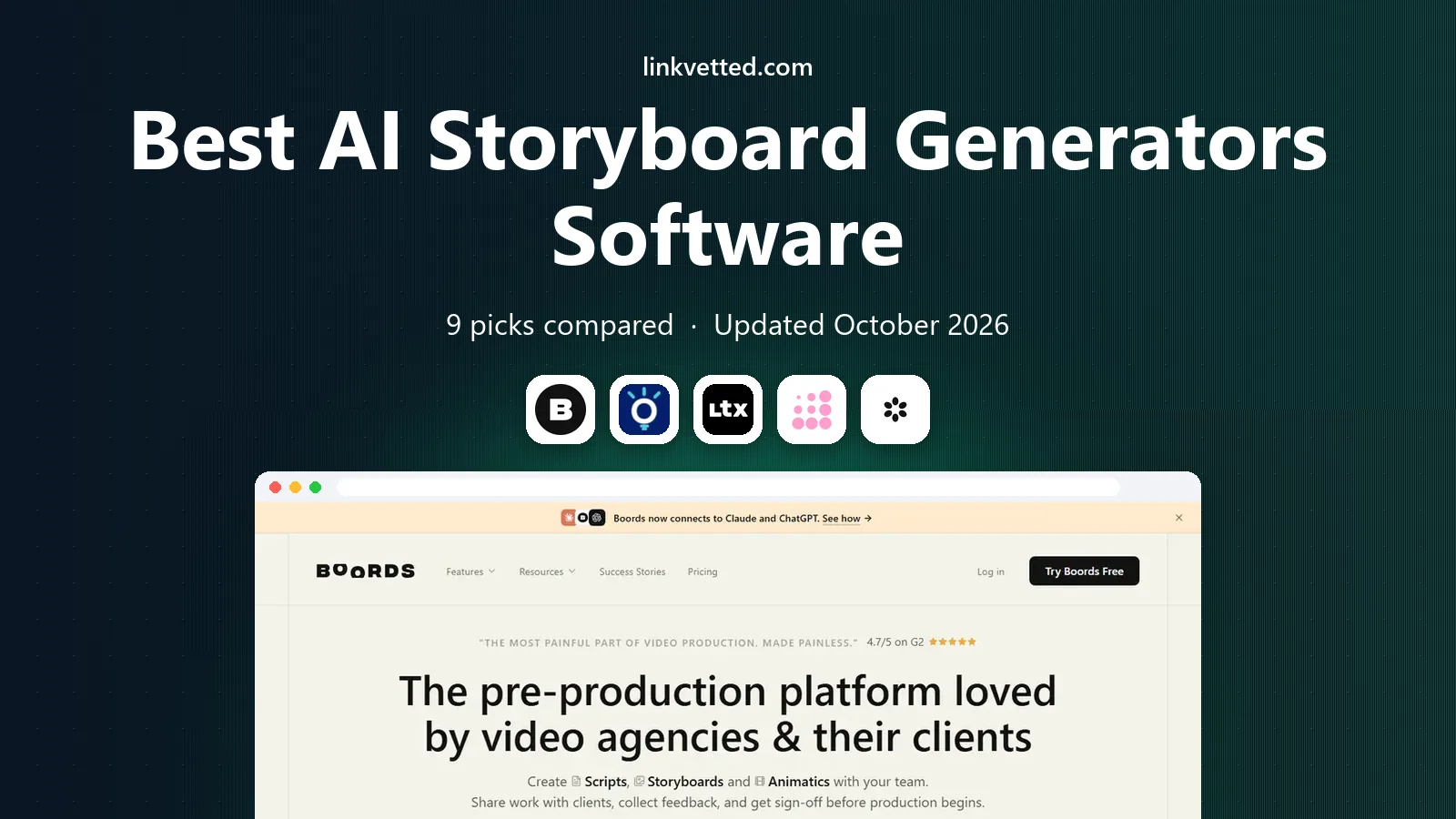
- Editor's choice
 Boords
Complete storyboard platform
Starts at$26 per monthVisit boords.comFull review - Great alternative
 StoryboardHero
Agency client boards
Starts at$19 per monthVisit storyboardhero.aiFull review - Also consider
 LTX Studio
Script to storyboard to video
Starts at$12 per monthVisit ltx.studioFull review
TL;DR:
- Boords is the most complete storyboard platform here, with AI frames, animatics, and client approvals in one place.
- StoryboardHero and Katalist suit agencies and indie creators that want script-to-frames speed without a steep learning curve.
- LTX Studio goes furthest toward video, linking storyboards to scenes and character consistency for filmmakers.
- Character consistency is the hardest part of AI frames, so test it on your own cast before paying for a large project.
Quick comparison
| Tool | Best for | Starts at | Free plan? | |
|---|---|---|---|---|
| Boords | Complete storyboard platform | $26 per month | Yes | Visit |
| StoryboardHero | Agency client boards | $19 per month | Free trial | Visit |
| LTX Studio | Script to storyboard to video | $12 per month | Yes | Visit |
 Katalist | Indie script to storyboard | $19 per month | Free trial | Visit |
 Storyflow | Assistant-built boards | $7.99 per month | No | Visit |
 Drawstory | Script breakdown storyboards | $32 per month | Yes | Visit |
 Storyboard That | Education and beginners | See website | Yes | Visit |
 Krock | Team review workflows | $10 per user per month | Yes | Visit |
 StudioBinder | Full production planning | $49 per month | Yes | Visit |
The best AI storyboard generators software
AI storyboard tools turn a script or brief into framed shots with captions, shot lists, and sometimes animatics, so directors, agencies, and creators can agree on a shoot before cameras roll. The best tool depends on whether the board itself is the deliverable, or just a step toward a finished video. The nine tools below cover both cases.
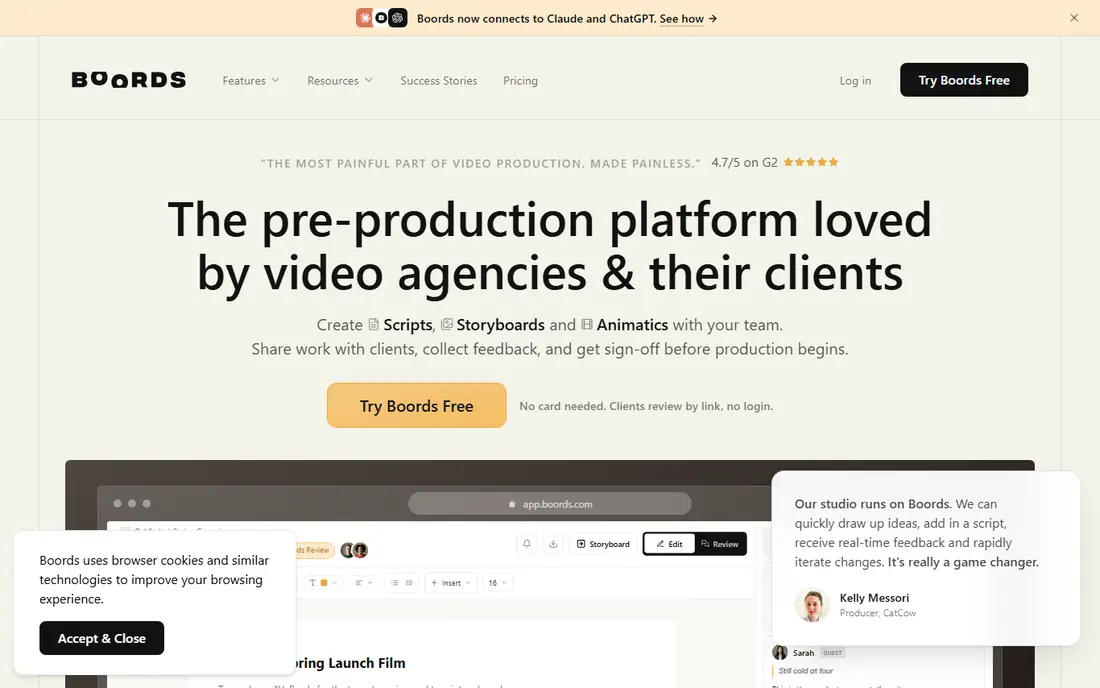
Boords is the most rounded storyboard platform in this list. You can build frames by hand or with AI images, set a cast for character consistency, assemble animatics with timing and sound, and send boards to clients for tracked approvals. Exports cover PDF, images, video, and document formats, which makes the board usable in pitches, shoots, and post-production. Solo starts at $26 per month billed annually, with a free plan for small trials.
The limit is AI volume. Lower tiers include a set number of AI credits, so a long commercial board can burn through them fast. Boords suits agencies, production teams, and freelancers whose storyboard is a client deliverable, not a rough sketch. If you only need a few frames, a cheaper tool may do.
- AI image generation
- Animatics
- Client approvals and version tracking
- AI credits are limited on lower tiers
- Price rises with team size
StoryboardHero is built for agencies that need branded storyboards for clients quickly. You start from a brief, shape a script, and generate frames with shot notes, then export a polished PDF that looks client-ready. Solo starts at $19 per month with a trial, which makes it one of the cheaper agency-focused options here.
There is no permanent free plan, so budget from day one, and team collaboration is simpler than in Boords or StudioBinder. StoryboardHero fits marketing teams and small agencies that produce ad boards regularly and want speed over deep production planning. For film pre-production with shot lists and schedules, pair it with a production tool.
- Brief to script to board workflow
- Branded PDF exports
- Fast agency turnaround
- No free plan
- Client access model varies by tier
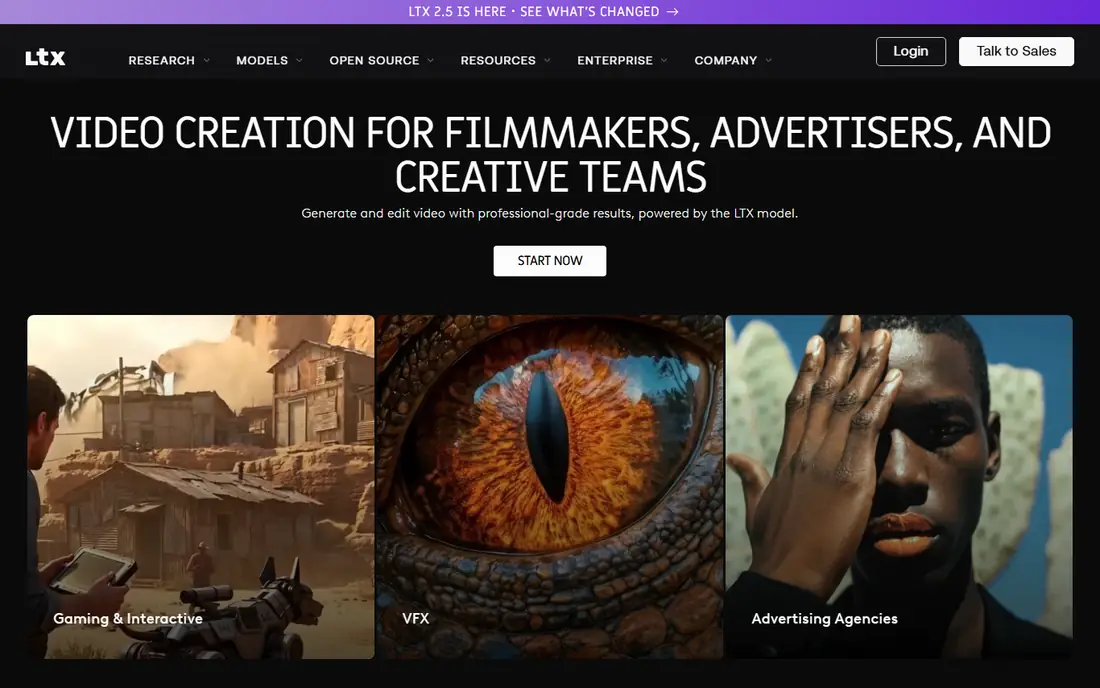
LTX Studio, from Lightricks, links storyboarding to video creation. You break a script into scenes, cast characters, control camera angles, and generate frames, then move toward motion and video from the same project. Paid plans start around $12 per month, with a free tier for trying the workflow. That path suits filmmakers and creators who want boards that feed directly into production.
The breadth can be a drawback when you only need a static board. Video generation settings add complexity, and larger projects need higher tiers. LTX Studio is our pick when the storyboard is step one toward a video, not the final deliverable on its own.
- Script to scenes workflow
- Character consistency tools
- Video generation path
- Video features can distract from simple boards
- Paid tiers needed for scale
Katalist turns a script into a storyboard with characters cast from references, scenes, and shot suggestions, at $19 per month with a trial. Its workflow suits indie filmmakers, YouTubers, and small studios that want to visualize a story without hiring an artist or learning a complex platform. The interface keeps choices focused on story, not production administration.
Its library and collaboration tools are lighter than Boords, and agency teams may miss approval tracking. Katalist fits solo creators and small teams best, especially for narrative work where character consistency across scenes matters. Test its character casting on your own cast before a long project.
- Script to storyboard generation
- Character casting
- Simple indie pricing
- Smaller template range than Boords
- Collaboration is lighter
Storyflow takes a different route: its connector lets ChatGPT, Claude, and other assistants build and read storyboards directly, so you can draft a script in chat and ask for a board on the same project. Pro at $14 per month billed annually adds AI image generation, while Plus at $7.99 per month covers structure and your own frames. Named character references help keep faces consistent across frames.
There is no free plan during early access, though invited collaborators join free, which may change. Storyflow suits creators who already plan in an AI assistant and want the board to appear without manual panel building. If you prefer to work inside one app, Boords or Katalist may feel more direct.
- Builds boards from scripts via chat assistants
- Named character references
- Shot lists included
- No free plan today
- AI frames need the Pro tier
Drawstory focuses on turning scripts into production-ready boards with cinematic framing, character consistency, and editable scenes. Plans start around $32 per month for a set image quota, rising with volume, which suits animators, YouTubers, and storytellers with regular output. Costume and angle controls give creators more say over each frame than a one-click generator.
Image quotas are the catch: long boards consume credits fast, so check the quota against your typical board length. Drawstory fits creators who board often and care about framing and character detail. Occasional users may get better value from a cheaper monthly tool or a free tier elsewhere.
- Script breakdown and framing controls
- Character and costume options
- Editable scenes
- Higher starting price than rivals
- Image quotas matter on long boards
Storyboard That is the beginner and classroom pick, not a pure AI generator, but it belongs here because many first-time board makers start with it. Drag-and-drop characters, scenes, and props let students and small teams build a board without drawing or prompting, and templates cover common story types. A free tier allows a few boards per week, with paid plans for private, unwatermarked work.
Its AI generation is far thinner than Boords or Katalist, and free boards carry limits and watermarks. Storyboard That suits teachers, students, and teams that need a quick visual plan, not a polished AI-generated ad board. Use it to learn boarding, then move to an AI tool for client work.
- Drag-and-drop scenes
- Huge art library
- Classroom-friendly
- Not a true AI generator
- Free boards are limited and watermarked
Krock is a review and workflow platform for storyboards, rather than a frame generator itself. Teams upload frames, leave time-coded or frame-specific comments, track approvals, and manage versions in one place. Pro starts at $10 per user per month, with a free tier for a single user, which makes it affordable for small production teams.
If you need AI frames, you will generate them elsewhere and bring them into Krock, which adds a step. Krock earns its place for teams where review chaos, not frame creation, is the bottleneck, especially agencies and studios with several reviewers. Pair it with Boords, Katalist, or LTX Studio for a full pipeline.
- Frame-by-frame feedback
- Approvals
- Cloud collaboration
- AI generation is not its core strength
- Needs another tool for frames
StudioBinder wraps storyboards into a full production platform with shot lists, shooting schedules, call sheets, and breakdowns. Indie plans start at $49 per month for two users, with a free starting tier, which makes sense when the board must feed a real shoot plan. Teams that already plan productions in StudioBinder gain the most, since boards, schedules, and contacts stay linked.
For a standalone board, StudioBinder is heavier and pricier than a dedicated storyboard tool. Its AI features are one part of a larger suite, not the headline. Choose it when production management matters as much as the board itself, and use a dedicated generator when you only need frames.
- Storyboards plus shot lists, schedules, and call sheets
- Strong production suite
- Higher price
- Storyboard AI is part of a larger system, not the focus
How we picked these
We compared official feature pages, pricing pages, and documentation for each tool, plus public reviews, and kept only products that exist and work today for AI-assisted or team storyboarding. We favored tools with clear export options and character consistency features, since those decide whether a board is usable on set. We did not claim hands-on testing. Prices should be rechecked on vendor sites, since AI credit models change often.
What to check before you pay
Start with the deliverable. If clients must approve a branded PDF, prioritize Boords or StoryboardHero. If the board feeds a shoot, prioritize StudioBinder or LTX Studio for shot lists and schedules. If you only need to visualize a story for yourself, a cheaper tool or free tier may be enough.
Next, test character consistency on your own cast, not on sample art. Generate the same character in five different shots and check whether face, clothing, and age stay stable. Check AI credit limits against your board length, since quotas decide real cost. Finally, confirm exports: PDF for clients, images for pitches, and video or animatic files for presentations, plus whether captions and shot notes carry over.
FAQ
What is an AI storyboard generator?
It is software that turns a script, brief, or text prompt into framed storyboard panels with images, captions, and shot notes. Some tools generate images with AI, while others use libraries or your own uploads. The output helps directors, clients, and crews agree on shots before filming.
Can AI keep the same character looking the same across frames?
Partly. Tools with character casting or named references do better than generic prompts, but consistency is still imperfect, especially for faces and clothing. Test your own cast across several frames before committing to a long board, and plan to fix key frames by hand.
Do I still need a human storyboard artist?
Often yes for final client or film work, especially for expressive or complex scenes. AI boards excel at speed, drafts, and pitches, while human artists handle nuance, emotion, and precise staging. Many teams use AI for the first pass and an artist for final frames.
Which tool is best for advertising storyboards?
Boords and StoryboardHero lead for agency work, thanks to branded exports, client approvals, and fast script-to-board workflows. Boords adds animatics and deeper collaboration, while StoryboardHero is cheaper and faster for simple ad boards. Choose based on whether approval tracking matters.
How much do AI storyboard tools cost?
Free tiers cover small trials, while paid plans in this list run from about $8 to $49 per month for solo or small-team use, plus AI credit limits on some tiers. Enterprise and large-team pricing is usually quoted. Always check credit quotas, since a long board can cost more than the monthly fee suggests.