Best AI Services in the IT Consulting Field in 2026: 8 Services Compared
Compare the best ai services in the it consulting field in 2026, from strategy and build to managed AI, to find the right consulting partner for your business.
- Editor's choice
 Accenture
Enterprise AI transformation
Starts atSee websiteVisit accenture.comFull review - Great alternative
 Deloitte
Regulated and risk-aware AI
Starts atSee websiteVisit deloitte.comFull review - Also consider
 IBM Consulting
AI built on enterprise data
Starts atSee websiteVisit ibm.comFull review
TL;DR:
- Large consulting firms suit regulated and enterprise AI work, while smaller specialists suit a single, focused build.
- Ask who owns the model, the data pipeline, and the ongoing monitoring before you sign, since those details decide long-term cost.
- A pilot with a clear success measure beats a broad AI roadmap with no owner and no deadline.
- Pricing is almost always by quote, so compare scope, team seniority, and support terms rather than headline rates.
Quick comparison
| Tool | Best for | Starts at | Free plan? | |
|---|---|---|---|---|
| Accenture | Enterprise AI transformation | See website | No | Visit |
| Deloitte | Regulated and risk-aware AI | See website | No | Visit |
| IBM Consulting | AI built on enterprise data | See website | No | Visit |
 Cognizant | Applied AI and automation | See website | No | Visit |
 TCS | Large-scale AI delivery | See website | No | Visit |
 Capgemini | AI strategy plus engineering | See website | No | Visit |
 Infosys | AI-led modernisation | See website | No | Visit |
 EY | AI assurance and governance | See website | No | Visit |
The best ai services in the it consulting field
IT consulting firms now sell AI as a full service, from strategy and data readiness to model build, deployment, and ongoing monitoring. The firms below all work at enterprise scale, but they differ in focus, industry depth, and delivery style. Our pick for most large buyers is Accenture for breadth, with IBM Consulting close behind for data-heavy work.
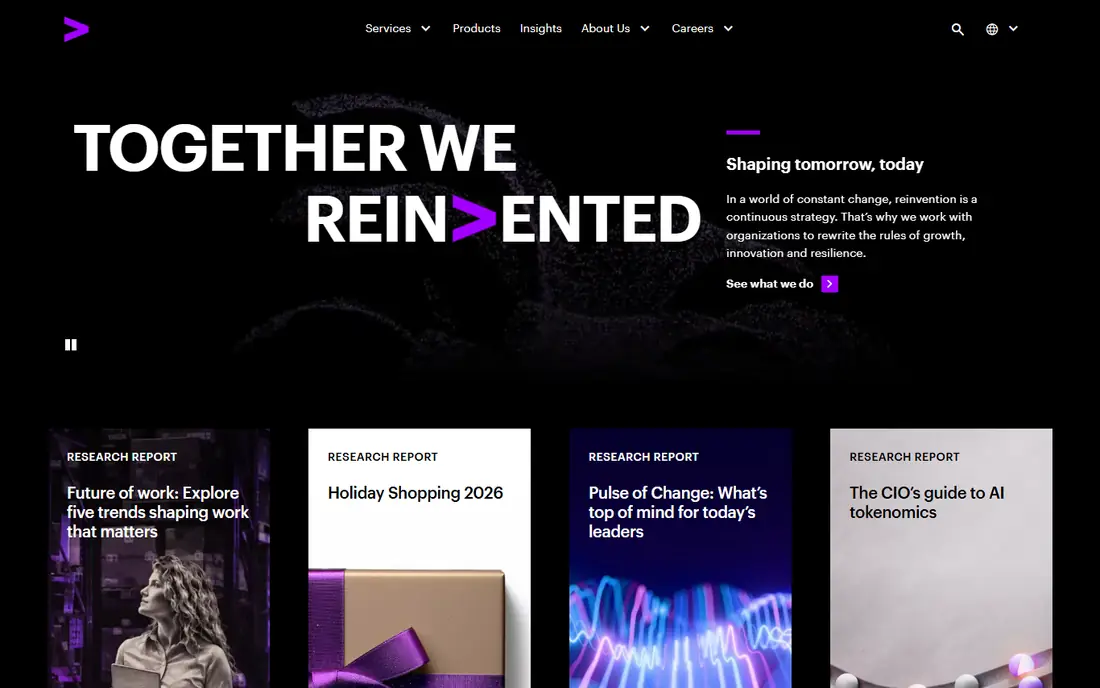
Accenture is the broadest choice on this list for a company that wants AI across many departments at once. Its work spans strategy, data platforms, custom model builds, and managed AI operations, with industry teams for sectors such as banking, health, retail, and manufacturing. That breadth helps when a project touches several systems and needs a single accountable partner.
The catch is cost and fit. Accenture pricing is by quote and sits at the premium end, and a small, single-use project may not get the same senior team as a multi-year programme. Buyers should ask for the named team, the pilot scope, and the handover plan in writing. For a large transformation, though, few firms match its delivery capacity.
- Very broad AI and industry coverage
- Large delivery teams
- Strong cloud partnerships
- Premium pricing
- Smaller projects may get less senior attention

Deloitte suits organisations where AI must pass risk, audit, and regulatory review before it goes live. Its consulting work pairs model building with controls, documentation, and governance, which matters in banking, insurance, health, and public sector work. Clients that need a defensible record of how a model was built and tested will value that approach.
The trade-off is pace. Deloitte engagements can feel process-heavy, and a team that wants a fast prototype may prefer a smaller AI studio for the first build. The firm is stronger when the AI system must be explainable, auditable, and supportable over years rather than shipped in a few weeks.
- Strong risk, audit, and compliance lens
- Deep industry practices
- Global delivery
- Engagements can be process-heavy
- Timelines may run longer than a specialist build
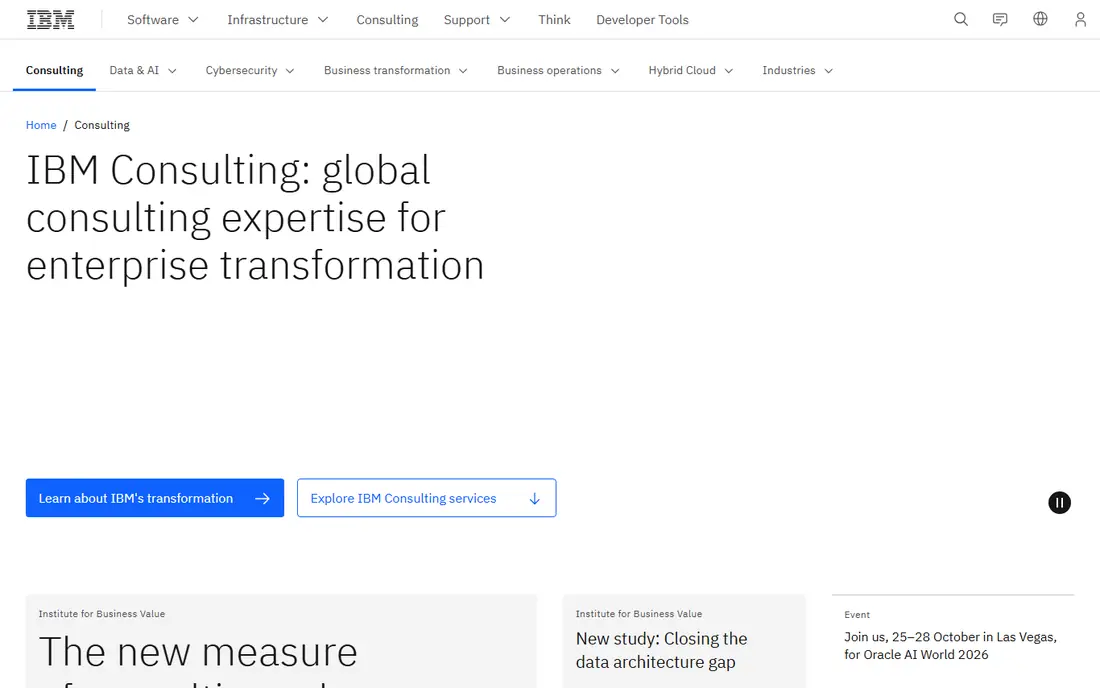
IBM Consulting fits companies that already run complex data estates and want AI grounded in their own systems rather than a generic chatbot. Its consultants work on data readiness, retrieval and governance, and deployment on hybrid cloud, with watsonx as a central platform option. That data-first stance helps when accuracy and control matter more than speed alone.
The limit is stack fit. A company with no IBM footprint can still use IBM Consulting, but the value is highest where its platforms and partnerships already fit. Smaller buyers may also find the engagement model heavy for a single use case. For a data-heavy enterprise, it is a strong, disciplined choice.
- Deep data and watsonx platform knowledge
- Strong hybrid cloud experience
- Enterprise focus
- Works best inside an IBM-leaning stack
- Less suited to a tiny, one-off project
Cognizant is a practical pick for applied AI: document processing, customer service automation, code assistance, and workflow automation that must plug into existing systems. Its delivery model suits companies that want a working system in production, not just a strategy deck. Industry coverage is broad, which helps mid-sized enterprises with varied needs.
The honest catch is consistency. With large delivery teams, the outcome depends heavily on the specific team assigned, so buyers should interview the delivery leads and check similar past work. A tightly defined scope, with clear acceptance tests, protects both sides. Priced by quote, it often sits below the most premium firms for comparable scope.
- Practical automation focus
- Broad delivery centres
- Experience across many industries
- Quality can vary by delivery team
- Scope needs tight definition
Tata Consultancy Services suits very large organisations that need AI delivered at scale and then run reliably for years. Its strengths are engineering discipline, testing, and managed operations, plus deep experience modernising legacy systems alongside new AI tools. For a global company with many locations and systems, that scale is a genuine advantage.
The downside is agility. Onboarding, governance, and contracting can take time, and a small pilot may move slower than it would with a boutique firm. TCS works best when the buyer has a multi-year view and a clear operating model. For a single, fast experiment, a smaller partner may be a better first step.
- Huge delivery scale
- Strong engineering discipline
- Long-term managed services
- Onboarding can be slow
- Smaller scopes may feel bureaucratic
Capgemini pairs AI strategy with engineering delivery, which helps companies that need both a plan and a working product. Its teams cover data platforms, generative AI applications, and automation, with partnerships across major cloud providers. European buyers in particular will find deep local delivery capacity.
The catch is variation. Industry depth and team seniority can differ by country and practice, so a buyer should check the local team rather than the global brand alone. Pricing is by quote and depends on scope, so comparable proposals need the same brief. With the right team, Capgemini is a balanced, capable partner.
- Balanced strategy and build capability
- Strong European and global presence
- Cloud partnerships
- Pricing by quote can vary widely
- Industry depth varies by region
Infosys fits companies modernising older systems while adding AI, rather than building AI in isolation. Its work often combines application modernisation, data platforms, and AI assistants for employees and customers. Accelerators and pre-built components can shorten delivery when the use case is common, such as document handling or service desk automation.
The limit is the same as for other large firms: process and team variation. A buyer should ask which accelerators are actually included, what is custom work, and who will support the system after launch. For a modernisation programme with AI as one part, Infosys is a credible, large-scale option.
- Strong modernisation and automation track record
- AI platforms and accelerators
- Global scale
- Large-firm processes can slow small projects
- Outcomes depend on the assigned team
EY is the pick when governance, trust, and assurance matter as much as the model itself. Its AI work covers strategy, risk, controls, and assurance, helping boards and regulators understand how an AI system was built, tested, and monitored. That lens is valuable for financial services, health, and other regulated sectors.
The trade-off is build depth. EY can partner on delivery, but a buyer that wants a product team to build and run a custom AI system for years may prefer Accenture, IBM Consulting, or TCS as the lead builder. Used for governance alongside a builder, EY adds a layer of discipline that many enterprises now require.
- Strong governance, risk, and assurance focus
- Global professional services reach
- Sector expertise
- Less suited as a sole product builder
- Engagements lean toward advisory and assurance
How we picked these
We compared firms that offer AI consulting as a named, ongoing service in the United States, with public service pages, case work, and enterprise delivery capacity. We favoured firms with data, governance, and managed AI capabilities, not just strategy decks. Pricing is by quote across this category, so we did not rank on price alone.
How to buy AI consulting without overpaying
Start with one use case, one owner, and one measure of success, such as hours saved, cases handled, or error rate reduced. A pilot that runs on real data, with a clear go or no-go decision, tells you more than a long roadmap. Ask every bidder to price the same pilot scope, so proposals can be compared fairly.
Check data, ownership, and support
Confirm who owns the prompts, pipelines, and model outputs, and what happens to your data during and after the engagement. Ask how the system will be monitored for drift, bias, and errors, and who fixes it when it fails. A build without a support plan becomes a liability within months.
Ask about team and handover
Request the names and experience of the delivery leads, not just the sales team. Ask what documentation, training, and handover your internal team will receive. The best engagement leaves your staff able to run, change, and question the system after the consultants leave.
FAQ
What do AI consulting services actually deliver?
They typically deliver strategy, data readiness work, a built AI application or automation, and a plan for monitoring and support. Some firms also provide managed AI operations, where they run the system for you. Clarify deliverables in the contract, since the term AI consulting covers very different scopes.
How much does AI consulting cost?
Most enterprise AI consulting is priced by quote, based on scope, data complexity, team seniority, and duration. A small pilot may cost far less than a multi-year transformation programme. Ask for a fixed pilot price and a separate estimate for scale-up, so you can decide with real numbers.
Should a small business hire a large AI consulting firm?
Usually not for a first project, since large firms are priced and structured for enterprise work. A small business often does better with a specialist studio or a managed AI tool for a single use case. Large firms become useful when the work is regulated, multi-system, or needs long-term managed support.
How long does an AI consulting pilot take?
A focused pilot often takes four to twelve weeks, depending on data access and approval steps. Data cleaning, security review, and integration usually take longer than model building itself. Build those steps into the timeline from the start.
What is the biggest risk in AI consulting projects?
The biggest risk is building a system nobody owns after launch, with unclear data rights and no monitoring plan. Scope creep is a close second. A written owner, a success measure, and a support term in the contract reduce both risks.
Sources
- https://www.accenture.com/us-en/services/applied-intelligence
- https://www.deloitte.com/us/en/services/consulting/services/artificial-intelligence.html
- https://www.ibm.com/consulting/artificial-intelligence
- https://www.cognizant.com/us/en/services/ai-services
- https://www.tcs.com/what-we-do/services/artificial-intelligence
- https://www.capgemini.com/services/artificial-intelligence/
- https://www.infosys.com/services/artificial-intelligence.html
- https://www.ey.com/en_us/ai