Best AI Security Platforms in 2026: 8 Platforms Compared
Compare the best AI security platforms in 2026, with AI posture, threat detection, endpoint protection and pricing for leading security vendors today.
- Editor's choice
 Wiz
Cloud and AI posture
Starts atSee websiteVisit wiz.ioFull review - Great alternative
 CrowdStrike Falcon
Endpoint and AI security
Starts atSee websiteVisit crowdstrike.comFull review - Also consider
 SentinelOne
Autonomous endpoint response
Starts atSee websiteVisit sentinelone.comFull review
TL;DR:
- Wiz leads for cloud and AI posture, showing which AI risks are actually exploitable in your cloud.
- CrowdStrike and SentinelOne suit teams that need AI-assisted endpoint protection with fast response.
- Darktrace and Vectra AI lead for network anomaly detection, using behaviour models rather than signatures alone.
- Microsoft Defender suits Microsoft-centred estates, with AI tools bundled into wider security plans.
- No single platform covers every AI risk, so map your AI assets first, then pick tools for each gap.
Quick comparison
| Tool | Best for | Starts at | Free plan? | |
|---|---|---|---|---|
| Wiz | Cloud and AI posture | See website | Free trial | Visit |
| CrowdStrike Falcon | Endpoint and AI security | See website | Free trial | Visit |
| SentinelOne | Autonomous endpoint response | See website | Free trial | Visit |
 Darktrace | Network anomaly detection | See website | No | Visit |
 Vectra AI | Hybrid network detection | See website | No | Visit |
 Microsoft Defender | Microsoft estates | See website | Free trial | Visit |
 Palo Alto Prisma AIRS | AI supply chain security | See website | Free trial | Visit |
 HiddenLayer | AI model protection | See website | Free trial | Visit |
The best AI security platforms
AI security now covers two different jobs: using AI to detect threats faster, and securing AI models, apps, and agents themselves. The platforms below cover both jobs, with different strengths for cloud, endpoints, networks, and AI-specific risks. Pricing is often quote-based for enterprise security, so we note that clearly where it applies.
Wiz maps cloud resources, identities, and data into a security graph, then shows which exposures form a real attack path. Its AI security posture features discover AI models, apps, agents, and related cloud resources, build an inventory of AI components, and flag misconfigurations, exposures, and data risks. That context helps teams fix exploitable risks first, not just the longest list.
The limit is scope. Wiz excels in cloud, but endpoint protection, email security, and network detection need separate tools. For cloud-first companies with AI workloads in production, Wiz is the strongest starting point for AI posture.
- Agentless cloud graph
- AI asset discovery
- Attack path analysis
- Quote-based pricing
- Cloud focus means endpoints need another tool
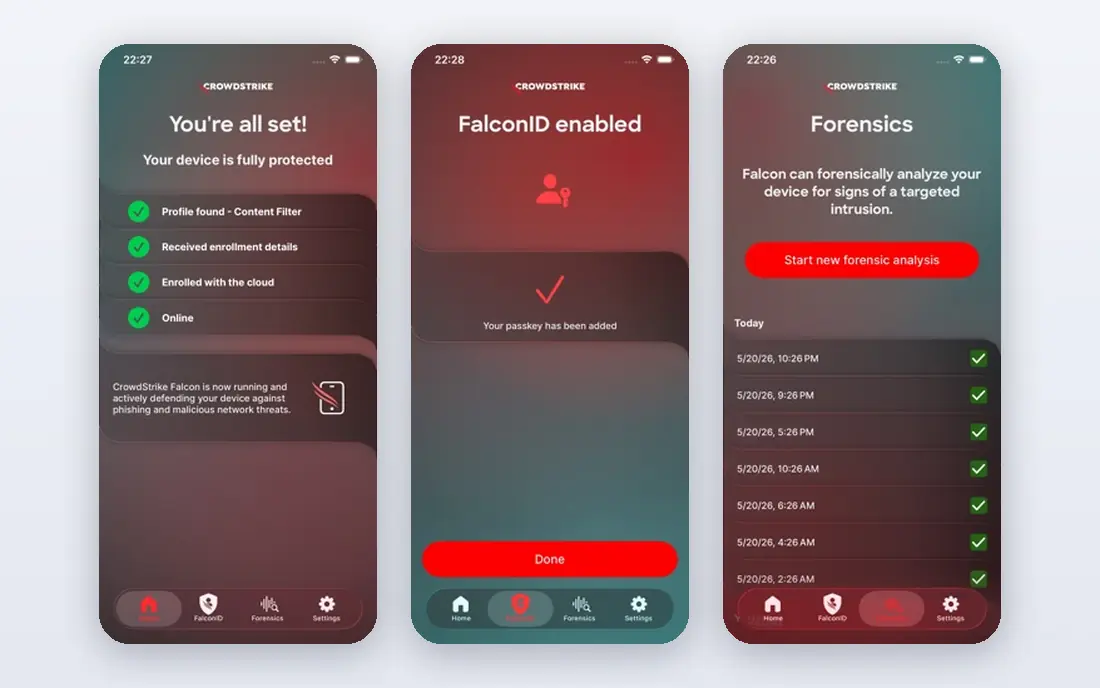
CrowdStrike Falcon pairs endpoint detection and response with AI tools, including Charlotte AI for triage and investigation help. Its AI security features add model scanning, data-leak guardrails, and cloud workload protection, which suit teams that already rely on Falcon for endpoints. Threat intelligence from CrowdStrike also enriches detections with context.
Entry pricing for small teams is published for basic Falcon Go plans, but advanced cloud and AI security features are usually custom-quoted. Small teams should confirm which modules are included, while larger teams benefit most from the full platform.
- Charlotte AI assistant
- Strong endpoint protection
- Cloud and identity modules
- Enterprise pricing is quote-based
- Full platform can be costly
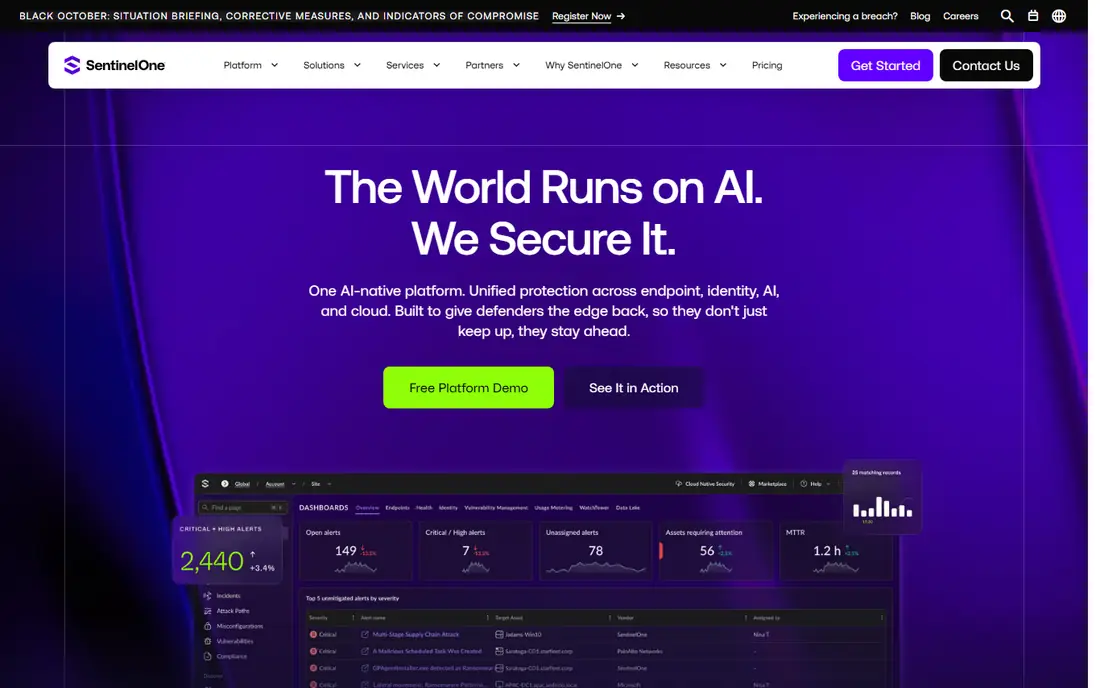
SentinelOne Singularity uses AI to detect, respond to, and roll back endpoint threats, including ransomware, with minimal analyst input. That autonomy suits small security teams that cannot staff a full operations centre around the clock. Its AI tools also help triage alerts and explain detections in plain terms.
Pricing varies by tier, with enterprise plans quoted, so small teams should check the entry tier carefully. SentinelOne also covers cloud and identity in wider plans, but network detection depth is thinner than Darktrace or Vectra. For endpoint-first teams, it is a strong rival to CrowdStrike.
- Autonomous response and rollback
- AI-assisted triage
- Broad platform
- Enterprise tiers are quote-based
- Setup needs tuning for best results
Darktrace builds a self-learning model of normal behaviour for each device and user, then flags deviations that may signal novel threats, insider activity, or lateral movement. That approach catches attacks that signature tools miss, across IT and operational technology networks. Autonomous response can contain a threat while analysts investigate.
Pricing is quote-only and module-based, with enterprise deployments often substantial. Darktrace also needs a learning period to model normal traffic, so early alerts need review. For complex network estates, it remains a leading choice for anomaly detection.
- Self-learning behaviour models
- IT and OT coverage
- Autonomous response options
- Quote-only pricing
- Needs tuning period to learn normal behaviour
Vectra AI focuses on network detection and response across hybrid, identity, and cloud environments. Its Attack Signal Intelligence prioritises behaviours that map to attacker techniques, which helps analysts focus on real threats instead of alert noise. That prioritisation is valuable for teams drowning in low-value alerts.
Like Darktrace, Vectra is quote-only and works best alongside endpoint and SIEM tools, not as a sole security product. Teams with hybrid estates and a mature operations function will get the most from it, while smaller teams may prefer an endpoint-led platform first.
- Attack Signal Intelligence
- MITRE mapping
- Hybrid cloud coverage
- Quote-only pricing
- Best as part of a wider detection stack
Microsoft Defender covers endpoints, identity, email, and cloud across Microsoft 365 and Azure, with Security Copilot adding AI-assisted investigation and reporting. For companies already standardised on Microsoft, that native coverage reduces integration work and keeps telemetry in one place. Defender for Cloud also adds AI posture features for multicloud workloads.
The trade-off is fit outside Microsoft. Teams with large Google, AWS, or on-prem estates may need extra tools for full coverage, and the best Defender value often sits inside E5 or similar bundles. For Microsoft-centred teams, Defender is the pragmatic, cost-effective pick.
- Native Microsoft 365 and Azure coverage
- Security Copilot
- Broad bundling
- Best value inside Microsoft plans
- Multi-vendor estates need extra work
Prisma AIRS, from Palo Alto Networks, secures AI applications, models, and agents across their lifecycle, including discovery, posture, runtime protection, and supply chain checks. It suits companies that already use Palo Alto firewalls, Prisma Cloud, or Cortex, since AI security connects to existing network and cloud controls. Gateway, SDK, and connector options cover different deployment styles.
Pricing is quote-based, and value is highest for teams with an existing Palo Alto footprint. Companies without that estate should compare HiddenLayer and Wiz for AI-specific coverage before committing to a full platform switch.
- AI app and model security
- Gateway and SDK options
- Broad platform
- Quote-based pricing
- Best on an existing Palo Alto estate
How we picked these
We compared official product pages, documentation, and public reviews in October 2026. We kept only platforms that still offer AI security or AI-assisted detection for production use, and we favoured tools with clear AI use cases, documented integrations, and a distinct strength. Where pricing was quote-based, we wrote See website rather than guessing.
How to choose an AI security platform
Start with an AI asset inventory. List every model, app, agent, API, and data source your company runs or plans to run, plus where each one lives. That list decides whether you need AI posture, model scanning, runtime guardrails, or all three, and it prevents buying a broad platform for a narrow problem.
Next, map existing coverage. Check what your endpoint, cloud, and SIEM tools already cover, then fill gaps with specialist tools. Trial with real AI workloads, not demos, and test prompt injection defences, data leak controls, and incident response. Also, confirm data handling, since security tools that process prompts or model data need clear privacy and retention terms.
Governance tips for AI tools
Set ownership for each AI system, require risk review before production, and log prompts, outputs, and access where feasible. Limit agent permissions to the minimum needed, and review third-party model and library supply chains regularly. Good governance reduces risk more than any single tool, and it makes platform selection clearer.
FAQ
What is the best AI security platform overall?
Wiz is our pick for cloud and AI posture, while CrowdStrike and SentinelOne lead for endpoint-led AI security. The best overall choice depends on whether your main risk is cloud AI exposure, endpoint threats, or network anomalies. Most enterprises use more than one platform.
Do I need a separate AI security tool if I already have endpoint protection?
Possibly, yes, if you run AI models or agents in production. Endpoint tools protect devices, but AI-specific risks such as prompt injection, model theft, and data leakage need posture, scanning, and runtime guardrails. Wiz, Prisma AIRS, and HiddenLayer cover those gaps.
How much do AI security platforms cost?
Enterprise AI security pricing is often quote-based, based on assets, users, or endpoints. Endpoint-led plans can start at a few dollars per device per month, while network and cloud platforms often run into five or six figures per year. Always get a written quote for your exact estate.
What is AI posture management?
AI posture management discovers AI assets, checks their configuration and exposure, and tracks risks across models, apps, and agents. It is similar to cloud posture management, but focused on AI-specific components, data flows, and attack paths. Wiz AI-SPM and Microsoft Defender for Cloud both offer this capability.
Can AI security tools stop prompt injection?
Guardrail tools can reduce prompt injection risk by screening inputs and outputs, but no tool blocks every attack. Combine guardrails with least-privilege agent permissions, input validation, and monitoring for suspicious behaviour. Test defences with red team exercises before relying on them in production.