Best AI Sales Software for B2B in 2026: 9 Tools Compared
We compare the best ai sales software for b2b across 9 tools, covering prospecting, outreach, forecasting, CRM fit, pricing and honest limits in 2026.
- Editor's choice
 HubSpot Sales Hub
Teams already using HubSpot CRM
Starts atFreeVisit hubspot.comFull review - Great alternative
 Apollo.io
All-in-one prospecting and outreach
Starts atFreeVisit apollo.ioFull review - Also consider
 Salesforce Sales Cloud
Large teams needing deep customization
Starts at$25 per user per monthVisit salesforce.comFull review
TL;DR:
- Apollo and HubSpot give small teams the fastest start, since both combine prospecting or CRM basics with outreach in one place.
- Gong and ZoomInfo suit larger teams that need call insight and contact data at scale, but both require a sales conversation for pricing.
- Clay stands out for data quality and personalization, while Outreach and Salesloft remain the classic choices for structured sales engagement.
- Check credit limits, seat minimums and onboarding fees before you sign, because those details change the real annual cost.
Quick comparison
| Tool | Best for | Starts at | Free plan? | |
|---|---|---|---|---|
| HubSpot Sales Hub | Teams already using HubSpot CRM | Free | Yes | Visit |
| Apollo.io | All-in-one prospecting and outreach | Free | Yes | Visit |
| Salesforce Sales Cloud | Large teams needing deep customization | $25 per user per month | Free trial | Visit |
 Outreach | Structured multi-channel sequences | See website | Free trial | Visit |
 Salesloft | Sales engagement with coaching | See website | Free trial | Visit |
 Clay | Data enrichment and personalization | $149 per month | Free trial | Visit |
 Gong | Call and deal insight | See website | No | Visit |
 ZoomInfo | Contact and company data | See website | Free trial | Visit |
 Pipedrive | Simple visual pipelines | $14 per user per month | Free trial | Visit |
The best AI sales software for B2B
We compared official feature pages, pricing pages, app listings and public reviews to find tools that genuinely help business-to-business teams find buyers, run outreach and close deals. Our pick for most teams starting out is Apollo, with HubSpot close behind for teams that want a CRM at the center.
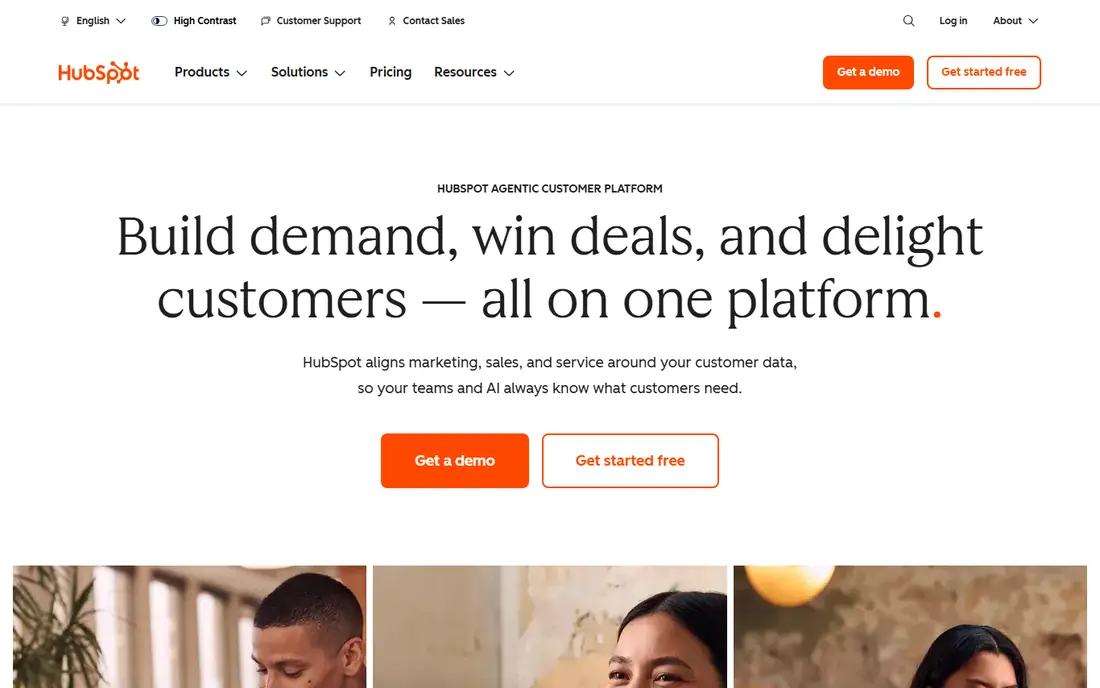
HubSpot Sales Hub works best when the CRM is already your home base. Contacts, deals, email sequences and meeting links live in one record, so reps spend less time switching tabs and copying notes between tools. The free CRM is generous for a small team, and the Starter tier adds basic automation at a modest seat price.
The honest catch is price growth. Professional seats are listed at $90 per seat per month on annual billing, with a one-time onboarding fee, and Enterprise seats are listed at $150 per seat per month on annual billing. If your team needs advanced forecasting, conversation insight or custom objects, budget for those tiers from the start rather than discovering the jump mid-year.
- Free CRM included
- Email sequences and meeting scheduling built in
- Large integration marketplace
- Costs rise fast at Professional and Enterprise tiers
- Onboarding fees apply on higher plans

Apollo is our pick for most small and mid-sized outbound teams because it covers the full early funnel. You can search for companies by size, industry and technology, build a list, enrich contacts and start a sequence without buying three separate tools. The free plan gives a small annual credit allowance, and the Basic plan is listed at $49 per user per month on annual billing.
The limit to watch is credits. Each email or phone reveal consumes credits, and a team that prospect heavily can burn through an annual allowance faster than expected. Apollo also works best as a prospecting layer, so teams with complex deal management often still sync it to a main CRM such as HubSpot, Salesforce or Pipedrive.
- Large contact database with filters
- Sequences, dialer and CRM in one plan
- Clear per-seat pricing
- Credit limits govern how much data you can pull
- Data accuracy varies by niche

Salesforce Sales Cloud remains the default for larger B2B organizations with complex sales processes. Pipelines, approvals, territory rules and forecasting can all be shaped to match how a company actually sells, and Einstein features add lead scoring, opportunity insight and forecasting help on higher tiers. The entry Starter price is listed at $25 per user per month, which makes a trial affordable.
That flexibility has a cost in effort. Small teams without an admin can find the setup slow, and the full value of Einstein features sits on higher-priced editions. Salesforce makes most sense when you have a defined process, a team that will use it daily and someone who owns the system.
- Deep customization and reporting
- Einstein AI features for forecasting and scoring
- Huge partner ecosystem
- Setup can be heavy without an admin
- Costs climb with add-ons and seats
Outreach built its name on sales engagement, and it still suits teams that run disciplined outbound and follow-up cadences. Reps work from prioritized task lists, sequences span email, calls and social touches, and managers get clear views of activity and reply rates. AI features help draft messages and surface the next best action, which cuts down on busywork.
The main drawback is transparency. Pricing requires a conversation with sales, so budgeting takes longer than with tools that publish a price list. Outreach also shines brightest when a team commits to its workflow, so a two-person team may find a lighter tool such as Apollo or Pipedrive a better fit.
- Strong sequence and task management
- AI help with email drafting and prioritization
- Solid Salesforce integration
- Pricing is not published on the main site
- Can feel heavy for very small teams
Salesloft pairs engagement with coaching in a way that suits teams trying to raise rep performance, not just send more email. Cadences organize touches across email, phone and social steps, while call recording and insight features help managers coach from real conversations. The platform syncs closely with Salesforce and other CRMs, so activity lands where managers already report.
As with Outreach, pricing is quote-based, which makes a quick cost comparison harder. Admins should also plan time for setup and training, since the coaching and analytics features only pay off when the team uses them consistently and managers review calls each week.
- Cadence management across channels
- Conversation insight and coaching tools
- Strong CRM sync
- Pricing requires a quote
- Learning curve for new admins
Clay takes a different approach from the rest of this list. Instead of one fixed database, it pulls data from many providers in a waterfall, so if one source lacks a phone number or job title, another source is tried. That makes it a strong choice for teams that care about data quality and personalized first lines at scale. Workflows can enrich, score and route leads automatically.
The trade-off is complexity. Clay rewards users who enjoy building tables and workflows, and it can overwhelm a rep who just wants a list and a send button. Pricing starts at $149 per month for a workspace, with credits governing enrichment volume, so heavy users should map credit use before committing.
- Waterfall enrichment from many data sources
- Strong AI personalization for outreach
- Flexible workflows
- Learning curve is steep for non-technical users
- Pricing is workspace-based, not per seat
Gong records and analyzes sales calls, then turns those conversations into deal insight, coaching notes and forecast signals. Managers can see which deals have stalled, which competitors appear most often and which talk patterns show up in won deals. AI summaries save reps from writing long call notes, and next steps are tracked against the CRM record.
Gong is not a prospecting tool, so it pairs with a CRM and an outreach tool rather than replacing them. Pricing is quote-based and the value depends on call volume, so a team that rarely talks to buyers on the phone will get less from it than a team running dozens of calls each week.
- Detailed conversation and deal analytics
- AI summaries and next-step tracking
- Strong CRM integration
- Quote-only pricing
- Best value only when call volume is high
ZoomInfo is the data layer behind many outbound programs. It offers company and contact records, technographic details, org charts and intent signals that show which accounts are researching topics related to your product. That depth helps account-based teams prioritize the right companies instead of working through a cold list in order.
The catch is cost and commitment. Pricing is not published and plans typically involve annual agreements, which puts ZoomInfo out of reach for some small teams. Apollo or Clay may deliver enough data at a lower starting price, while ZoomInfo fits teams that need depth, accuracy and intent data across a large target market.
- Large, frequently updated business database
- Intent signals and org charts
- Strong CRM integrations
- Quote-only pricing
- Minimum commitments can suit larger teams better
Pipedrive keeps the CRM simple, which is exactly why many small B2B teams stick with it. Deals move across a visual board, activities and follow-ups are easy to set, and the mobile app works well for reps on the road. The Essential plan is listed at $14 per user per month on annual billing, which makes it one of the most affordable paid options here.
Pipedrive does not try to be a prospecting database, so teams that need large contact lists should pair it with Apollo, Clay or ZoomInfo. Its AI features, including lead scoring and email summaries, also sit on higher plans, so buyers should check which tier includes the features they expect.
- Clear visual pipeline that reps actually update
- AI help with summaries and lead scoring on higher plans
- Quick setup
- Prospecting database is limited compared with Apollo or ZoomInfo
- Advanced AI sits on higher tiers
How we picked these
We started from official vendor feature and pricing pages, then checked app store listings and public user reviews for signs of real-world limits such as credit caps, onboarding fees and quote-only pricing. We favored tools with a clear B2B focus, current AI features and a track record of serving sales teams, and we mixed affordable starting points with enterprise-grade options. Where a vendor does not publish a price, we say so instead of guessing.
What to check before you buy AI sales software
Start with your bottleneck. If you lack pipeline, a prospecting tool such as Apollo or ZoomInfo matters more than a coaching platform. If you have pipeline but lose deals late, Gong-style insight or a stronger CRM process will help more than another list.
Data, credits and integrations
Ask how credits work, how often data refreshes and how the tool syncs with your CRM. A tool that creates duplicate contacts or drops activity notes will cost hours each week, even if the monthly price looks low.
AI features worth paying for
Prioritize AI that saves measurable time, such as call summaries, email drafting from CRM context and lead scoring based on your own closed deals. Treat generic AI writing as a bonus, not a reason to buy, and review AI-drafted messages before sending, since errors in a first email are hard to undo.
Trial plan
Run a two-week trial with real lists and real calls. Measure reply rates, data accuracy and time saved per rep, and check whether managers actually open the reports. If only one rep uses the tool after two weeks, the problem is fit, not features.
FAQ
What is the best AI sales software for B2B teams on a budget?
Apollo and Pipedrive are strong budget picks. Apollo covers prospecting and outreach from a free plan, while Pipedrive offers a visual CRM from $14 per user per month on annual billing. Pick Apollo if finding contacts is the bottleneck, and Pipedrive if managing deals is the bottleneck.
What are the best AI tools for B2B sales prospecting?
Apollo, ZoomInfo and Clay lead for prospecting. Apollo combines a database with sequences, ZoomInfo adds depth and intent signals, and Clay improves data quality through waterfall enrichment. Teams with a defined target market often pair one of these with their CRM.
Do I need a separate CRM if I buy an AI sales tool?
It depends on the tool. HubSpot, Salesforce and Pipedrive are CRMs, while Outreach, Salesloft, Gong and Clay work best alongside a CRM. If you buy an engagement or insight tool without a CRM, you still need somewhere to store deals and report revenue.
How much does AI sales software cost?
Prices range from free plans to quote-based enterprise agreements. Entry paid plans on this list start at $14 per user per month for Pipedrive and $49 per user per month for Apollo Basic on annual billing, while Gong, ZoomInfo, Outreach and Salesloft require quotes. Always add onboarding fees and credit costs to the seat price.
Is AI sales software safe for customer data?
Check each vendor privacy policy, data processing terms and security pages before purchase. Look for controls such as role-based access, single sign-on and CRM sync settings, and avoid feeding sensitive customer details into AI features unless the vendor states how that data is handled.