Best AI Sales Automation Tools for GTM in 2026: 9 Tools Compared
Compare the best ai sales automation tools for gtm in 2026, from prospecting and enrichment to sequencing and forecasting, with pricing and free plans.

- Editor's choice
 Apollo
All-in-one prospecting and outreach
Starts at$49 per seat per monthVisit apollo.ioFull review - Great alternative
 Clay
Data enrichment and GTM workflows
Starts at$167 per monthVisit clay.comFull review - Also consider
 Outreach
Enterprise sales engagement
Starts atSee websiteVisit outreach.ioFull review
TL;DR:
- Apollo and Clay cover the two most common starting points, with Apollo bundling data and outreach and Clay focusing on enrichment and workflow building.
- Outreach and Salesloft remain the enterprise picks for teams that run large, multi-step sequences across email, phone, and LinkedIn.
- HubSpot Sales Hub is the simplest choice for teams that already run their CRM on HubSpot and want AI features inside it.
- Cheaper outreach tools such as Instantly and Smartlead suit small teams that mainly need cold email at scale, not a full revenue platform.
- Every tool here charges differently, so compare seat prices, credit limits, and add-on costs before committing to an annual contract.
Quick comparison
| Tool | Best for | Starts at | Free plan? | |
|---|---|---|---|---|
| Apollo | All-in-one prospecting and outreach | $49 per seat per month | Yes | Visit |
| Clay | Data enrichment and GTM workflows | $167 per month | Yes | Visit |
| Outreach | Enterprise sales engagement | See website | No | Visit |
 Salesloft | Revenue orchestration for mid-market teams | See website | No | Visit |
 HubSpot Sales Hub | CRM-native AI selling | $20 per seat per month | Yes | Visit |
 Instantly | Cold email at scale | $47 per month | No | Visit |
 Smartlead | High-volume cold email | $39 per month | No | Visit |
 Reply.io | Multichannel outreach for small teams | $59 per user per month | No | Visit |
 Gong | Conversation intelligence and forecasting | See website | No | Visit |
The best AI sales automation tools for GTM
Go-to-market work now spans prospecting, enrichment, outreach, meetings, and forecasting, and no single tool does all of it equally well. The tools below each own a different part of that chain, so the right pick depends on where your team loses the most time.
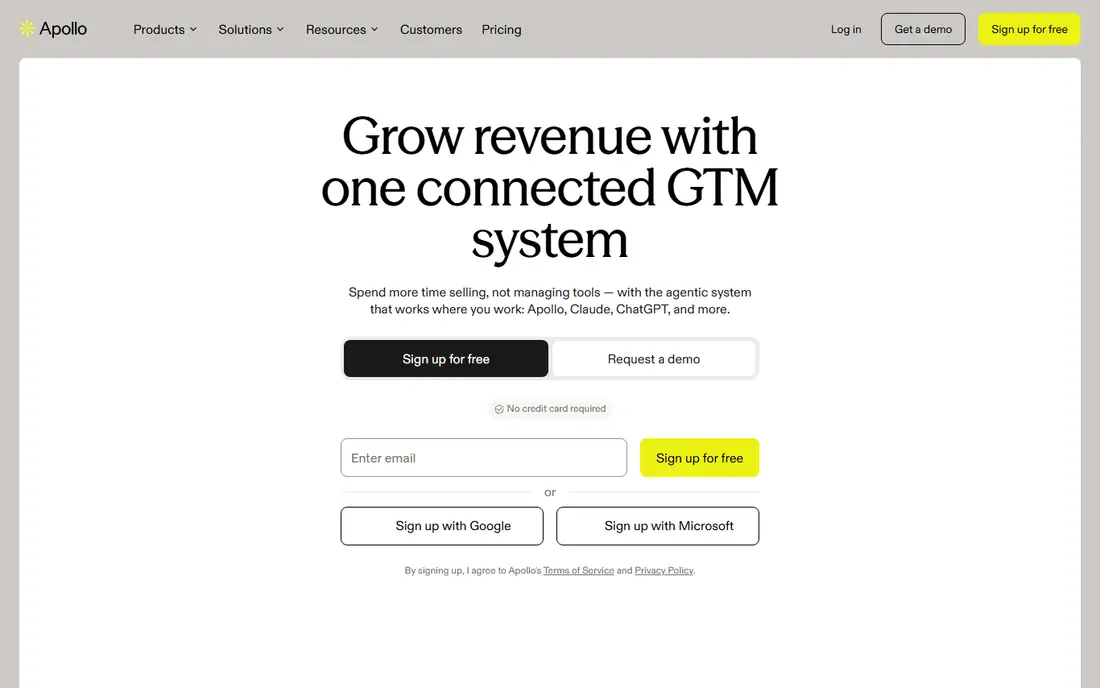
Apollo pairs a large B2B contact database with sequences, a dialer, and AI help for drafting emails and researching accounts. For a small team, that combination matters because it removes the need to buy a separate data vendor and a separate outreach tool in the first year. The free plan lets a team test the database and basic sequences before paying.
The catch is that database quality is uneven outside mainstream industries, so niche teams should verify a sample of contacts before building a campaign around them. Apollo also works best when someone owns list hygiene and sequence testing, since volume without targeting still produces poor reply rates. For most startups, though, it is our pick for the best starting point.
- Large contact database
- Built-in sequences and dialer
- AI email drafting and research
- Data accuracy varies by niche
- Advanced features sit on higher tiers

Clay is the tool behind many modern outbound lists. It pulls data from more than 100 providers in a waterfall, so a lookup only falls through to a pricier source when cheaper ones come up empty, and it can run AI research steps that turn raw company data into usable personalization. Teams use it to build targeted lists, score accounts, and push clean records into a CRM or outreach tool.
Clay does not send emails or make calls itself, so budget for an outreach tool alongside it. It also rewards users who enjoy building workflows, and teams that want a simple list export may find it more than they need. For RevOps and data-driven teams, it is the strongest enrichment option on this list.
- Waterfall enrichment across many providers
- Flexible workflow builder
- AI research agents
- No native outreach channels
- Learning curve for new users
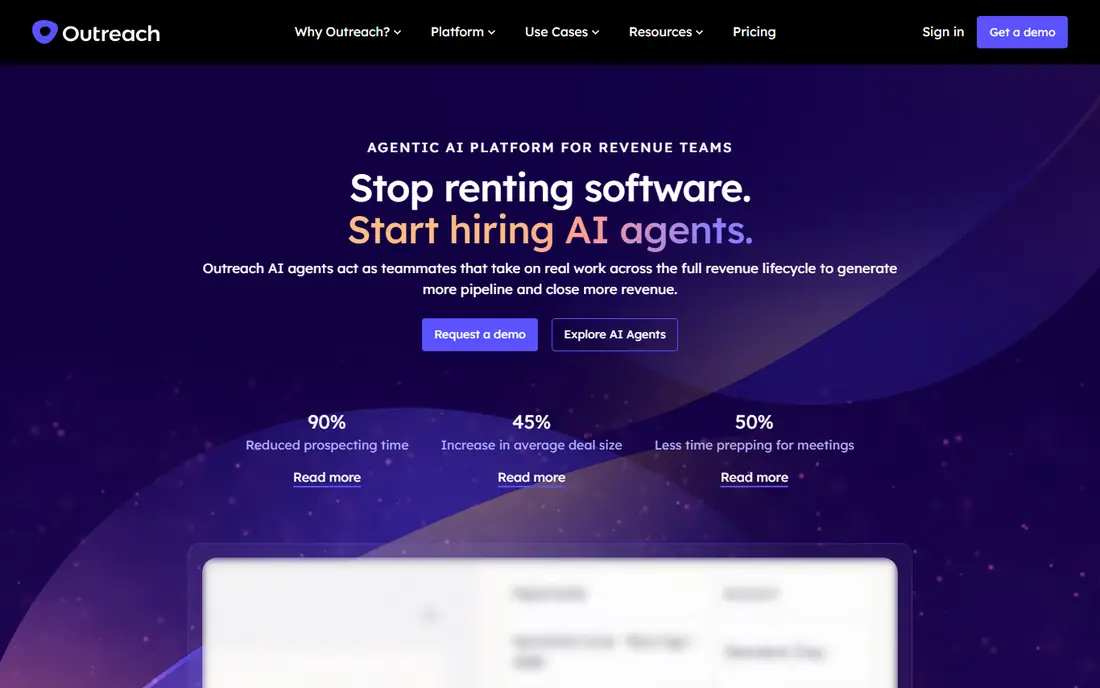
Outreach is built for sales organizations that run structured, multi-channel sequences at scale. Its AI features help with account research, meeting preparation, and next-step guidance, while managers get detailed reporting on sequence performance and rep activity. Large teams value the governance controls, such as permissions, approvals, and standardized plays.
The trade-off is cost and complexity. Pricing is quoted, implementation takes real effort, and a team of two or three reps will likely find it overbuilt. Outreach earns its place here for companies with a dedicated sales operations function and a pipeline that justifies an enterprise platform.
- Deep sequence and workflow controls
- AI agents for prospecting tasks
- Strong analytics
- Quote-only pricing
- Heavy setup for small teams
Salesloft gives revenue teams one place to run cadences, log calls, review conversations, and track pipeline health. Its AI tools summarize calls, surface deal risks, and help reps prioritize the accounts most likely to move. Teams that already use Salesforce or a similar CRM will find the integration straightforward.
Salesloft does not include its own prospect database, so pair it with Apollo, Clay, or a similar source for contact data. Pricing is also quoted, which makes budget planning harder for smaller companies. For mid-market teams that want engagement plus coaching in one system, it is a strong alternative to Outreach.
- Cadences across email, phone, and social
- Built-in conversation intelligence
- Forecasting add-ons
- Quote-only pricing
- Data must come from elsewhere
HubSpot Sales Hub suits teams that want AI selling features without stitching together four vendors. Breeze, its AI layer, drafts emails, scores leads, summarizes records, and helps with prospect research, all inside the CRM reps already open each day. The free tier covers basic CRM use for up to two users, and the Starter tier adds sequences and calling at a modest price.
The honest weakness is scale pricing. As seats and feature needs grow, HubSpot moves into Professional and Enterprise tiers that cost far more, and enrichment runs on credits that can add up. Teams already committed to HubSpot, however, will get more value here than from a standalone tool that needs constant syncing.
- Free CRM for small teams
- Breeze AI inside familiar workflows
- Sequences and email tracking included
- Costs rise quickly at higher tiers
- Enrichment is credit-based
Instantly focuses on one job and does it well: sending cold email campaigns with warmup, inbox rotation, and deliverability monitoring built in. Small agencies and founders like it because campaigns can be live in an afternoon, and the pricing stays approachable even with several sending accounts. Lead data is available as a separate add-on rather than bundled in the base plan.
It is not a CRM, and it will not replace a tool like Gong for call analysis or Clay for enrichment. Teams that need multichannel sequences or deep pipeline reporting should look elsewhere. For email-led outbound on a budget, Instantly is hard to beat.
- Affordable cold email sending
- Warmup and deliverability tools
- Simple campaign setup
- Limited CRM depth
- AI features are narrower than full GTM platforms
Smartlead is built for senders who run many mailboxes and care about landing in the primary inbox. Unlimited email warmup is included, campaigns can rotate across inboxes automatically, and deliverability settings are unusually detailed for the price. Agencies managing outreach for several clients often pick Smartlead for exactly that control.
The interface is denser than Instantly, and new users should expect a short learning period before campaigns feel natural. Like Instantly, it needs a separate data source for prospect lists. For high-volume senders, the deliverability tooling justifies the extra setup time.
- Unlimited warmup included
- Multiple inboxes per campaign
- Deliverability controls
- Interface takes time to learn
- No built-in prospect database
Reply.io covers more channels than the email-only tools while staying friendly to small teams. A single sequence can mix email, LinkedIn steps, calls, and SMS, and its AI assistant, Jason, can draft and handle replies for teams willing to pay for it. A built-in prospect database reduces the need for a separate data subscription at the start.
Reporting and governance are lighter than Outreach or Salesloft, so large teams may outgrow it. Pricing also climbs once the AI assistant and extra contacts are added. For a team of a few reps running multichannel outbound, Reply.io hits a practical middle ground.
- Email, LinkedIn, calls, and SMS in one sequence
- AI assistant for drafting
- Prospect database included
- AI assistant costs extra on some plans
- Reporting is lighter than enterprise tools
Gong records, transcribes, and analyzes sales calls and meetings, then turns that conversation data into coaching notes, deal risk alerts, and forecast signals. Managers use it to spot stalled deals early, and reps use it to review what top performers say differently. Its Engage product adds outbound sequences, but conversation intelligence remains the core strength.
Gong is priced by quote and includes a platform fee on top of per-seat costs, so it fits teams with enough call volume to justify the spend. A two-person team will get less from it than a ten-person team with a real coaching routine. For organizations that sell over calls and want to learn from every conversation, it is the category leader.
- Call and meeting analysis at scale
- Deal warnings and forecasting
- Coaching insights for managers
- Quote-only pricing
- Needs call volume to pay off
How we picked these
We compared official pricing pages, feature lists, and plan details for each vendor, and checked them against current roundups of GTM and prospecting tools. We kept only tools that exist and work today, that serve a clear GTM job such as prospecting, enrichment, engagement, or conversation intelligence, and that publish enough pricing or plan detail to compare honestly. Tools that were quote-only stayed on the list only when their role was distinct and widely adopted, and we marked their pricing as See website rather than guessing.
What to check before you buy
Start with the job, not the feature list. If your pipeline problem is finding the right accounts, spend on data and enrichment first with Apollo or Clay. If the problem is follow-through, an engagement tool such as Outreach, Salesloft, or Reply.io matters more. If deals stall after the first call, Gong addresses a different gap entirely.
Watch the total cost
Seat prices hide credits, platform fees, and add-ons. Ask each vendor what a typical month costs at your seat count and volume, including enrichment credits, AI assistant fees, and extra sending accounts. A tool that looks cheap at the Starter tier can double in price once those items are added.
Protect your sender reputation
Cold email tools only work when deliverability is treated as a discipline. Warm up new domains, keep lists targeted, honor opt-outs promptly, and follow the anti-spam rules that apply in your market, including CAN-SPAM in the US. AI drafting helps with volume, but a human review before sending still catches the errors that damage a domain.
Run a short pilot
Give two finalists the same list, the same offer, and two weeks of real sending or calling. Compare reply rates, meeting rates, and the time reps actually spend in the tool. The winner is usually the one reps keep opening after the novelty wears off, not the one with the longest feature page.
FAQ
What is the best AI sales automation tool for GTM for a small team?
Apollo is our pick for most small teams because it combines prospecting data, sequences, and a dialer in one subscription with a free plan to start. HubSpot Sales Hub is the better choice if the team already runs on HubSpot. Clay fits teams that want deeper list building and already have an outreach tool.
What is the best ai sales software for gtm automation at enterprise scale?
Outreach and Salesloft lead at enterprise scale, with deep sequence controls, governance, and analytics that smaller tools cannot match. Gong adds conversation intelligence and forecasting on top of either one. Expect quoted pricing and a longer implementation than with self-serve tools.
Do I need both Clay and Apollo?
Not always. Apollo covers data plus outreach, which is enough for many teams. Clay earns its place when list quality and custom workflows matter more than convenience, for example when you enrich from many sources or score accounts with custom rules. Some teams use Clay to build lists and Apollo or another tool to run sequences.
How much do AI sales automation tools cost?
Prices on this list range from free plans at Apollo, Clay, and HubSpot to $39 to $59 per user per month at Smartlead, Instantly, and Reply.io, with enterprise tools quoted individually. Add enrichment credits, AI assistant fees, and platform charges to the seat price before comparing totals.
Can AI write and send outreach on its own?
AI can draft emails, research accounts, and suggest next steps, but fully autonomous sending still needs human oversight. Review AI drafts for accuracy, keep personalization truthful, and monitor reply quality weekly. Teams that skip review tend to see lower reply rates and more spam complaints.
Is cold email still effective in 2026?
Yes, when it is targeted and relevant. Short, specific messages to well-chosen accounts still book meetings, while generic blasts hurt deliverability and brand reputation. The tools on this list help most when they are paired with good lists, honest subject lines, and prompt follow-up.