Best AI RFP Software: 8 Tools Compared
Compare the best AI RFP software for faster, more accurate proposal responses, with content libraries, AI drafting, approvals, and current pricing today.

- Editor's choice
 Loopio
Proven RFP response platform
Starts atFrom $20,000 per yearVisit loopio.comFull review - Great alternative
 Responsive
Complex enterprise questionnaires
Starts atSee websiteVisit responsive.ioFull review - Also consider
 QorusDocs
Proposal automation in Microsoft tools
Starts atSee websiteVisit qorusdocs.comFull review
TL;DR:
- Loopio is the most proven AI RFP platform for midsize and enterprise teams, with a published starting price and a strong content library.
- Responsive suits complex enterprise questionnaires, including security and compliance documents, where document parsing and collaboration matter most.
- AI native tools such as AutoRFP.ai, Inventive AI, and DeepRFP offer faster setup and lower entry costs, but with shorter governance track records.
- AI drafting saves time only when answers are reviewed against approved sources, since unchecked AI output can invent details or use outdated content.
- Most enterprise RFP tools are quote priced, so compare them on library quality, AI controls, integrations, and implementation support, not on headline price alone.
Quick comparison
| Tool | Best for | Starts at | Free plan? | |
|---|---|---|---|---|
| Loopio | Proven RFP response platform | From $20,000 per year | No | Visit |
| Responsive | Complex enterprise questionnaires | See website | No | Visit |
| QorusDocs | Proposal automation in Microsoft tools | See website | No | Visit |
 AutoRFP.ai | AI native RFP drafting | See website | No | Visit |
 Upland Qvidian | Template driven enterprise proposals | See website | No | Visit |
 Inventive AI | AI first proposal responses | See website | No | Visit |
 DeepRFP | Low cost AI RFP drafting | $75 per user per month | No | Visit |
 RocketDocs | Content library and response automation | See website | No | Visit |
The best AI RFP software
We compared RFP tools on content library quality, AI drafting and review controls, document import, collaboration, approvals, and integrations. We used vendor pricing pages and comparison guides, and we note where pricing is quote based rather than publishing a number we could not verify.

Loopio is the most established RFP response platform on this list, with a content library, project workflows, and generative AI that drafts answers from approved library entries. Its Foundations plan starts at $20,000 a year and includes unlimited projects, unlimited library entries, generative AI, and standard support, while Enhanced and Enterprise add multi language libraries, multi step reviews, separate business units, and premium support. That published starting point makes budgeting easier than with quote only rivals.
The trade offs are cost and setup time. Twenty thousand dollars a year is a large commitment for a small team, and building a useful library takes weeks of collecting, reviewing, and tagging approved content. Reviewers also note that search can return loosely related answers and that export formatting sometimes needs cleanup. For a team that answers RFPs regularly and wants a proven platform with strong support, Loopio remains the benchmark.
- Published starting price
- Strong searchable library
- Generative AI with review workflows
- High entry cost for small teams
- Library setup takes weeks
- Export formatting can need cleanup

Responsive, formerly RFPIO, is built for complex response work, including RFPs, security questionnaires, due diligence questionnaires, and proactive proposals. Its document import handles messy spreadsheets and long documents better than most rivals, and its AI can rewrite, synthesize from multiple sources, and bulk fill answers, with collaboration and approval workflows for large teams. Integrations with Salesforce, HubSpot, and other sales tools keep response work close to the deal pipeline.
Pricing is quote based, with published comparisons putting entry implementations in a similar range to Loopio and larger deployments well above that. Implementation is also heavier, since enterprise questionnaires need careful library and workflow setup. For a large team handling complex, high stakes questionnaires, Responsive is a top choice. For a small team with simple RFPs, a lighter AI native tool may launch faster and cost less.
- Strong document parsing
- Handles security questionnaires and DDQs well
- Broad enterprise integrations
- Quote based pricing
- Implementation is heavier
- Cost rises with scale
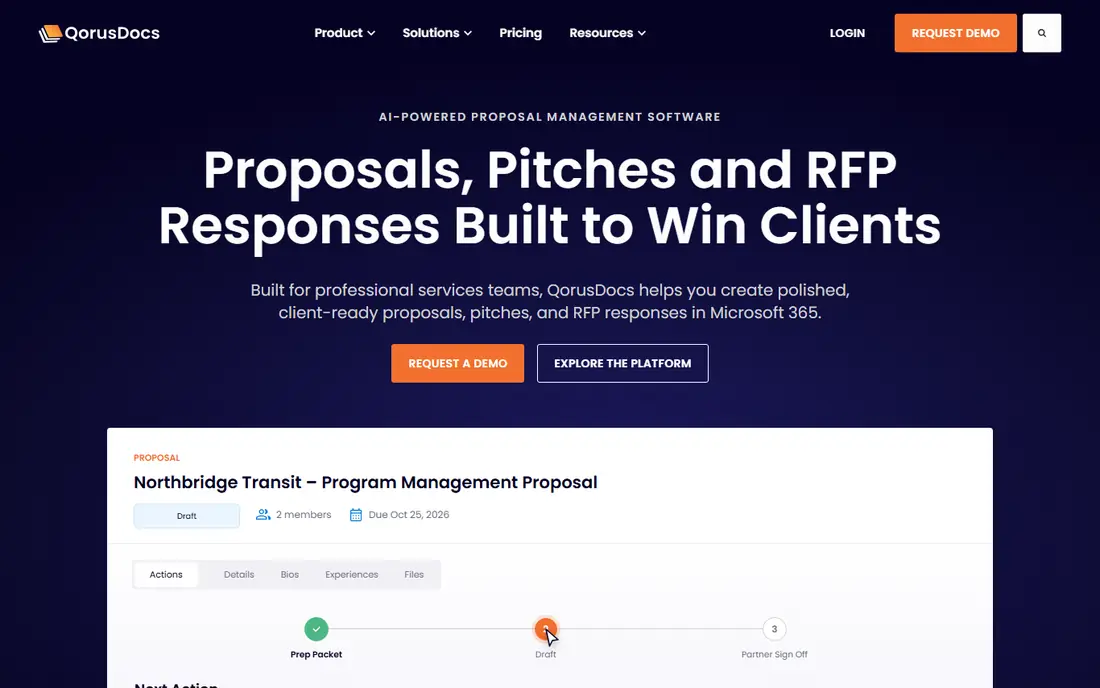
QorusDocs focuses on proposal creation inside Microsoft Word, Teams, and SharePoint, which suits teams that already live in Microsoft tools. It offers a content library, proposal templates, and collaboration features that let sales and subject experts build proposals without leaving Word. That familiarity shortens adoption, since staff do not need to learn a separate response workspace for every document.
Against Loopio and Responsive, QorusDocs is stronger on proposal documents than on long questionnaire automation, and pricing is quote based, so small teams cannot see a price without a sales conversation. AI capabilities also vary by plan, so confirm what AI drafting and content suggestions are included in your quote. If your team builds proposals in Word and wants automation without changing tools, QorusDocs is a natural fit.
- Works inside Word and Teams
- Strong proposal templates
- Good for Microsoft based teams
- Quote based pricing
- AI features vary by plan
- Less RFP questionnaire depth than Loopio
AutoRFP.ai is an AI native RFP tool that drafts responses from connected knowledge sources, with project based plans that include unlimited users on some tiers. That model suits teams that answer RFPs in bursts or that want to try AI drafting without paying per seat for every contributor. Setup is typically faster than legacy platforms, since the AI can start from existing documents and past responses with less manual library building.
The risk is youth. AutoRFP.ai has a shorter governance and enterprise track record than Loopio or Responsive, and pricing details require a quote, so total cost is harder to compare upfront. Teams in regulated industries should test its approval workflows, source citations, and audit trails carefully. For a team that wants AI drafting speed and flexible user pricing, AutoRFP.ai is a promising modern option.
- AI first drafting from your sources
- Project based plans with unlimited users
- Faster setup than legacy tools
- Newer vendor with a shorter track record
- Pricing details need a quote
- Governance features still maturing
Upland Qvidian is a long established enterprise proposal and RFP automation platform, used by large organizations for template driven responses with strong content and governance controls. It centralizes approved content, builds reusable templates for consistency at volume, and supports collaboration, version control, and multi stakeholder approvals. Response tracking and analytics cover status across many concurrent proposals.
Qvidian's age shows in its interface, which feels less modern than AI native tools, and its AI features are less central than those of Loopio, Responsive, or Inventive AI. Pricing is quote based. For a large enterprise that values template control, governance, and a long vendor history over the newest AI features, Qvidian remains a solid choice. For a team that wants AI drafting as the main feature, a newer tool may fit better.
- Long enterprise history
- Template automation
- Content governance and approvals
- Quote based pricing
- Interface feels older than AI native rivals
- AI features lag newer tools
Inventive AI positions itself as an AI first RFP response platform, with AI drafting, intelligent search across connected sources, and workflows for proposal teams. Its modern interface and AI centered design appeal to teams frustrated by manual library upkeep in legacy tools, and it handles RFPs, questionnaires, and proposals in one workspace. Published comparisons list it among the leading AI native alternatives to Loopio and Responsive.
Like other AI native vendors, Inventive AI is quote priced and newer than the legacy platforms, so enterprise buyers should check its security, approval, and audit features carefully. AI output still needs human review, and library quality still affects answer quality, even with strong AI. For a team that wants AI drafting at the center of its workflow and is willing to evaluate a newer vendor, Inventive AI is worth a trial.
- AI native drafting and search
- Fast answers from connected sources
- Modern interface
- Quote based pricing
- Newer vendor
- Library governance needs active upkeep
DeepRFP offers AI RFP drafting at a published price near $75 per user per month, which makes it one of the most transparent and affordable AI RFP tools on this list. That pricing suits small and midsize teams that answer RFPs regularly but cannot justify a $20,000 annual enterprise platform. Setup is quick, since AI drafting starts from uploaded documents and past responses rather than a months long library build.
The trade off is depth. DeepRFP has a smaller feature set, fewer integrations, and less published information on enterprise governance, approvals, and support than Loopio or Responsive. Teams with complex security questionnaires or strict compliance workflows should test those cases specifically. For a small team that wants AI help on RFPs at a clear per user price, DeepRFP is a practical entry point.
- Published per user pricing
- AI drafting at a lower entry cost
- Quick to start
- Smaller feature set than enterprise platforms
- Fewer integrations
- Support and governance depth unclear
RocketDocs, formerly known as PMAPS, offers content management, proposal automation, and RFP response workflows for growing teams. Its library organizes approved answers, its automation fills and tracks questionnaires, and its proposal tools help teams produce consistent documents faster. That combination suits midsize teams that have outgrown spreadsheets and shared drives but do not yet need a full enterprise platform.
Pricing is quote based, and AI capabilities vary by plan, so buyers should confirm what AI drafting, if any, is included in their quote. RocketDocs also has a smaller market presence than Loopio or Responsive, which means fewer public reviews to compare. For a growing team that wants library automation with room to add AI features, RocketDocs is a solid mid market option.
- Strong content library and automation
- Proposal and questionnaire workflows
- Good for growing teams
- Quote based pricing
- AI features need confirmation by plan
- Smaller brand presence than Loopio
How we picked these
We compared RFP tools with current AI features, a working content library, and a real customer base, using vendor pricing pages, product documentation, and comparison guides. We favored tools with published pricing where available, and we flagged quote based pricing rather than inventing rates. We weighed AI drafting quality controls, library governance, document import, collaboration, and integrations together, since a fast AI draft that cannot be trusted or approved is worse than a slower, accurate answer.
Buying AI RFP software wisely
Test AI on your hardest questionnaire
Do not judge an RFP tool on a simple demo. Run a trial with a real, recent questionnaire from your pipeline, including spreadsheets, security questions, and technical items, and score the AI drafts for accuracy, source use, and tone. Check how easily reviewers can correct answers and how those corrections feed back into the library.
Put human review and source control first
Require that AI answers cite or link to approved sources, and set approval rules so no AI draft goes out unreviewed. Decide who owns library content, how often it is reviewed, and what happens when a source document changes. AI speed without governance creates compliance risk, especially on security and legal answers.
Compare total cost, not just the starting price
Enterprise RFP pricing often includes implementation, onboarding, integrations, and support that are not in the headline figure. Ask for a written quote covering year one total cost, renewal terms, user limits, and AI feature availability by plan. A lower starting price with expensive add ons can cost more than a higher all in platform.
FAQ
What is the best AI software for RFP responses?
Loopio is the best general pick for proven AI RFP software, while Responsive suits complex enterprise questionnaires. AI native tools such as AutoRFP.ai, Inventive AI, and DeepRFP offer faster setup and lower entry costs, so the best RFP AI software for your team depends on volume, complexity, and governance needs.
How does AI RFP software work?
AI RFP software imports a questionnaire, drafts answers from your approved content library and connected documents, and routes drafts for human review and approval. The best tools cite sources, learn from corrections, and keep a library of approved answers so future responses stay consistent.
Can AI write an entire RFP response?
AI can draft most standard answers, but human review remains essential, especially for technical, security, legal, and pricing items. Unreviewed AI output can invent details, use outdated content, or miss the exact wording a buyer asked for, so treat AI as a drafting assistant, not a final author.
How much does AI RFP software cost?
Enterprise platforms such as Loopio start near $20,000 a year, while most rivals are quote based and scale with users and features. Lower cost AI tools such as DeepRFP publish per user pricing near $75 a month, so small teams have options well below enterprise prices.
Is AI RFP software safe for confidential proposals?
Reputable vendors offer access controls, audit trails, and data handling terms, but safety depends on configuration and vendor terms. Ask how your documents are stored, whether they are used to train models, and what security certifications the vendor holds before uploading sensitive proposal content.
What is the difference between RFP software and AI RFP tools?
Traditional RFP software organizes a content library and project workflows, while AI RFP tools add generative drafting, intelligent search, and automated filling from your sources. The best modern tools combine both, with a governed library underneath AI drafting, so speed does not come at the cost of accuracy.