Best AI Pricing Tools in 2026: 8 Tools Compared
Compare the best ai pricing tools in 2026, with price optimization, elasticity models, deal guidance, competitor tracking, and dynamic pricing for B2B teams.
- Editor's choice
 Pricefx
B2B companies that want a broad modular pricing platform
Starts atSee websiteVisit pricefx.comFull review - Great alternative
 Vendavo
Enterprise manufacturers and distributors with complex pricing
Starts atSee websiteVisit vendavo.comFull review - Also consider
 PROS
Large enterprises that need AI deal pricing at scale
Starts atSee websiteVisit pros.comFull review
TL;DR:
- Enterprise B2B tools win on deal guidance and margin control, while retail tools win on assortment and markdown speed.
- Most enterprise pricing tools are quote-based, so budget for implementation and data work, not just a licence fee.
- Price recommendations need guardrails, since unguarded dynamic pricing can damage trust and channel relationships.
- Smaller sellers should start with competitor tracking and rules, not a full optimization platform.
Quick comparison
| Tool | Best for | Starts at | Free plan? | |
|---|---|---|---|---|
| Pricefx | B2B companies that want a broad modular pricing platform | See website | No | Visit |
| Vendavo | Enterprise manufacturers and distributors with complex pricing | See website | No | Visit |
| PROS | Large enterprises that need AI deal pricing at scale | See website | No | Visit |
 Zilliant | Mid-market to large B2B teams that need governed pricing | See website | No | Visit |
 Competera | Large retailers that need AI assortment and lifecycle pricing | See website | No | Visit |
 Prisync | Ecommerce sellers that need competitor tracking and dynamic pricing | From $99 per month | Free trial | Visit |
 BlackCurve | Mid-market retail and ecommerce teams that want public pricing | From £199 per month | Free trial | Visit |
 Omnia Retail | European and global ecommerce teams that need dynamic pricing | From €399 per month | Free trial | Visit |
The best ai pricing tools
We compared AI pricing tools for B2B manufacturers, distributors, retailers, and ecommerce sellers, focusing on optimization, deal guidance, competitor tracking, and execution. Enterprise tools are mostly quote-based, so we mark those prices as See website where vendors do not publish a starting price. This is general information only and is not financial advice; test price changes carefully, since pricing affects margin, demand, and customer trust.
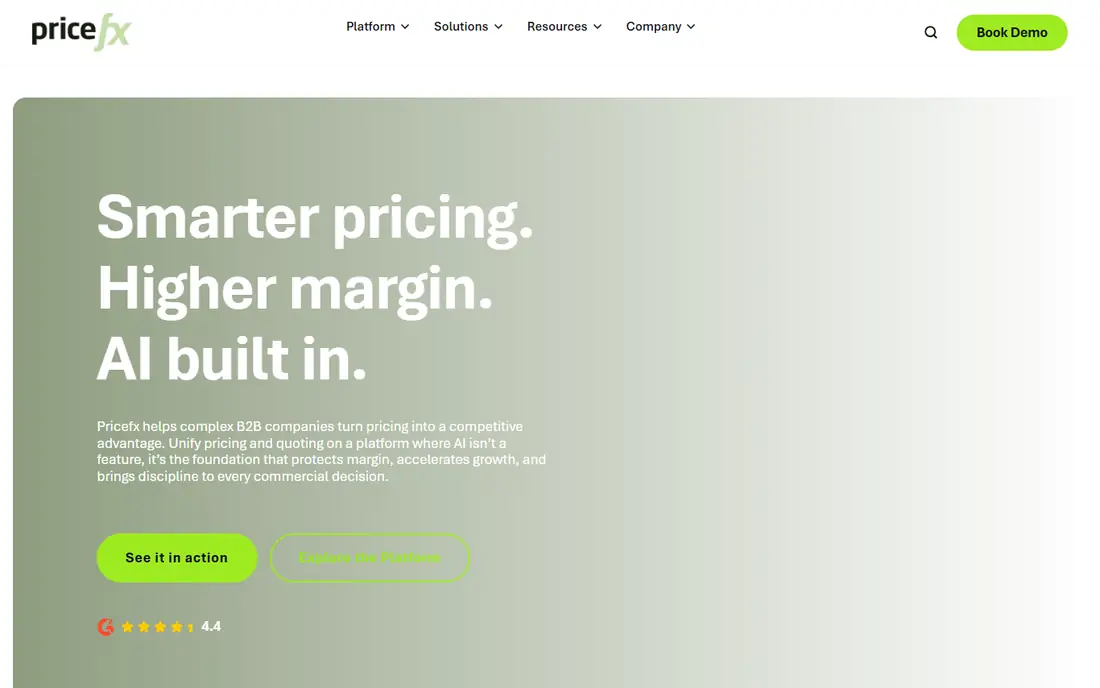
Pricefx is the broadest B2B pricing platform here, with price management, CPQ, AI optimization, rebate management, and analytics in one cloud platform. Its PricingAI engine gives deal-level guidance to sales teams, and Pricefx Copilot lets pricing managers ask questions in plain language and get visual analytics back.
The breadth comes with cost and complexity. Pricing is custom, implementation takes time, and mid-market teams may find the full feature set more than they need. Companies that want one platform for pricing end to end, rather than several point tools, get the most value.
- Modular price management, CPQ, optimization, and rebates
- Deal-level guidance
- Conversational AI copilot
- Quote-based pricing
- Advanced optimization has a learning curve
Vendavo suits enterprise manufacturers and distributors that manage complex list, customer, and deal pricing across many products and channels. It combines price management, optimization, deal guidance, and rebates, with a focus on margin analysis and ERP integration.
The trade-off is scale and cost. Enterprise deals are reported in six figures per year, and implementation is a major project, not a quick signup. Smaller B2B teams should compare Zilliant or Pricefx modules before committing to a full enterprise platform.
- Price management and optimization
- Deal guidance
- Rebate management
- ERP and CRM links
- Six-figure annual costs reported for enterprise deals
- Implementation is a major project
PROS is built for large enterprises with complex, high-volume pricing, including airlines, hotels, and manufacturing. Its AI pricing engine gives personalized, real-time recommendations and next-best actions across the sales lifecycle, with newer AI agents for bundling and insights.
That power suits large operations, but it is overkill for small sellers. Pricing is custom and enterprise-grade, and teams need clean data and change management to get value. If your pricing is mainly list-based with few deals, a simpler tool may be faster.
- AI price optimization and real-time deal guidance
- Bundling and insights agents
- Airline, travel, and manufacturing depth
- Enterprise pricing and complexity
- Best suited to large, high-volume operations
Zilliant suits B2B distribution and manufacturing teams that need governed price management plus optimization. Its micro-segmentation approach creates many customer segments for precise pricing, and it pairs price management with CPQ and agreements for execution.
Pricing is quote-based, with annual costs reported from about 50,000 to 150,000 dollars, so it suits mid-market and larger teams rather than small sellers. Teams should test time to value on their own data, since segmentation quality depends on clean customer and deal history.
- Price management and optimization
- Micro-segmentation for customer pricing
- CPQ and agreements
- Quote-based pricing reported from 50,000 to 150,000 dollars per year
- Setup needs data work
Competera
Best for: Large retailers that need AI assortment and lifecycle pricing
Competera is built for large retailers and omnichannel sellers, with AI optimization for large assortments, scenario planning, and lifecycle pricing from launch to markdown. Its contextual AI models demand and competitor signals to recommend prices across many SKUs.
The retail focus is also the limit. B2B teams that need deal guidance and negotiated customer pricing should look at Pricefx, Vendavo, or Zilliant instead. Retailers should test scenario accuracy on their own assortment before committing to an enterprise contract.
- Retail price optimization
- Demand and elasticity models
- Scenario planning
- Lifecycle and markdown pricing
- Enterprise pricing
- Retail focus means B2B deal pricing is not its strength
Prisync
Best for: Ecommerce sellers that need competitor tracking and dynamic pricing
Prisync suits ecommerce sellers that need to track competitor prices and adjust their own prices with rules. Starting pricing is around 99 dollars per month for URL-based monitoring, with dynamic pricing and MAP monitoring for sellers that compete mainly on price.
It is not a full enterprise optimization platform, so elasticity modelling and assortment planning are lighter than Competera or Quicklizard. For a small to mid-size seller, that simplicity is a plus, since setup is faster and costs stay predictable.
- Competitor price monitoring
- Dynamic pricing rules
- MAP monitoring
- Multi-channel price tracking
- Optimization depth is lighter than enterprise retail platforms
- URL-based pricing scales with catalogue size
BlackCurve
Best for: Mid-market retail and ecommerce teams that want public pricing
BlackCurve suits mid-market retail and ecommerce teams that want public pricing and a clear starting point. Plans start from about 199 pounds per month billed annually, with pricing rules, optimization, and profitability insights across channels.
The public price is a real advantage over quote-only rivals, since budgeting is easier. Larger retailers with very large assortments or complex markdown needs should still compare Competera and Quicklizard, but mid-market teams get strong value here.
- Pricing rules and optimization
- Profitability insights
- Multi-channel price management
- Pound pricing may need conversion for US teams
- Enterprise assortment depth is lighter than larger rivals
Omnia Retail
Best for: European and global ecommerce teams that need dynamic pricing
Omnia Retail is a retail dynamic pricing tool with transparent starting pricing from about 399 euros per month, plus custom enterprise plans. It combines competitor tracking with AI-driven dynamic pricing and rules, which suits ecommerce teams that reprice often.
The EU focus and euro pricing suit European sellers best, though global teams also use it. B2B deal pricing is not its strength, so manufacturers and distributors should stay with B2B platforms. Retailers should test rule controls and guardrails before automating large assortments.
- Dynamic pricing with AI agent features
- Competitor tracking
- Transparent starting pricing for retail
- Euro pricing and EU focus may suit some teams less
- Enterprise B2B features are limited
How we picked these
We compared official feature pages, pricing pages, and public reviews for each tool, and we checked that each product exists, works today, and truly fits the topic. Where a vendor quotes rather than publishes a price, we say so instead of guessing a number.
We also weighed fit for different team sizes, since the best choice for a solo operator is rarely the best choice for a larger team. That is why the list mixes well-known leaders with smaller options that suit narrower needs, and why each write-up names an honest weakness as well as a strength.
How to choose an AI pricing tool
Start with your pricing problem. B2B teams usually need list, customer, and deal pricing with approvals. Retail teams usually need assortment pricing, elasticity, promotions, and markdowns. Ecommerce sellers usually need competitor tracking and repricing rules. Those are different tools, even though vendors use similar AI language.
Check data and guardrails first
Ask what data the model needs, how long setup takes, and how you set floors, caps, and channel rules. A model that recommends prices without guardrails can create channel conflict or margin loss. Also ask how recommendations are explained, since pricing managers need to defend changes internally.
Test recommendations on real deals
Run past deals or SKUs through the tool and compare recommended prices with actual outcomes. Check win rates, margin, and exception rates, not just model accuracy. A tool that looks accurate in a demo can still fail on your product mix.
Budget for change management
Pricing changes affect sales, finance, and customers. Plan training, approval workflows, and communication for price moves. The best tool fails if sales teams ignore recommendations or override them without recording a reason.
Before you pay, run a short trial with your real work, not a demo dataset. Check setup time, support response, and the total monthly cost at your real user or volume level. A tool that passes that test is far more likely to still suit you in six months than a tool chosen from a feature list alone.
FAQ
What is an AI pricing tool?
An AI pricing tool uses sales, cost, demand, and competitor data to recommend prices, test scenarios, and guide deals. It can optimize list prices, customer prices, promotions, and markdowns, depending on whether it serves B2B, retail, or ecommerce teams.
How much do AI pricing tools cost?
Enterprise B2B tools are usually quote-based and can run to five or six figures per year with implementation. Retail and ecommerce tools are cheaper, with BlackCurve from about 199 pounds per month and Prisync from about 99 dollars per month.
Are AI pricing tools worth it for small businesses?
For small sellers, competitor tracking and rule-based repricing usually pay off faster than full optimization. Full platforms suit larger assortments or complex B2B pricing, where small margin gains across many deals add up.
Can AI pricing tools integrate with ERP and CRM?
Yes, leading B2B tools integrate with ERP and CRM systems for list prices, customer data, and deal guidance. Confirm your exact ERP and CRM versions, and check whether pricing flows both ways or only exports recommendations.
Is dynamic pricing risky?
It can be, if prices change too often or without guardrails. Use floors, caps, and channel rules, test changes on a subset of products first, and watch customer feedback and channel partner reactions before rolling out wider changes.