Best AI Observability Tools in 2026: 10 Tools Compared
Best AI observability tools compared: we review 10 platforms for LLM tracing, costs, evaluations and agent monitoring in production AI apps for growing teams.

- Editor's choice
 LangSmith
LangChain and LangGraph apps
Starts atFreeVisit langchain.comFull review - Great alternative
 Langfuse
Open source LLM observability
Starts atFreeVisit langfuse.comFull review - Also consider
 Arize AX and Phoenix
OTel native observability
Starts atFreeVisit arize.comFull review
TL;DR:
- LangSmith is the natural pick for LangChain and LangGraph apps, while Langfuse and Arize Phoenix suit teams that want open source or framework neutral tracing.
- Helicone and Portkey add gateway and cost controls on top of observability, which suits teams running many models.
- Free tiers are generous for prototypes but have retention limits, so check trace retention before you rely on a tool for production debugging.
- The best AI observability platform for agents adds session and trajectory views, not just single prompt traces.
- Self-hosting keeps prompt data in your infrastructure, but it adds maintenance that managed cloud plans avoid.
Quick comparison
| Tool | Best for | Starts at | Free plan? | |
|---|---|---|---|---|
| LangSmith | LangChain and LangGraph apps | Free | Yes | Visit |
| Langfuse | Open source LLM observability | Free | Yes | Visit |
| Arize AX and Phoenix | OTel native observability | Free | Yes | Visit |
 Helicone | API request logging and costs | Free | Yes | Visit |
 Portkey | Multi-model gateway plus observability | Free | Yes | Visit |
 Datadog LLM Observability | Datadog users | See website | No | Visit |
 New Relic AI Monitoring | New Relic users | See website | No | Visit |
 Weights and Biases Weave | Teams on Weights and Biases | Free | Yes | Visit |
 HoneyHive | Evaluations plus observability | Free | Yes | Visit |
 Braintrust | Evaluation led observability | Free | Yes | Visit |
The best AI observability tools
AI observability shows what your language model app actually did: which prompts ran, which tools were called, how long each step took, what it cost, and whether the output was good. The best observability tools for AI systems combine tracing, cost tracking, and evaluations, so teams can debug agents and catch quality drops. We compared official pricing and feature pages for the tools below.

LangSmith is LangChain's observability platform, and it traces LangChain and LangGraph apps with almost no setup. Its Developer plan is free for one seat and 5,000 base traces per month, while Plus costs $39 per seat per month with 10,000 base traces. Prompt management, datasets, and evaluations sit alongside tracing, so teams can test prompt changes against real cases.
The limit is retention. Base traces are kept 14 days, and extended retention costs extra, so plan for that if you need long term debugging. Self-hosting is limited to enterprise tiers. For teams already building on LangChain or LangGraph, LangSmith is the most direct observability choice.
- Native LangChain and LangGraph tracing
- Prompt hub and evaluations
- Accepts OpenTelemetry traces
- Plus plan is $39 per seat per month
- Base trace retention is 14 days
Langfuse is an open source LLM observability platform with tracing, cost tracking, prompt management, and evaluations. Its Hobby cloud plan is free with 50,000 units per month and 30-day retention, while Core costs $29 per month and Pro costs $199 per month. Self-hosting is free and offers full parity, which suits teams with data residency needs.
Langfuse works with LangChain, LlamaIndex, LiteLLM, and raw OpenAI SDKs, so it fits teams that do not want to lock into one framework. The trade off is maintenance if you self-host, including upgrades and storage. For framework neutral, open source observability, Langfuse is our first pick.
- Open source with full self-hosting
- Framework neutral tracing
- Prompt experiments and datasets
- Cloud Core plan is $29 per month
- Self-hosting needs maintenance
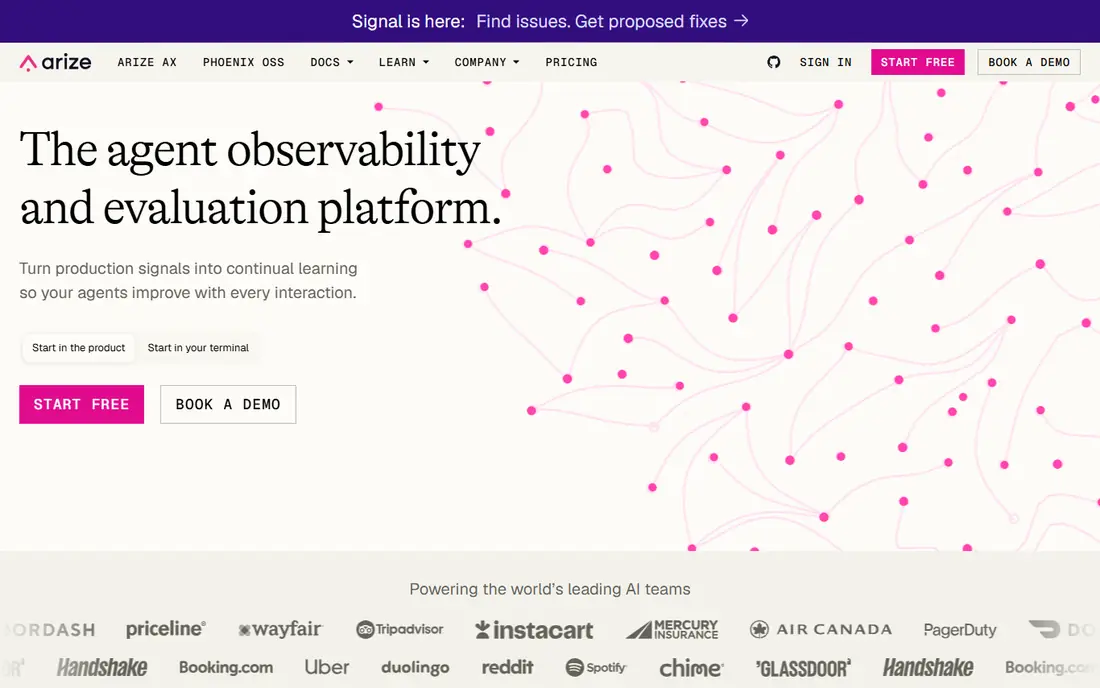
Arize offers Phoenix as an open source observability tool and AX as its managed platform. Phoenix is free to self-host, while AX Free covers 25,000 spans per month and AX Pro costs $50 per month. Both use OpenTelemetry and OpenInference, which makes tracing portable across frameworks and providers.
Arize is strong for retrieval augmented generation debugging and production monitoring, with evaluation templates and session level tracing in newer versions. The two product names can confuse buyers, so start with Phoenix for self-hosting or AX Free for managed use, then upgrade to AX Pro when volume grows. For OTel based teams, Arize is a strong, standards based pick.
- OpenTelemetry native tracing
- Phoenix is open source
- Strong evaluation library
- AX Pro is $50 per month
- Two products can confuse new buyers
Helicone works as a proxy in front of LLM APIs, logging requests, costs, and latency with little code change. Its Hobby plan is free with 10,000 requests per month, while Pro costs $79 per month. That proxy model suits teams that call many providers and want cost and request visibility without rewriting app code.
Helicone was acquired by Mintlify in March 2026, and some comparisons note a slowed roadmap since then. Self-hosting is available on enterprise tiers, not as a simple free deployment. For fast API observability and cost tracking, Helicone remains useful, but check its current roadmap before a long term commitment.
- Drop-in proxy logging
- Per-request cost tracking
- Open source core
- Pro plan is $79 per month
- Roadmap slowed after acquisition by Mintlify in 2026
Portkey combines an AI gateway with observability, letting teams route requests across providers, set fallbacks, apply guardrails, and track costs and traces in one place. Its free tier suits prototypes, with paid plans from $49 per month in recent guides. That gateway role is valuable when a team uses several models and needs one control point.
The trade off is scope. Portkey is broader than a pure tracing tool, so teams that only need traces may prefer Langfuse or LangSmith. For multi-provider apps that need routing, retries, and observability together, Portkey is the best fit here.
- AI gateway for many providers
- Observability, fallbacks, and guardrails
- On-premise on enterprise
- Paid plans from $49 per month
- Gateway features can overlap with app code
Datadog LLM Observability adds language model tracing, evaluations, and cost tracking to Datadog's infrastructure platform. Teams that already monitor servers, apps, and logs in Datadog can see AI traces in the same place, which helps when a slow model call affects an app endpoint. Pricing is usage based and enterprise focused, with no simple free tier for this product.
Datadog makes most sense for organizations already committed to Datadog. Standalone AI teams will find Langfuse, LangSmith, or Arize cheaper and simpler. For enterprise teams that need AI and infrastructure monitoring together, Datadog is the natural choice.
- LLM traces alongside infrastructure monitoring
- Usage based enterprise pricing
- Broad integrations
- Pricing is usage based and enterprise focused
- Best value only inside Datadog
New Relic AI Monitoring tracks language model apps inside New Relic, with traces, token costs, latency, and quality signals alongside application performance data. That unified view helps teams that already use New Relic for apps and infrastructure, since AI problems appear next to the services they affect.
Pricing is usage based and aimed at enterprise buyers, so small teams should compare it against free tier tools first. New Relic suits organizations that have standardized on its platform and want AI monitoring without adding another vendor. Pure AI teams will likely prefer a dedicated observability tool.
- AI monitoring inside New Relic
- Traces, costs, and quality signals
- Enterprise controls
- Pricing is usage based
- Best value only inside New Relic
Weights and Biases Weave is the LLM tracing and evaluation product from Weights and Biases, known for experiment tracking. Weave traces calls, tracks costs, and supports evaluations, with a free tier and paid plans from $60 per month in recent guides. Teams that already track models in Weights and Biases benefit from keeping observability in the same platform.
Weave is less widely discussed as a standalone observability tool than LangSmith or Langfuse, so check its integrations for your stack. For machine learning teams that already use Weights and Biases, Weave is a convenient, capable addition. For pure app teams, Langfuse may be simpler.
- Tracing and evaluations for LLM apps
- Fits teams already using Weights and Biases
- Free tier available
- Paid plans from $60 per month
- Less known as a pure observability tool than LangSmith
HoneyHive combines LLM observability with evaluation workflows, helping teams trace agent runs and test changes against datasets. A free tier is available, with paid plans priced by usage and team size. That evaluation focus suits teams that iterate on prompts and agents often and need to prove that a change improved quality.
Pricing transparency is weaker than LangSmith or Langfuse, so ask for a quote at your volume. The ecosystem is also smaller, which can matter for integrations. HoneyHive fits teams that prioritize evaluations alongside tracing, especially for agent apps where single prompt traces are not enough.
- Tracing plus evaluation workflows
- Good for agent testing
- Free tier available
- Paid pricing is less clearly published
- Smaller ecosystem than LangSmith
Braintrust is an evaluation platform with tracing and prompt management, built around datasets and experiments. Its free tier covers limited usage, with paid plans from $249 per month in recent guides. That evaluation first design suits teams that treat prompt and model changes like software releases, with tests before deployment.
The paid entry price is high compared with Langfuse or LangSmith, and self-hosting is limited to enterprise tiers. Braintrust fits teams that need rigorous evaluations and can justify the cost, especially for production AI products where quality regressions are expensive. Smaller teams may start with Langfuse and add Braintrust later.
- Strong dataset driven evaluations
- Tracing and prompt management
- Free tier available
- Paid plans from $249 per month
- Enterprise self-hosting only
How we picked these
We compared official pricing pages and recent AI observability comparisons from October 2026. We favored tools that trace production LLM and agent apps, track costs, and support evaluations, and we included open source, gateway, and enterprise monitoring options. Where pricing was usage based or quote based, we said so, and we noted retention limits because they affect debugging in production.
How to choose an AI observability tool
Start with your stack. LangChain teams should test LangSmith first. Framework neutral teams should test Langfuse or Arize Phoenix. Multi-provider teams should test Portkey or Helicone. Teams already on Datadog or New Relic should test their existing platform before adding a new vendor.
Check traces, costs, and retention together
A good tool shows the full trace for an agent run, including tool calls and retries, not just the final prompt. It also shows token costs per trace and per user, so you can spot expensive paths. Finally, check retention: a 14-day limit may be fine for debugging, but not for audits or long term quality trends.
Test evaluations on a real failure
Pick a recent bad output from your app and try to reproduce, score, and fix it in each shortlisted tool. The tool that makes that loop fastest, from trace to dataset to new evaluation, is the one your team will actually use. Also check data residency and privacy controls, since traces can contain user prompts.
FAQ
What is the best AI observability tool?
LangSmith is best for LangChain apps, Langfuse is best for open source and framework neutral tracing, and Arize Phoenix is best for OpenTelemetry based teams. The best AI observability tool depends on your framework, your data rules, and whether you need evaluations as well as tracing.
What is the best AI agent observability tool?
LangSmith, Langfuse, and Arize all offer agent observability, with session and trajectory views that show multi-step agent runs. Test each with a real agent trace, including tool calls, to see which view helps your team debug fastest.
Are there free AI observability tools?
Yes, LangSmith, Langfuse, Arize Phoenix, Helicone, Portkey, Weave, HoneyHive, and Braintrust all offer free tiers or free self-hosted versions. Free tiers have volume and retention limits, so check those before using a free plan in production.
How much does AI observability cost?
Free tiers cover prototypes, while paid entry prices here range from $29 per month for Langfuse Core to $39 per seat for LangSmith Plus, $50 for Arize AX Pro, and $79 for Helicone Pro. Costs scale with trace volume, so model your monthly LLM calls before choosing a plan.
Do I need AI observability if I already use Datadog or New Relic?
You may not need a separate tool if your team already uses Datadog or New Relic, since both now offer AI monitoring. A dedicated tool still helps if you need deep prompt evaluations, dataset testing, or self-hosting that your existing platform does not provide.
Can I self-host AI observability tools?
Yes, Langfuse and Arize Phoenix offer full self-hosting, while LangSmith and Braintrust offer self-hosting mainly on enterprise tiers. Self-hosting keeps prompt data in your infrastructure but adds maintenance, upgrades, and storage costs.