Best AI Model Orchestration Platforms in 2026: 8 Platforms Compared
We compared the best AI model orchestration platforms, from LangGraph and Flyte to Airflow and Dagster, on pipelines, scaling, and ease of use for teams.
- Editor's choice
 LangGraph
Stateful agent and model workflows
Starts atFreeVisit langchain.comFull review - Great alternative
 CrewAI
Role-based multi-agent crews
Starts atFreeVisit crewai.comFull review - Also consider
 Flyte
Scalable ML and data workflows
Starts atFreeVisit flyte.orgFull review
TL;DR:
- LangGraph and CrewAI suit agent and multi-step model workflows where state, retries, and human approval matter.
- Flyte, Kubeflow, Airflow, and Dagster suit data and model pipelines that must run on a schedule, at scale, and with retries.
- Prefect and MLflow suit teams that want simpler orchestration or strong experiment tracking alongside their pipelines.
- Most core frameworks are open source, so the real cost is hosting, engineering time, and model API usage.
- The best AI model orchestration platform matches your workload: agents, batch pipelines, or training jobs.
Quick comparison
| Tool | Best for | Starts at | Free plan? | |
|---|---|---|---|---|
| LangGraph | Stateful agent and model workflows | Free | Yes | Visit |
| CrewAI | Role-based multi-agent crews | Free | Yes | Visit |
| Flyte | Scalable ML and data workflows | Free | Yes | Visit |
 Kubeflow | ML pipelines on Kubernetes | Free | Yes | Visit |
 Apache Airflow | Scheduled data and model pipelines | Free | Yes | Visit |
 Dagster | Data-aware pipeline orchestration | Free | Yes | Visit |
 Prefect | Simpler Python workflow orchestration | Free | Yes | Visit |
 MLflow | Experiment tracking and model lifecycle | Free | Yes | Visit |
The best AI model orchestration platforms
AI model orchestration means coordinating the steps around a model: getting data, calling the model, checking results, retrying failures, and handing output to the next step. We compared official documentation, pricing pages, and project pages for tools that are actively maintained in October 2026.

LangGraph models a workflow as a graph of nodes and edges, with typed state that persists between steps. That design suits agent workflows that loop, branch, call tools, and pause for human approval, because the run can resume from a saved checkpoint after a failure instead of starting over. It builds on the LangChain ecosystem, so teams get many model and tool integrations.
LangGraph is our pick for teams building production agents with complex control flow. The catch is that you write and maintain the graph in code, and non-engineers will not own it directly. Managed deployment through LangSmith adds cost on top of the free framework, so budget for seats and usage if you use the hosted path.
- Explicit graph control with checkpointing
- Human-in-the-loop steps
- Large LangChain integration ecosystem
- Code-heavy with no visual builder
- Managed hosting adds seat and usage costs
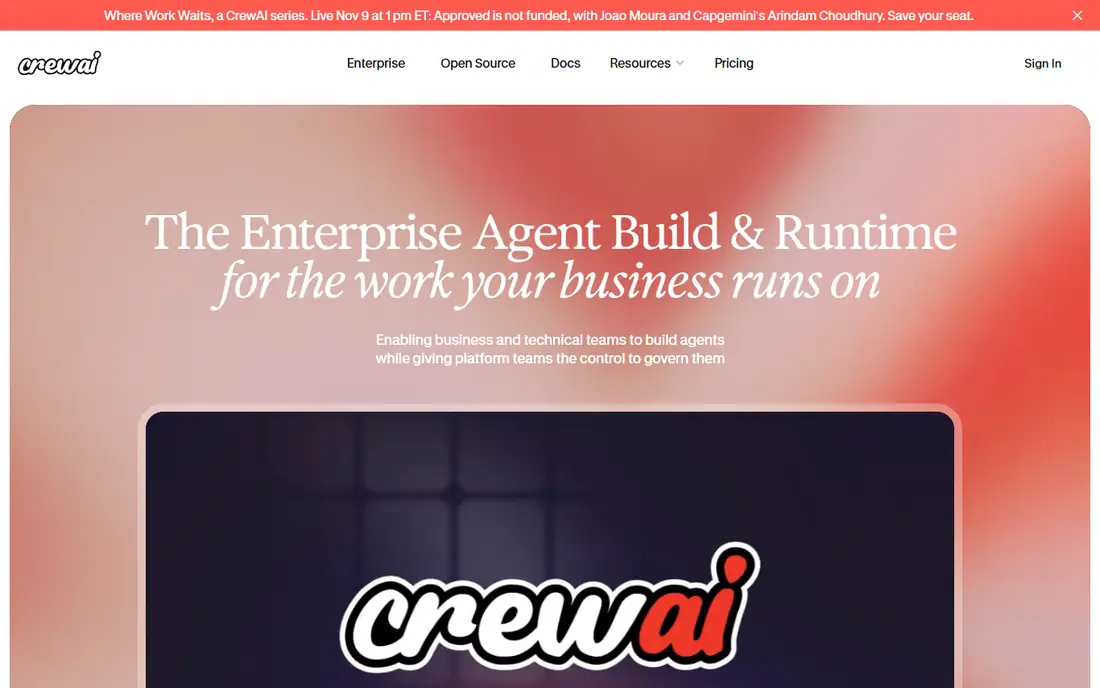
CrewAI organizes work as crews of agents, each with a role, a goal, and tools, and it runs them in sequence or in a hierarchy. That model is easy to explain to a team and fast to prototype, which is why it became popular for multi-agent tasks such as research, drafting, and review. The open-source core is free, and a paid cloud offering exists for teams that want managed runs.
CrewAI fits teams that want a working multi-agent system quickly and do not need to control every state transition by hand. The trade-off is control. When a workflow needs precise checkpointing, branching, and recovery, LangGraph gives more direct control, while CrewAI trades some of that for speed and simplicity.
- Simple role, goal, and task model
- Fast to prototype
- Open-source core
- Less fine-grained state control than LangGraph
- Paid cloud tiers add cost at scale
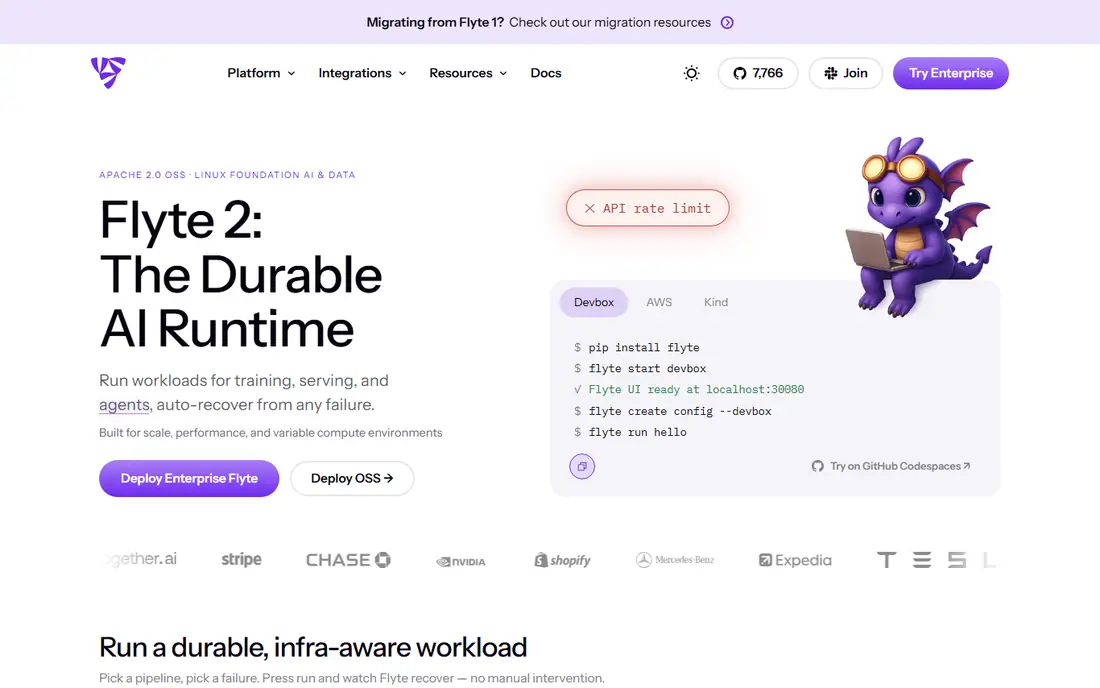
Flyte is a workflow orchestrator built for machine learning and data pipelines at scale, with typed tasks, versioned workflows, and execution on Kubernetes. It handles retries, caching, and parallel runs, which matters when training or batch inference jobs are long and expensive. Teams at larger ML organizations use it to keep pipelines reproducible across environments.
Flyte fits teams that run serious ML workloads and already operate Kubernetes. The honest cost is operations skill. A small team without platform engineering may find Flyte heavier to run than Prefect or Dagster, even though the software itself is free.
- Built for large-scale ML workflows
- Strong typing and versioning
- Runs on Kubernetes
- Setup and operations need platform skills
- Smaller community than Airflow
Kubeflow brings machine learning workflows to Kubernetes, with components for pipelines, distributed training, model serving, and notebooks. It suits organizations that have standardized on Kubernetes and want their ML platform to run the same way in any cloud or on premises. Pipelines can be built in Python and versioned like code.
Kubeflow is a strong choice for platform teams, and a poor choice for a small team that just wants to schedule a few jobs. Installation, upgrades, and component choices take real Kubernetes skill, and the project moves fast enough that keeping up is part of the job.
- Full ML lifecycle on Kubernetes
- Pipelines, training, and serving components
- Portable across clouds
- Complex to install and upgrade
- Needs Kubernetes expertise
Apache Airflow is the most widely used open-source workflow orchestrator, and it defines pipelines as code in Python, with a scheduler, a web interface, and a large library of operators for databases, clouds, and tools. It suits batch pipelines that run on a schedule, such as nightly data preparation, model retraining, and batch scoring. Managed Airflow services exist for teams that do not want to run it themselves.
Airflow fits teams that want a proven, well-understood scheduler and a large hiring pool. The catch is that Airflow is built around scheduled, batch-style workflows, so highly dynamic agent loops or event-driven model calls fit less naturally than they do in LangGraph or Prefect.
- Mature scheduler with a huge operator library
- Python-defined workflows
- Wide adoption
- Dynamic or event-driven workflows are awkward
- Needs care at large scale
Dagster organizes pipelines around data assets, so each step declares what it produces and what it depends on. That makes it easier to see which models or reports are stale, to backfill a single asset, and to test a pipeline locally before deploying it. Its interface shows asset health and run history in a way that data teams find practical.
Dagster fits data and ML teams that think in terms of datasets and models rather than just tasks. The trade-off is the learning curve. Teams used to plain task graphs need time to adopt the asset model, and the managed cloud offering adds a subscription on top of the free open-source core.
- Data assets as first-class concepts
- Good local development experience
- Strong observability
- Learning curve for the asset model
- Managed cloud adds cost
Prefect lets developers turn Python functions into workflows with retries, scheduling, and observability, with less setup than a full platform install. It handles dynamic workflows well, where the next step depends on the result of the last one, which suits model pipelines that branch on data quality or model output. A managed cloud version removes the need to host the control plane.
Prefect is our pick for teams that want to move fast in Python without adopting a heavy platform. The catch is cost at scale on the managed tier, where usage-based pricing needs monitoring. Self-hosting the open-source version avoids that, but then your team owns operations.
- Python-native and easy to start
- Dynamic workflows
- Managed cloud option
- Managed pricing is usage based
- Very large deployments need planning
MLflow covers the model lifecycle around orchestration: tracking experiments and parameters, comparing runs, registering models, and packaging them for deployment. It is framework neutral, so teams using different training libraries can share one registry and one history of results. That makes it a useful companion to Airflow, Dagster, or Flyte rather than a replacement for them.
MLflow fits almost any ML team as a first step toward organized model work. The honest limit is scope. If you need scheduling, retries, and dependency management across many steps, pair MLflow with a true orchestrator from this list instead of stretching it into that role.
- Experiment tracking, model registry, and deployment tools
- Framework neutral
- Easy to adopt
- Not a full pipeline scheduler by itself
- Needs another orchestrator for complex scheduling
How we picked these
We compared official documentation, pricing pages, and project activity for tools that orchestrate model-related work in October 2026. We kept tools that are actively maintained and widely used, and we covered three kinds of work: agent workflows, data and training pipelines, and model lifecycle management. We excluded tools that only host models or only provide observability, because they do not orchestrate steps.
What to check before you buy
Start by naming your workload type. Agent workflows need state, retries, and human approval, while batch pipelines need scheduling, backfills, and data dependencies. A tool that excels at one may be awkward at the other, so test with a real workflow, not a toy example, and include a failure case.
Then check the cost beyond the license. Open-source tools are free to download, but hosting, storage, model API calls, and engineering time are not. If you choose a managed service, ask how usage is metered and what a busy month would cost. Finally, check observability. You need to trace a run, see which step failed, and replay it, or debugging will eat the time orchestration was meant to save.
FAQ
What is AI model orchestration?
AI model orchestration is the coordination of steps around a model, such as preparing data, calling the model, checking output, retrying failures, and passing results onward. It turns a single model call into a reliable workflow that can run on a schedule, at scale, or as part of an agent. Without it, teams end up with fragile scripts that are hard to debug and rerun.
What is the best software for AI model orchestration?
The best software for AI model orchestration depends on the workload. LangGraph suits stateful agent workflows, while Airflow, Dagster, and Flyte suit scheduled data and training pipelines. MLflow suits experiment tracking and model registry needs, and Prefect suits teams that want a simpler Python-native start.
Are AI model orchestration tools free?
Many core frameworks are open source and free to use, including LangGraph, Airflow, Dagster, Prefect, Flyte, Kubeflow, and MLflow. Costs come from hosting, managed services, model API usage, and engineering time. Always compare the total running cost, not just the license price.
Do I need Kubernetes for AI orchestration?
No, Kubernetes is required mainly for Kubeflow and commonly used with Flyte, but Airflow, Dagster, Prefect, and LangGraph run without it. Kubernetes helps at large scale and for portable ML platforms, but it adds operational work. Start without it unless your team already runs Kubernetes well.
How do agent frameworks differ from pipeline orchestrators?
Agent frameworks such as LangGraph and CrewAI manage multi-step reasoning, tool use, and state inside an agent run. Pipeline orchestrators such as Airflow and Dagster manage scheduled, repeatable jobs across data and models. Many production systems use both: a pipeline prepares data and retrains a model, and an agent framework uses that model at run time.