Best AI Mode SEO Tracking Tools in 2026: 8 Tools Compared
Compare the best AI Mode SEO tracking tools for 2026, with pricing, engines covered, and prompt tracking, so you can see how your brand shows up in AI answers.

- Editor's choice
 Peec AI
SEO teams and agencies
Starts at$95 per monthVisit peec.aiFull review - Great alternative
 Profound
Enterprise brand tracking
Starts atSee websiteVisit tryprofound.comFull review - Also consider
 Otterly.AI
Small budgets
Starts at$29 per monthVisit otterly.aiFull review
TL;DR:
- Google AI Mode gives short, sourced answers instead of a list of links, so a tool must check the answer itself, not just a ranking position.
- Otterly.AI is the cheapest clear starting point in this list, while Profound and Scrunch suit larger teams with bigger budgets.
- Peec AI stands out for agencies because it does not charge per seat, which keeps multi-client reporting simpler.
- Prices and engine coverage change often in this new category, so confirm the current plan on the vendor site before you pay.
Quick comparison
| Tool | Best for | Starts at | Free plan? | |
|---|---|---|---|---|
| Peec AI | SEO teams and agencies | $95 per month | Free trial | Visit |
| Profound | Enterprise brand tracking | See website | Free trial | Visit |
| Otterly.AI | Small budgets | $29 per month | Free trial | Visit |
 Scrunch | Teams that also want site audits | $250 per month | Free trial | Visit |
 AthenaHQ | Trying many AI engines | Free | Yes | Visit |
 Goodie AI | Revenue and shopping visibility | $399 per month | Free trial | Visit |
 ZipTie | Paying only for what you track | See website | No | Visit |
 Rankscale | Low cost multi-engine tracking | $20 per month | Free trial | Visit |
The best AI Mode SEO tracking tools
AI Mode is the part of Google Search that answers a question directly, with sources cited inside the answer. These tools run your prompts through AI Mode and other answer engines, then record whether your brand appears, what gets cited, and how that changes over time.
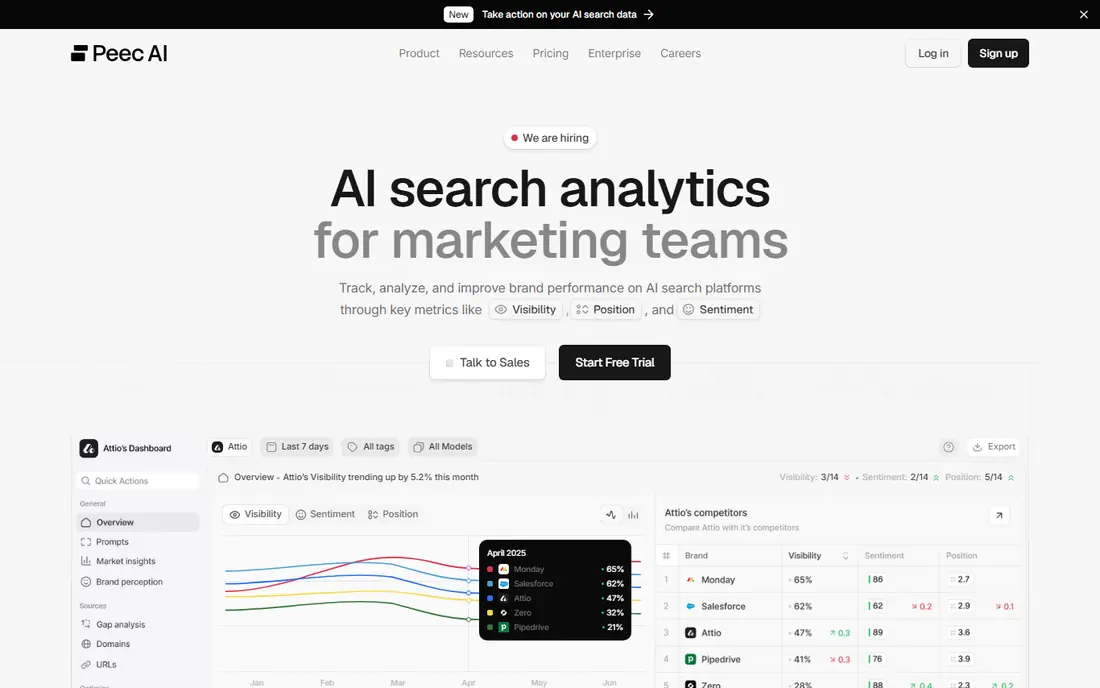
Peec AI is our pick for most SEO teams that need AI Mode tracking without a long sales process. You add the prompts your customers actually ask, choose which engines to watch, and get a daily view of brand mentions, citations and competitor positions. The dashboard stays focused on answers rather than drowning you in charts, which makes the weekly report easier to write.
The catch is the engine limit on the entry plan. If you want AI Mode, ChatGPT, Gemini and Perplexity all at once, you will need a higher plan or a careful rotation of engines. Agencies will still like the unlimited seats, because clients and colleagues can view reports without adding to the bill. Check the current engine list before subscribing, since vendors add and remove engines as these platforms change.
- Covers AI Mode alongside ChatGPT, AI Overviews, Gemini, Copilot and Naver
- Unlimited seats on paid plans
- Prompt-level competitor tracking
- Entry plan covers only three engines at a time
- Pricing is higher than the cheapest tools here

Profound is the tool to shortlist when AI visibility is a board-level concern rather than a side project. It tracks a wide set of answer engines, including AI Mode, ChatGPT, Gemini, AI Overviews, Claude, Copilot, Grok and DeepSeek on enterprise tiers, and it pairs that tracking with data about how AI crawlers visit your site. That combination helps a large team explain why a brand appears in some answers and not others.
The trade-off is cost and complexity. There is no simple published starter price, and the full feature set is built for teams with a formal buying process. A small business that only wants to watch a handful of prompts will get the same headline answer from a cheaper tool. For an enterprise team, though, the depth of engine coverage and the analytics connections are hard to match.
- Very wide engine coverage on enterprise plans
- Connects AI crawler activity to analytics tools
- Content agents turn findings into fixes
- Pricing is quote based and aimed at larger budgets
- Smaller teams may find the setup heavier than they need
Otterly.AI is the sensible first step if you are new to AI search tracking. The entry plan is far cheaper than most rivals, and it still covers ChatGPT, AI Overviews, Perplexity and Copilot, with Gemini, AI Mode and Claude available as add-ons. For a small site watching its core commercial questions, 15 prompts is often enough to learn whether AI answers are sending you traffic or sending it to a competitor.
The limit to watch is prompt count. Once you add brand terms, product comparisons and local questions, 15 prompts fill up fast, and the next tier is a jump in price. Otterly.AI also keeps its interface simple, which is a strength for a solo marketer and a weakness for a team that wants deep citation analysis. Start here, learn which prompts matter, and upgrade only when the list outgrows the plan.
- Lowest published entry price in this list
- Simple daily tracking
- Unlimited seats
- Entry plan covers only 15 prompts
- Some engines are paid add-ons
Scrunch suits a team that wants more than a mention count. Alongside daily prompt tracking, it audits your site for the things that affect how AI systems read and cite it, such as page structure and clarity. That makes it a good fit for a content team that already publishes regularly and wants its existing pages to show up more often in AI answers.
The price puts it out of reach for many small businesses, and that is the honest catch. At $250 per month, you are paying for the audit and optimisation side as well as the tracking, so it only makes sense if someone on your team will act on the audit findings. If you only need to know whether your brand appears in AI Mode, a cheaper tracker will do that job for less.
- Combines prompt monitoring with AI-focused site audits
- Covers ChatGPT, Perplexity, AI Overviews and Copilot
- Guidance on making pages easier for AI systems to read
- High entry price for small teams
- Fewer prompts than some cheaper rivals at a similar spend
AthenaHQ is the best way to try AI Mode tracking without paying first. The free tier gives you a set of credits to run checks across engines including ChatGPT, Perplexity, AI Overviews, Gemini and Copilot, so you can see real answers for your brand before committing. On paid plans the engine list widens further, which suits a team that wants to compare how different AI systems describe the same brand.
The jump from free to paid is steep, and the credit model needs care. One credit equals one answer, so a long prompt list checked daily will use credits faster than a weekly check of a short list. That said, for a team that is still deciding whether AI search matters for its market, the free tier removes the risk of paying for a tool before you know the answer.
- Free tier lets you try real tracking before paying
- Broad engine coverage on paid plans
- Credit based system suits uneven workloads
- Paid plans start much higher than the free tier suggests
- Credit counting takes a little getting used to
Goodie AI is built for brands that sell products and want to know whether AI answers recommend those products. It tracks visibility at the product level, not just the brand level, and it links that visibility to revenue and shopping behaviour. For an ecommerce team, that is a genuinely different question from "did we get mentioned," and it is the reason Goodie charges more than a basic tracker.
For a service business or a publisher, much of that product depth will go unused, and the price will feel hard to justify. Goodie also expects a team that will act on its optimisation suggestions each month. If you sell physical products through AI shopping answers, shortlist it. If you do not, pick a cheaper tracker and spend the difference on content.
- Tracks AI Mode, ChatGPT, AI Overviews, Perplexity and Copilot
- SKU level tracking for product brands
- Revenue attribution features
- Expensive entry price
- More than a content-only team is likely to need
ZipTie takes a different approach to pricing, and it will appeal to buyers who dislike paying a flat monthly fee for prompts they rarely check. You pay per check, choose the frequency for each prompt, and add engines without a per-engine surcharge. Seats, projects and competitors are unlimited, which keeps agency reporting simple.
The downside is that there is no free tier to learn on, so you need to plan your prompt list before you start spending. ZipTie also focuses on measurement rather than drafting fixes for you, so your team still has to turn the findings into content changes. For a careful buyer who wants transparent, traceable numbers, that focus is a strength. For a buyer who wants the tool to write the fix, look at Scrunch or Goodie instead.
- Usage based pricing with no per-seat charges
- You choose daily, weekly or monthly checks
- Traceable numbers linked to the underlying answers
- No free plan
- Pricing depends on how many prompts and engines you run, so totals vary
Rankscale is worth a look if your budget is tight but your engine list is long. It covers more answer engines than most tools near its price, including several that larger tools reserve for higher tiers. The entry plan is cheap, and the credit system means a team that checks prompts weekly rather than daily can stretch a small budget further.
The catch is maturity. Rankscale is a smaller name than Profound or Peec AI, and its public documentation is thinner, so you should run the trial with your real prompts and check that the answers it records match what you see in the apps themselves. If the trial holds up, it is one of the best value options here. If you need vendor support and long track records, pay more for a larger tool.
- Low entry price with a wide engine list
- Credit based plans suit smaller prompt lists
- Covers ChatGPT, Gemini, Perplexity, Claude, DeepSeek, Mistral, Grok and Copilot
- Smaller vendor with less public documentation than the leaders
- Plan limits are credit based and need checking
How we picked these
We compared official feature pages, pricing pages and public comparisons for tools that track AI Mode and other answer engines, and we kept only tools that check the answer itself rather than a traditional search ranking. We favoured tools with a published price or a clear trial, a prompt list you can edit, and coverage of Google AI Mode or AI Overviews alongside ChatGPT and Perplexity. Where prices differ between sources, we used the more conservative figure or listed the price as See website, and you should confirm the current plan before buying.
What to check before you buy an AI Mode tracker
Start with your prompt list, not the vendor demo. Write down the 20 to 50 questions your customers actually ask, including comparisons, "best" lists and problem questions, then ask each vendor how many of those prompts are included, how often they are checked, and which engines are covered on the plan you would buy. A tool that checks 200 prompts weekly is not the same as one that checks 50 prompts daily, and the difference matters when an AI answer changes after a news story or a product launch.
Next, check what you get beyond a mention count. Citations tell you which pages the AI system trusts, competitor tracking tells you who is winning the answer, and sentiment or share of voice tells you whether the mention helps you. Decide which of those you will actually use in a monthly report. Finally, ask how the data leaves the tool. Exports and reports matter because AI visibility work usually needs to be shared with people who will never log in to the tracker itself.
Picking the right plan size
If you are a solo marketer, start with the smallest plan that covers your core prompts and one competitor. If you run an agency, favour unlimited seats and per-client workspaces over a slightly lower headline price, because seat charges add up fast across clients. Enterprise teams should ask about API access, historical data and security review early, since those are often restricted to higher tiers.
FAQ
What is the best AI Mode SEO tracking tool?
There is no single winner, because the right tool depends on budget and prompt count. Otterly.AI is the cheapest clear starting point, Peec AI suits agencies that need unlimited seats, and Profound suits enterprises that need the widest engine coverage. Start with a trial on your real prompts before committing to a yearly plan.
What is the best AI Mode SEO tracking tool for a small business?
Otterly.AI or Rankscale are the strongest small business options here, because both start at a low monthly price and cover the main answer engines. AthenaHQ is also worth trying first, since its free tier lets you see real results before you pay. Keep your prompt list short at first, then expand it once you know which questions drive enquiries.
How is AI Mode tracking different from normal rank tracking?
Normal rank tracking records your position in a list of links for a keyword. AI Mode tracking records whether your brand appears inside a generated answer, which sources are cited, and how competitors are described. A brand can rank well in classic results and still be absent from the AI answer, which is why the two kinds of tracking measure different things.
Do these tools also track ChatGPT and Perplexity?
Most of them do, but engine coverage varies by plan, so check the plan details rather than the homepage headline. Peec AI, Profound, Scrunch, AthenaHQ and Rankscale all cover several answer engines, while some engines on Otterly.AI are paid add-ons. If one engine drives most of your traffic, make sure it is included on the plan you buy.
How often should AI Mode prompts be checked?
Daily checks suit fast-moving topics such as product launches, news and pricing comparisons, because AI answers can change quickly. Weekly checks are enough for stable topics such as evergreen guides and brand terms, and they cost less on credit based plans. Many teams check their top commercial prompts daily and the rest weekly.
Can AI Mode tracking replace Google Search Console?
No, it should sit alongside Search Console rather than replace it. Search Console shows real clicks and impressions from Google Search, while an AI tracker shows how AI answers describe your brand, including answers that never produce a click. Use both together to see the full picture of how people find you.