Best AI Image Detector Tools in 2026: 9 Tools Compared
Compare the best AI image detector tools in 2026, with free checks, API detection, accuracy limits and pricing for journalists, teachers and teams and tips.
- Editor's choice
 Illuminarty
Everyday single-image checks
Starts atFreeVisit illuminarty.comFull review - Great alternative
 Sightengine
Product moderation and API use
Starts at$29 per monthVisit sightengine.comFull review - Also consider
 Hive Moderation
Platforms at scale
Starts atSee websiteVisit hivemoderation.comFull review
TL;DR:
- No AI image detector is fully reliable, so use detectors as a signal for human review, not as a final verdict.
- Illuminarty is our pick for everyday checks, free for a few images per day, with explanations that help you judge a result.
- Sightengine suits teams building moderation into a product, from $29 per month for 10,000 operations, with a free tier.
- Hive Moderation suits platforms at scale, with usage pricing around $3 per 1,000 images for moderation and about $6 per 1,000 for AI detection.
- Running two detectors on a borderline image catches more errors than trusting one score alone.
Quick comparison
| Tool | Best for | Starts at | Free plan? | |
|---|---|---|---|---|
| Illuminarty | Everyday single-image checks | Free | Yes | Visit |
| Sightengine | Product moderation and API use | $29 per month | Yes | Visit |
| Hive Moderation | Platforms at scale | See website | Yes | Visit |
 AI or Not | Quick casual checks | $5 per month | Yes | Visit |
 ZeroGPT | Free single-image self-checks | Free | Yes | Visit |
 Copyleaks | Text plus image checking | $9.99 per month | Free trial | Visit |
 Winston AI | Text plus image dashboards | $19 per month | Free trial | Visit |
 DeepAI | Developers using other DeepAI tools | $5 per month | Yes | Visit |
 Reality Defender | Enterprise deepfake screening | See website | Free trial | Visit |
The best AI image detector tools
AI-generated images now fool most people most of the time, especially after compression and cropping. Detectors help by looking for statistical patterns, artefacts and model fingerprints that humans miss, but even the best tools miss 5 to 15 percent of AI images and flag some real photos wrongly. The tools below cover casual checks, newsroom verification and platform-scale moderation, and we compared official pricing pages and feature documentation for tools in active use in 2026.
Illuminarty is the best starting point for a journalist, teacher or curious reader checking one image. It offers a few free checks per day, with a paid tier for more, and it explains its reasoning with visual cues that help you see which parts of an image look synthetic. That explainability matters, because a bare percentage score tells you nothing about why a tool is suspicious.
The free tier will not suit a team checking thousands of images, and Illuminarty is not a bulk moderation API. For single-image verification, classroom use and second opinions on viral photos, it is the most helpful free tool here. Pair it with another detector on borderline cases, and treat a close score as uncertain, not as proof either way.
- Free daily checks
- Explanations and heatmaps for borderline images
- Simple interface
- Free tier limits daily checks
- Not built for bulk API moderation

Sightengine is a moderation API that also detects AI-generated images, which makes it a good fit for apps, marketplaces and social products that already need content moderation. The free tier covers 2,000 operations per month, capped at 500 per day, and the Starter plan costs $29 per month for 10,000 operations. Pricing per operation is about $0.002, or $2 per 1,000 operations, in recent reports.
Rate limits apply on free and starter plans, at one request per second in recent documentation, so high-volume teams need a higher plan. Sightengine also covers nudity, violence and other moderation categories, so a product team can combine AI detection with safety checks in one API. For a developer building moderation into a product, it is one of the clearest and most affordable options.
- Free tier with 2,000 operations per month
- Clear API
- Combines AI detection with moderation
- Rate limits on free and starter plans
- Per-operation costs add up at scale
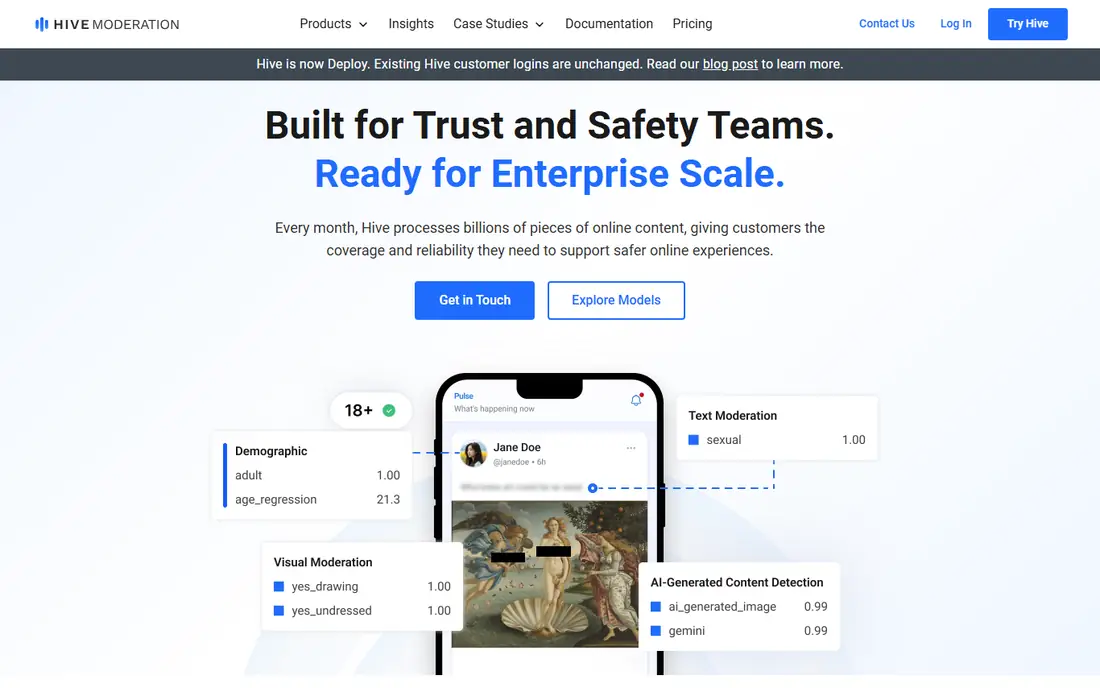
Hive Moderation, from Hive AI, is built for platforms moderating large volumes of user content. It detects AI-generated images, video and audio through an API, with usage pricing reported at about $3 per 1,000 images for general moderation and about $6 per 1,000 requests for dedicated AI detection, plus a developer tier with 100 requests per day. A free browser checker and Chrome extension let casual users test single images without a contract.
Pricing varies by endpoint, so confirm which endpoint you are pricing before comparing Hive with rivals, since moderation and AI detection rates differ. Enterprise volumes go through sales, with higher rate limits and support. For a platform, brand-safety vendor or large publisher, Hive is the scale pick in this list.
- Scales to platform volumes
- Image, video and audio detection
- Free browser checker for casual use
- Pricing varies by endpoint
- Enterprise sales process for large volumes
AI or Not is the quickest casual checker here: upload an image, get a verdict, move on. The free tier includes about $5 of credits, worth roughly 20 image checks in recent reports, and paid plans start at $5 per month for about 500 checks. Credits work across image and audio checks, which suits users who check both media types occasionally.
Detail on borderline results is thinner than Illuminarty, so a close score needs a second tool. The credit model also needs a little tracking if you check often. For a reader, student or social media user who wants a fast second opinion without signing up for an API, AI or Not is a handy, low-cost option.
- Very simple interface
- Low-cost credit packs
- Covers image and audio checks
- Limited detail on borderline results
- Credit model needs tracking
ZeroGPT is best known for text detection, but it also offers AI image detection, and its free tier makes it a useful first pass for a single image. Upload a photo, get a verdict, and decide whether a deeper check is worth it. That simplicity suits self-checks, homework checks and quick social media verification.
Image detection is not ZeroGPT's main focus, and specialists like Illuminarty or Sightengine are likely tuned better for image-specific signals. API access is limited on the free tier, so developers should look elsewhere. As a free, no-fuss first check, ZeroGPT earns its place, especially when paired with a second detector.
- Free to use
- Simple single-image checks
- No signup needed for basic checks
- Image detection is not its main focus
- Limited API on the free tier
Copyleaks suits schools, publishers and content teams that need text and image checking in one dashboard. Paid plans start at $9.99 per month, with API access and reporting tools that help a team review many submissions. The text detection side is well documented, with high published accuracy figures for text, while image detection sits inside the broader AI detection suite.
Do not mistake text accuracy for image accuracy: the published figures cover text, and image performance varies by generator and image type. For a team that already checks text for AI use and wants image checks in the same workflow, Copyleaks is convenient. For image-only work, a specialist may give clearer image-specific detail.
- Combines text and image detection
- Good for schools and publishers
- Clear dashboards
- Published accuracy figures cover text, not images
- Image features are part of a broader suite
Winston AI, like Copyleaks, combines AI text detection, image detection and plagiarism checks in one dashboard, starting at $19 per month. That bundle suits educators and editors who review student work, freelance submissions and published content, and who want one report rather than three tools. Team features and history tracking help a department keep records.
Image detection is secondary to text here, and the starting price is higher than casual single-image checkers. A newsroom or classroom that mainly checks images should start with Illuminarty or Sightengine. A team that checks text and images together will get more value from Winston AI as a combined workflow.
- Combines text and image detection
- Team dashboards
- Plagiarism checks included
- Image detection is secondary to text
- Starting price is higher than casual checkers
DeepAI offers an AI image detector alongside its image generation, editing and API tools, with a free tier and a paid plan at $5 per month. That makes it convenient for a developer already using DeepAI for other work, since detection sits in the same account and API family. The interface is simple, and API access lets a small project add a check without a large contract.
Detector quality varies by generator and image type, as with every tool here, and DeepAI is less specialised for moderation than Hive or Sightengine. For a hobby project, a small app or a developer testing detection ideas, DeepAI is a low-cost, low-friction start. For production moderation, choose a specialist.
- Free tier plus $5 per month paid plan
- API access
- Fits a broader DeepAI workflow
- Detector quality varies by model
- Less specialised than Hive or Sightengine
Reality Defender is an enterprise deepfake detection platform covering audio, video and image, with real-time screening for calls, meetings and communications. It suits fraud prevention teams, financial institutions and identity verification workflows, where a fake voice or video carries direct financial risk. A free tier with 50 audio or image scans per month in recent reports lets teams test it before a sales conversation.
Pricing for larger use is quote-based, and the platform is overkill for checking a single viral photo. Company-reported accuracy figures should also be read as marketing numbers, not independent lab results, since they are not broken out by modality or false-positive rate. For enterprise screening, Reality Defender is a serious, multimodal option.
- Multimodal detection across audio, video and image
- Real-time screening
- Built for fraud and identity risk
- Enterprise pricing by quote
- Overkill for casual single-image checks
How we picked these
We compared official pricing pages, free tiers and feature documentation for AI image detectors in active use in 2026, covering casual checks, API moderation and enterprise screening. We favoured tools with a usable free tier or trial, clear API options where claimed, and honest limits, and we noted where published accuracy figures covered text rather than images. We did not run a controlled benchmark across every generator, and we did not invent accuracy scores. Test each shortlisted tool on images from the newest generators before relying on it for high-stakes decisions.
How to verify an image without being fooled by one score
Start with context, not the detector. Ask where the image came from, who shared it first, and whether a trusted source has published the same image. Reverse image search often finds the original, an earlier version, or a debunk, faster than any detector. Check metadata, shadows, hands, text in the image and background details, but remember that newer generators fix many of those tells.
Next, run two detectors, not one. Use Illuminarty for an explained check and Sightengine or Hive for a second opinion on borderline cases, and treat agreement as stronger evidence than a single high score. A close or conflicting result means uncertain, not fake or real. For high-stakes cases, such as news publication, legal evidence or fraud decisions, add human expert review and, where possible, contact the source directly.
Finally, never use a detector score alone to accuse a person of faking an image. False positives happen, especially on compressed, cropped or heavily edited real photos, and a public accusation based on one score can harm an innocent person. Use detectors to prioritise review, keep records of your checks, and state uncertainty honestly when you publish or report a finding.
FAQ
What is the best AI image detector tool overall?
Illuminarty is our pick for everyday single-image checks, free for a few images per day, with explanations that help you judge a result. Sightengine is best for teams building detection into a product, and Hive Moderation is best for platforms at scale. No tool is fully reliable alone, so use two detectors on borderline images.
Are AI image detectors accurate?
They are useful but not conclusive. Even the best tools miss 5 to 15 percent of AI images and flag some real photos wrongly, and accuracy varies by generator, compression and editing. Treat a detector score as a signal for human review, not as proof. Agreement between two detectors is stronger evidence than one score.
Is there a free AI image detector?
Yes. Illuminarty offers free daily checks, AI or Not includes free credits, ZeroGPT offers free single-image checks, and Sightengine offers a free tier with 2,000 operations per month. Hive also offers a free browser checker. Free tiers suit occasional checks, while bulk work needs a paid plan or API.
Can AI detectors detect images from Midjourney, DALL-E and Stable Diffusion?
Most detectors aim to cover major generators, including Midjourney, DALL-E and Stable Diffusion, but performance drops on the newest model versions and on images that have been compressed, cropped or edited. Test a detector on images from the newest generators before relying on it, and re-test as models update.
What is the difference between an AI image detector and a deepfake detector?
An AI image detector checks whether a still image was likely generated by AI. A deepfake detector, like Reality Defender, also covers video and audio, including face swaps and voice clones, often in real time. For a single photo, an image detector is enough. For video calls, voice fraud or identity checks, use a multimodal deepfake platform.
Should I trust a detector score to publish a story?
No, not alone. Use the score as one input alongside source checks, reverse image search, metadata review and, for important stories, expert or source confirmation. State uncertainty honestly if the evidence is mixed, and keep records of every check you ran. A single score should never be the sole basis for a public claim.