Best AI Citation Analysis Software in 2026: 9 Tools Compared
Compare the best AI citation analysis software for research, from Scite and Semantic Scholar to Connected Papers, Litmaps, and ResearchRabbit in 2026.
- Editor's choice
 Scite
Smart citations and claim checking
Starts at$20 per monthVisit scite.aiFull review - Great alternative
 Semantic Scholar
Free scholarly search and citations
Starts atFreeVisit semanticscholar.orgFull review - Also consider
 Connected Papers
Visual related-paper maps
Starts atSee websiteVisit connectedpapers.comFull review
TL;DR:
- Citation analysis tools differ: Scite classifies how papers cite a claim, while Connected Papers and Litmaps map related papers, and Semantic Scholar offers broad search.
- A citation count alone does not prove a finding is sound, since later papers may mention, support, or contrast a claim for different reasons.
- Free tools such as Semantic Scholar, ResearchRabbit, and Connected Papers cover many needs, while Scite suits deeper claim checking.
- Always read the citing paper in context before citing a support or contrast label, since classifications can miss nuance, methods, or scope.
- For a systematic review, use these tools for discovery and scoping, then follow a formal search protocol in established databases.
Quick comparison
| Tool | Best for | Starts at | Free plan? | |
|---|---|---|---|---|
| Scite | Smart citations and claim checking | $20 per month | Yes | Visit |
| Semantic Scholar | Free scholarly search and citations | Free | Yes | Visit |
| Connected Papers | Visual related-paper maps | See website | Yes | Visit |
 ResearchRabbit | Free citation discovery maps | Free | Yes | Visit |
 Litmaps | Literature maps and discovery | See website | Yes | Visit |
 Elicit | AI-assisted literature research | See website | No | Visit |
 Consensus | Evidence-based research answers | See website | No | Visit |
 SciSpace | AI research reading and analysis | See website | No | Visit |
 Scholarcy | Article summaries and citation extraction | See website | No | Visit |
The best AI citation analysis software
We compared tools on citation data, classification, mapping, search, pricing, and fit for students, researchers, and librarians. Our pick for most researchers is Scite, because Smart Citations show how later papers treat a claim, not only how often a paper was cited.
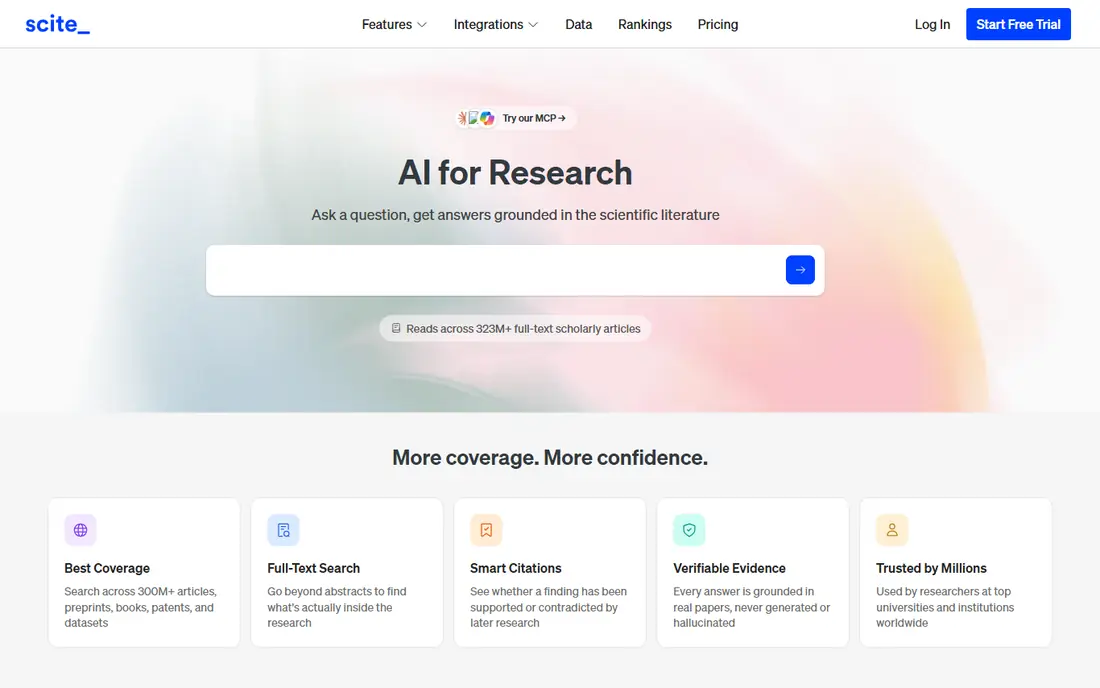
Scite fits researchers, librarians, and editors who need to check whether a finding still holds up. Instead of a bare citation count, Scite shows citing sentences and classifies them, so you can see whether later work supported, merely mentioned, or contrasted a claim. Its reference check also helps authors spot retracted or heavily disputed references before submission.
The trade-off is cost and interpretation. A contrast label does not always mean a finding is wrong, since studies can differ by population, method, or endpoint, so you must read the citing paper. Start with the free plan for basic search and limited reports, then upgrade only if you regularly check reference lists or monitor author sets.
- Smart Citations classify citations as supporting, mentioning, or contrasting
- Reference check flags disputed or retracted references
- Assistant answers with linked papers
- Paid plans start at $20 per month on annual billing in recent pricing summaries
- Full reports and dashboards need a paid plan
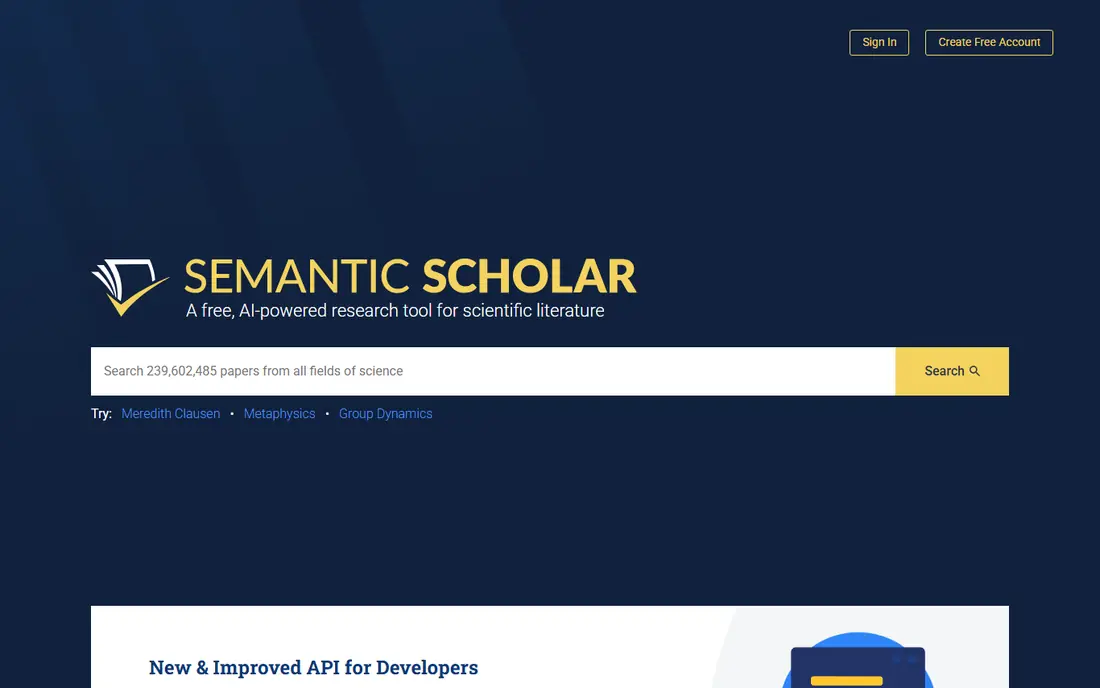
Semantic Scholar fits students and researchers who need a free, reliable starting point for citation analysis. Its search covers papers, authors, and venues, with citation counts, references, and citing papers on each paper page. That breadth makes it useful for scoping a topic, finding key papers, and tracing citation chains without a subscription.
The limit is depth of citation context. Semantic Scholar shows that a paper was cited, but it does not classify each citing sentence as supporting or contrasting in the way Scite does. Pair it with Scite for claim checking, or with Connected Papers for mapping, when you need more than counts and lists.
- Free search across a large scholarly corpus
- Citation and reference lists
- Author and paper pages with influence data
- No Smart Citation classification like Scite
- AI features vary by product and need checking
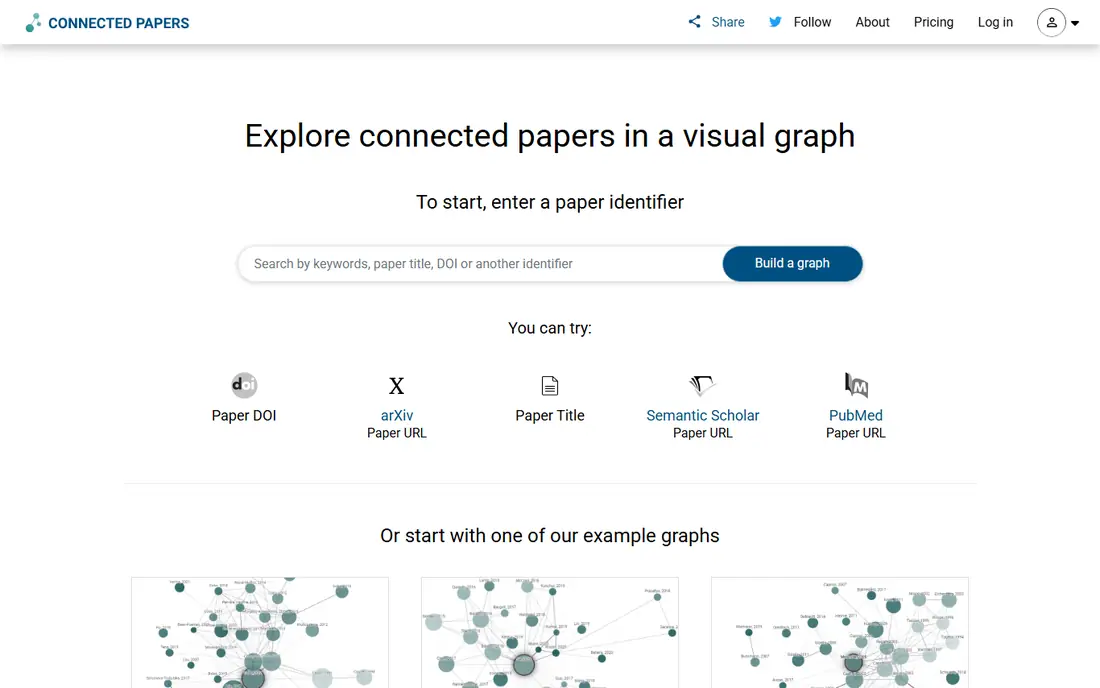
Connected Papers fits researchers who have one key paper and want to find the most closely related work quickly. Enter a paper, and the tool builds a graph based on co-citation and bibliographic coupling, showing prior works that the seed cited and derivative works that later cited it. That view helps you spot clusters, key authors, and papers you might have missed.
The honest weakness is coverage. A graph shows a limited set of related papers and is not a complete systematic search, so it can miss relevant work outside the main cluster. Use it for scoping and discovery, then run a formal database search for a review, thesis, or grant proposal.
- Visual graph of related papers from one seed paper
- Prior and derivative work lists
- BibTeX export for selected papers
- Free plan limits maps per month
- One seed paper per graph limits broad multi-seed discovery
ResearchRabbit fits researchers who want a free, visual way to explore citation networks from several seed papers at once. You can start with a paper, a collection, or an imported reference list, then explore recommendations, authors, and timelines. That flexibility suits literature scoping, thesis planning, and staying current in a field.
The catch is method. Like Connected Papers, ResearchRabbit is best for discovery and overview, not for a replicable systematic review search. Document your formal search separately in established databases, and use ResearchRabbit to find additional papers and authors to check against that search.
- Free for individuals with full features
- Collections from papers or reference lists
- Timeline and author views
- Discovery focus means it is not a formal systematic review tool
- Citation data depends on external sources
Litmaps fits researchers who like to build literature maps step by step, starting from one seed paper or a set of papers. Its seed maps suggest related work, while discover maps refine suggestions from several papers, and map views show connections among papers you selected. That structure helps students organize a reading list around a clear question.
The limit is similar to other mapping tools: maps are a discovery aid, not a complete search. Pro pricing, reported at $120 per year in older comparisons, should be confirmed on the current site, since plans change. Use Litmaps to organize and explore, then verify key papers in full text and in formal databases.
- Seed and discover maps for related papers
- Map views for selected publications
- Pro plan for unlimited maps and filters
- Free limits apply to maps and features
- Pricing and limits should be confirmed on the current pricing page
Elicit fits researchers who need to compare many papers on the same question, such as intervention, population, and outcomes. Its AI search returns relevant papers and extracts structured details into tables, which speeds scoping and early synthesis. That format helps teams decide which papers deserve full reading.
The honest weakness is AI error. Extracted details can miss nuance, misread methods, or conflate results, so every table entry that matters for a claim must be checked against the full paper. Treat Elicit as a scoping and organization aid, not as a source you cite without reading the original.
- AI-assisted search across papers with structured extraction
- Tables for study details
- Useful for scoping and synthesis
- AI extraction needs human verification
- Pricing and free access vary and should be confirmed before relying on it
Consensus fits researchers and students who want a quick, evidence-linked answer to a focused question, such as whether studies support a treatment or effect. Its consensus meter summarizes agreement across papers, while linked sources let you check the underlying studies. That structure is more useful than a general chatbot answer with no sources.
The catch is scope and nuance. A meter can hide differences in population, dose, outcome, or study quality, so a strong consensus in one setting may not apply to yours. Read the top papers, check study types, and note limitations before you use a Consensus answer in your own work.
- Research answers linked to papers
- Consensus meter for agreement across studies
- Filters for study type and quality signals
- Coverage varies by field
- A consensus label does not replace reading methods and limitations
SciSpace fits researchers who read many papers and want help summarizing, questioning, and comparing them. Its copilot can explain sections, answer questions about a paper, and help build literature review notes, which saves time during early reading. Citation tools also help track sources as you build a review.
The trade-off is trust. AI summaries can simplify methods, miss caveats, or overstate findings, so treat every summary as a draft to verify. Read the full methods and results for any paper you cite, and keep your own notes alongside AI output for audit and accuracy.
- AI copilot for reading papers and answering questions
- Citation and reference tools
- Literature review workflow features
- AI answers need verification against full text
- Pricing and free limits vary by plan
Scholarcy fits students and researchers who need to triage many papers quickly and decide which ones deserve full reading. Its summaries highlight background, methods, results, and limitations, while citation tools help you capture references for a library. That triage value matters when a search returns hundreds of papers.
The limit is depth. A summary cannot replace reading for a paper you plan to cite for a key claim, and citation extraction still needs a human check for accuracy. Use Scholarcy to prioritize reading, then read full texts for the papers that shape your argument.
- Summaries with key findings, methods, and limitations
- Citation extraction and reference tools
- Browser and library integrations
- Summary quality varies by paper type and field
- Not a full citation network or mapping tool
How we picked these
We compared official product pages, pricing summaries, university library guides, and public reviews to judge citation analysis fit. We favored tools with clear citation data, classification, mapping, or AI-assisted analysis, rather than general chatbots that generate references without sources. We also mixed free and paid tools, so students and funded researchers can each find a relevant option.
We did not claim hands-on testing of every AI classification, and we did not treat AI labels as final judgments on a paper. Prices change often, so we used See website where a vendor does not publish a stable starting price, and we used $20 per month for Scite based on recent pricing summaries. Readers should confirm current plans, and should always read citing papers in context before relying on a label.
How to use citation analysis well
Start with a clear question and a seed set of key papers, rather than browsing without a goal. Use Semantic Scholar for broad search, Connected Papers or ResearchRabbit for mapping, and Scite for claim checking, then record which papers you included and why. That record helps you defend your review and avoid cherry-picking.
Read citations in context
A supporting citation may cite only one part of a paper, while a contrasting citation may reflect a different method or population. Open the citing paper, find the sentence, and check what it actually claims. Also check for retractions, corrections, and editorials, since those notices change how a paper should be used.
Combine counts, maps, and reading
Use citation counts to find influential papers, maps to find clusters and gaps, and full reading to judge quality. No single metric proves importance, since review papers, methods papers, and controversial papers can all earn high counts for different reasons. Note author, venue, sample, and limitations alongside each citation you plan to use.
Keep an audit trail
Save your search terms, seed papers, map settings, and dates, so another researcher can follow your path. Export citations to a reference manager such as Zotero, and link notes to full texts. For a thesis, grant, or systematic review, also run a formal search in established databases and report that protocol separately.
FAQ
What is the best AI citation analysis tool?
Scite is the strongest pick for claim checking, because Smart Citations classify how later papers treat a claim. Semantic Scholar is the best free starting point for search and citation lists, while Connected Papers and ResearchRabbit are best for visual discovery. Choose based on whether your main need is verification, search, or mapping.
What are the best citation analysis platforms for AI research?
Scite, Semantic Scholar, Elicit, Consensus, and SciSpace all support AI-related research, with Scite for citation context, Semantic Scholar for search, and Elicit, Consensus, and SciSpace for AI-assisted synthesis. Coverage varies by subfield, so test each tool with papers from your exact topic. Always verify AI output against full texts before citing.
Is Scite free?
Scite offers a free account with basic search and limited reports, while paid plans add unlimited reports, dashboards, and reference checks. Recent pricing summaries list paid plans starting at $20 per month on annual billing, with higher tiers for heavier use. Check the current pricing page for your region and plan details before subscribing.
Are Connected Papers and ResearchRabbit free?
Connected Papers offers a free plan with a limited number of maps per month, while ResearchRabbit is free for individuals with full features. Litmaps also offers a free plan with limits, plus a paid Pro plan for unlimited maps. Free limits suit occasional discovery, while regular literature work may need a paid plan or a mix of free tools.
Can citation analysis replace a literature review?
No, citation tools help with discovery, scoping, and claim checking, but a literature review also needs a formal search, critical appraisal, and synthesis. Use maps and counts to find papers and patterns, then read full texts, assess methods, and write your own analysis. For a systematic review, follow a published protocol and report your search methods.
How do I check if a paper has been contradicted?
Search the paper on Scite and read citing sentences classified as contrasting, then open those citing papers to check context. Also check Semantic Scholar citing lists, publisher pages for corrections or retractions, and Retraction Watch where relevant. A contrast label is a lead for reading, not a final verdict on the original finding.
Sources
https://scite.ai https://www.semanticscholar.org https://www.connectedpapers.com https://www.researchrabbit.ai https://www.litmaps.com https://elicit.com https://consensus.app https://scispace.com https://www.scholarcy.com