Best Admission-Based Nonprofit Software in 2026: 8 Tools Compared
Compare the best admission-based nonprofit software for 2026, with applications, admissions workflows, donor records, fundraising, and pricing for nonprofits.
- Editor's choice
 Slate by Technolutions
Admissions and application management
Starts atSee websiteVisit technolutions.comFull review - Great alternative
 Blackbaud Raiser's Edge NXT
Donor and constituent management
Starts atSee websiteVisit blackbaud.comFull review - Also consider
 Salesforce Nonprofit Cloud
Flexible nonprofit constituent platform
Starts at$36 per monthVisit salesforce.comFull review
TL;DR:
- Slate by Technolutions leads for admissions, with application management, communication tracking, and decision workflows built in.
- Blackbaud Raiser's Edge NXT and Salesforce Nonprofit Cloud suit larger nonprofits that need deep donor and constituent records alongside admissions.
- Bloomerang, DonorPerfect, and Neon CRM suit smaller nonprofits that need donor management without enterprise complexity.
- Most enterprise nonprofit pricing is quote-based, so budget by record count, users, and modules, not by a single published price.
Quick comparison
| Tool | Best for | Starts at | Free plan? | |
|---|---|---|---|---|
| Slate by Technolutions | Admissions and application management | See website | Free trial | Visit |
| Blackbaud Raiser's Edge NXT | Donor and constituent management | See website | Free trial | Visit |
| Salesforce Nonprofit Cloud | Flexible nonprofit constituent platform | $36 per month | Free trial | Visit |
 Bloomerang | Donor retention for small nonprofits | See website | Free trial | Visit |
 DonorPerfect | Donor and fundraising management | See website | Free trial | Visit |
 Neon CRM | All-in-one nonprofit CRM | See website | Free trial | Visit |
 Virtuous | Donor CRM with automation | See website | Free trial | Visit |
 Little Green Light | Simple donor tracking for small nonprofits | See website | Free trial | Visit |
The best admission-based nonprofit software
Admission-based nonprofits admit students, members, participants, or residents through an application process, then stay in touch with donors, alumni, and families. That dual need, admissions plus fundraising, shapes this list. Some tools excel at applications and decisions, while others excel at donor records and giving. The best fit depends on which side drives more of your daily work.
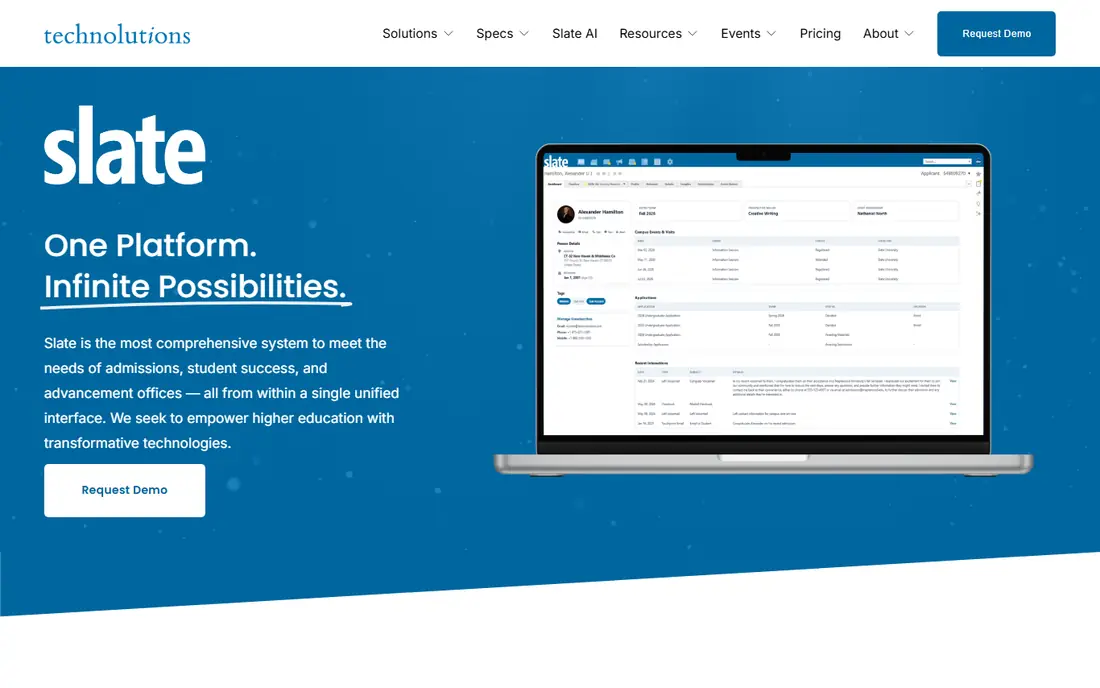
Slate is our pick for the admissions side of this category. It is widely used by colleges and schools to manage applications, track communications, review files, and record decisions in one system. Staff can see student-level data, communication history, and application status without stitching together spreadsheets and email.
The catch is scope and pricing. Slate is an admissions platform first, so nonprofits that need deep fundraising, grant, and donor analytics may pair it with a donor CRM. Pricing is also quote-based, which makes quick comparison harder. For admission-based organizations where application volume and decision quality drive the mission, Slate offers a depth that generic CRMs rarely match.
- Purpose-built for admissions and enrollment
- Strong communication and decision workflows
- Student-level data views
- Pricing is quote-based
- Learning curve for advanced configuration
Blackbaud Raiser's Edge NXT suits larger nonprofits that need a central hub for fundraising data. It tracks donors, gifts, campaigns, appeals, and funds, with reporting that helps development teams see who gives, how often, and through which channels. The wider Blackbaud ecosystem adds events, email, and payment tools for larger organizations.
The trade-off is cost and complexity. Pricing is quote-based and scales by constituent record count, with events, email, and advanced reporting often carrying extra costs. Small nonprofits may find it heavy and costly. For well-resourced nonprofits with complex donor relationships, Raiser's Edge NXT offers a depth that smaller tools cannot match.
- Deep constituent and giving history
- Strong reporting and fundraising analytics
- Large nonprofit ecosystem
- Quote-based pricing with add-on costs
- Implementation and training take time

Salesforce Nonprofit Cloud suits nonprofits that want to model admissions, programs, donors, and volunteers in one flexible platform. It combines constituent records, fundraising, grants, and program tracking, with automation for follow-up and reporting across teams. Published comparisons list Sales Cloud Enterprise for nonprofits from $36 per user per month, with Nonprofit Cloud editions higher.
The catch is implementation. Salesforce does not ship as a ready-made admissions system, so teams must configure objects, workflows, and reports, or work with a partner. That effort pays off for larger organizations with unique processes, but it can overwhelm a small team. For nonprofits planning long-term growth on Salesforce, the platform ceiling is high.
- Flexible constituent and program models
- Strong automation and reporting
- Large integration ecosystem
- Setup needs Salesforce skill
- Nonprofit pricing varies by edition and users
Bloomerang suits small and mid-sized nonprofits that focus on donor retention. It shows donor engagement, giving history, and retention risk in clear views, and it helps staff follow up with the right donors at the right time. Setup is simpler than enterprise platforms, which helps lean teams start fast.
The limit is admissions depth. Bloomerang is a donor CRM first, so application review, decision workflows, and enrollment tracking need custom fields or a separate admissions tool such as Slate. For nonprofits where fundraising drives most daily work and admissions are simpler, Bloomerang offers a friendly, focused system.
- Clear donor retention and engagement views
- Simple setup for small teams
- Email and giving tools
- Admissions workflows need custom setup
- Advanced features sit on higher plans
DonorPerfect is a long-running donor management system for nonprofits of many sizes. It tracks donors, gifts, pledges, campaigns, and communications, with reporting and mail merge tools for appeals and thank-you letters. That breadth helps development teams manage the full fundraising cycle without a patchwork of tools.
The trade-off is polish and price transparency. The interface is functional rather than modern, and pricing is quote-based, so buyers must request a current figure based on records and users. For nonprofits that value a proven donor system and do not need cutting admissions workflows, DonorPerfect remains a solid choice.
- Long track record with nonprofits
- Donor, gift, and campaign tracking
- Reporting and mail tools
- Interface feels older than newer rivals
- Pricing requires a quote
Neon CRM suits nonprofits that run admissions, membership, events, and fundraising together. It combines constituent records, donations, memberships, events, and communications in one platform, which helps admission-based organizations track a person from applicant to member to donor. Reporting and automation support follow-up across that journey.
The catch is complexity. The breadth that helps larger programs can feel busy for a small team that only needs donor tracking. Setup also rewards careful configuration of forms, memberships, and campaigns. For nonprofits that want one system for several program types, Neon CRM offers a practical all-in-one option.
- CRM, fundraising, events, and membership in one system
- Good for admission and membership programs
- Reporting tools
- Feature breadth can feel busy
- Setup takes time to configure well
Virtuous suits nonprofits that want to automate donor follow-up and personalization. It tracks giving, engagement, and communication, then helps staff build journeys that respond to donor behavior, such as first gifts, lapsing donors, and major gift signals. The interface is modern and easier to adopt than older enterprise systems.
The limit is price transparency and fit. Pricing is quote-based, and teams that do not use automation may not get full value from the platform. Small nonprofits with simple donor tracking may find Bloomerang or Little Green Light enough. For growth-focused nonprofits that want automation to drive retention, Virtuous is worth a demo.
- Automation for donor journeys
- Strong giving and engagement views
- Modern interface
- Quote-based pricing
- Best value for teams ready to use automation
Little Green Light suits small nonprofits that need clean donor records without enterprise cost or complexity. It tracks constituents, gifts, pledges, and communications in a simple layout that volunteers and part-time staff can learn quickly. That simplicity helps small teams keep donor data current instead of letting it drift in spreadsheets.
The trade-off is depth. Little Green Light does not offer the admissions workflows of Slate or the advanced automation of Virtuous, and reporting is simpler than Blackbaud or Salesforce. For a small admission-based nonprofit with modest application volume, it can serve as a solid donor companion to a separate admissions process, or as a starting CRM before growth demands more.
- Simple donor and gift tracking
- Easy setup for small teams
- Affordable for lean budgets
- Limited admissions and program depth
- Reporting is simpler than enterprise tools
How we picked these
We compared official feature pages, pricing pages, and published nonprofit software comparisons, plus user reviews, for tools that serve admission-based nonprofits in 2026. We favored tools that are still sold and supported, that cover admissions, constituent records, or donor management, and that span small, mid-sized, and large organizations. Prices are starting figures where published, and quote-based tools are marked as such.
What to check before you buy admission-based nonprofit software
Start with the applicant journey, then the donor journey. Map how an applicant applies, submits documents, receives a decision, and becomes a member, student, or participant. Then map how a donor gives, receives thanks, and stays engaged. A tool that handles only one journey well will leave the other in spreadsheets.
Check data, privacy, and integration needs early. Confirm how applicant and donor records link, how duplicate records are merged, and how the tool handles sensitive data for minors or students where relevant. Ask how it connects to email, payment, accounting, and any existing admissions system, since a nonprofit stack rarely runs on one tool alone.
Trial tips that save time
Test with a real applicant and a real donor record. Walk the applicant from form to decision, and the donor from gift to thank-you, in the same trial. If staff cannot find status, history, or next steps quickly, adoption will suffer during busy admission and giving seasons.
FAQ
What is admission-based nonprofit software?
Admission-based nonprofit software helps organizations that admit students, members, or participants manage applications, decisions, and ongoing relationships with donors and families. It may combine admissions workflows with donor CRM, or pair an admissions tool with a separate donor system.
Is Slate only for colleges?
Slate is best known in higher education and schools, but its application and communication workflows also suit other admission-based programs. Check whether your program type, decision process, and data needs match Slate's admissions model before you choose it.
How much does nonprofit software cost?
Enterprise nonprofit pricing is often quote-based and scales by records, users, and modules. Smaller donor tools publish lower entry prices, while Blackbaud, Salesforce, and Slate require a quote, so request a full quote for your record count and team size.
Can one tool handle admissions and fundraising?
Some platforms such as Neon CRM and Salesforce Nonprofit Cloud cover both, but many nonprofits pair Slate for admissions with a donor CRM such as Blackbaud or Bloomerang for fundraising. The best model depends on which workflow is larger and more complex for your team.
How do nonprofits protect applicant and donor data?
Choose tools with role-based access, audit trails, and clear privacy policies, and limit access to sensitive records. For student data, confirm compliance needs with your legal and data advisors, and train staff on handling applicant and donor information.