Best Accounting Software for VAT Returns in 2026: 9 Tools Compared
best accounting software for vat returns compared for UK businesses in 2026: 9 MTD-ready tools, pricing, VAT schemes and direct HMRC filing explained clearly.
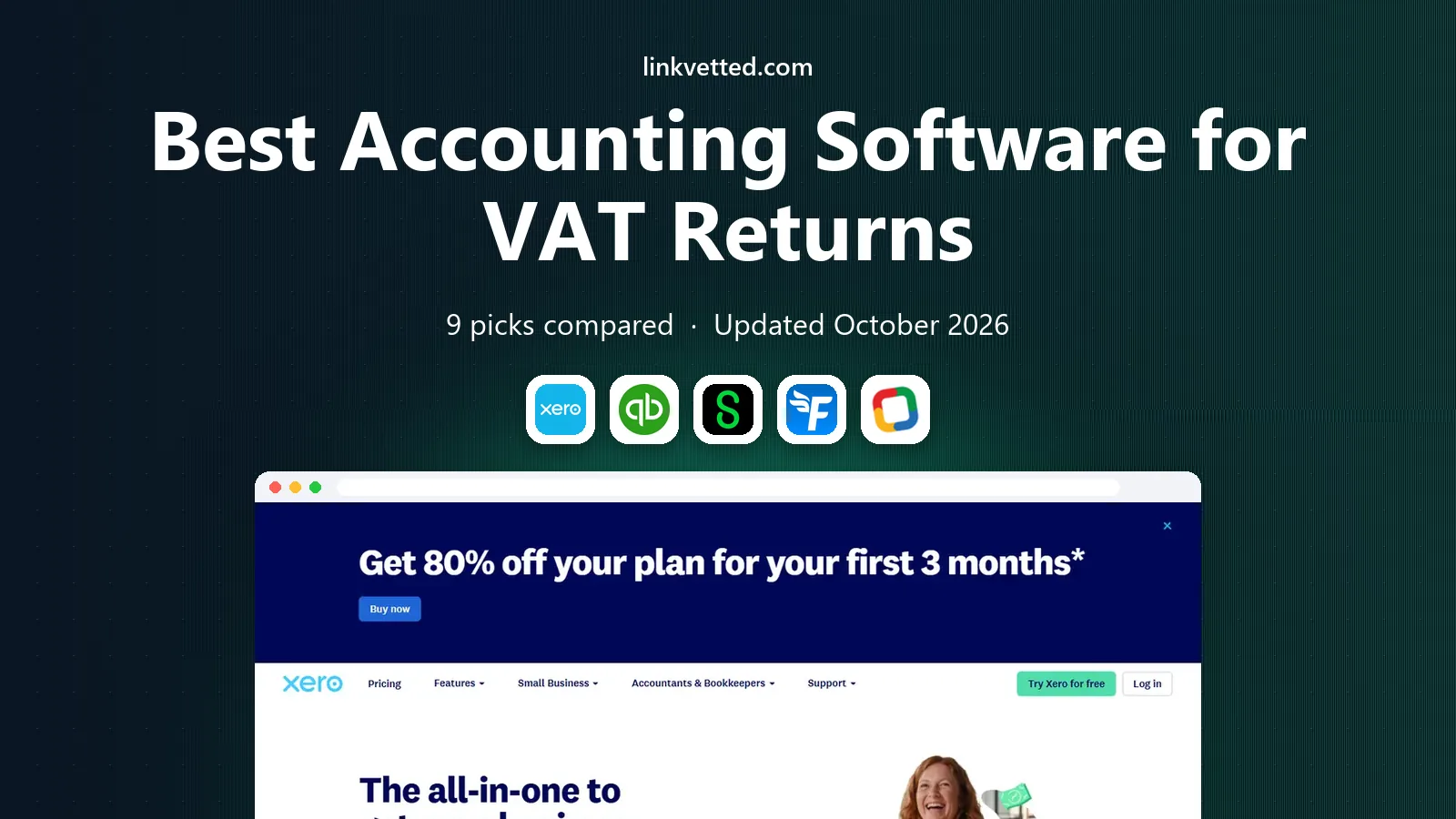
- Editor's choice
 Xero
Most UK small businesses
Starts at£18 per monthVisit xero.comFull review - Great alternative
 QuickBooks Online
VAT filers who want phone support
Starts at£16 per monthVisit quickbooks.intuit.comFull review - Also consider
 Sage Accounting
Established SMEs and payroll
Starts at£18 per monthVisit sage.comFull review
TL;DR:
- Xero Ignite at £18 per month and QuickBooks Simple Start at £16 per month are the cheapest VAT-ready entry points from the two largest UK providers.
- FreeAgent at £19 per month is strong for sole traders and limited companies that want tax forecasting and Self Assessment in the same place, and it is free with a qualifying NatWest, Royal Bank of Scotland, Ulster Bank or Mettle account.
- Zoho Books stands out on price, with a free plan that includes VAT handling for smaller volumes, while paid plans start at £12 per month.
- Every tool here must be checked against HMRC recognition for Making Tax Digital, because a tool that handles invoices is not automatically approved for VAT filing.
- This is general information only and is not tax advice; check your VAT scheme, registration threshold and deadlines with HMRC or your accountant.
Quick comparison
| Tool | Best for | Starts at | Free plan? | |
|---|---|---|---|---|
| Xero | Most UK small businesses | £18 per month | Free trial | Visit |
| QuickBooks Online | VAT filers who want phone support | £16 per month | Free trial | Visit |
| Sage Accounting | Established SMEs and payroll | £18 per month | Free trial | Visit |
 FreeAgent | Sole traders and small limited companies | £19 per month | No | Visit |
 Zoho Books | Low cost and automation | Free | Yes | Visit |
 FreshBooks | Service businesses and time tracking | £16 per month | Free trial | Visit |
 KashFlow | Simple UK bookkeeping | See website | Free trial | Visit |
 Clear Books | Low cost MTD filing | Free | Yes | Visit |
 QuickFile | Very small businesses on a budget | Free | Yes | Visit |
The best accounting software for VAT returns
VAT returns reward tidy records more than clever features. The tools below all help UK businesses record VAT, prepare a return and submit it to HMRC, but they differ on scheme support, invoice limits and the price you pay once an introductory offer ends.

Xero is our pick for most people because it combines direct VAT submission with a very large UK accountant network. If your accountant already uses Xero, sharing records, asking questions and reviewing a return before it is filed becomes much simpler. The Ignite plan covers VAT returns, bank reconciliation and invoicing, which is enough for many micro businesses.
The catch is the limit on Ignite, which allows 20 invoices and 10 bills a month in current UK pricing summaries. That cap suits a steady sole trader or a small consultancy, but a shop or agency that invoices daily will hit it fast and need Grow at £39 per month. Prices exclude VAT, and introductory discounts fall away after the first months, so budget from the list price rather than the launch offer.
- Direct MTD VAT filing
- Wide accountant network
- Large app marketplace
- Invoice caps on Ignite
- Payroll and multi-currency need higher plans

QuickBooks Online appeals to owners who want a familiar interface and a person to call when a return looks wrong. Simple Start is the lowest QuickBooks plan that handles VAT, and it adds estimates, mileage tracking and single-user access. For a VAT-registered sole trader who mainly needs invoicing, expenses and a clean VAT return, it covers the core job without a long setup.
Watch the tier ladder before you commit. Essentials adds bills and multi-currency, while stock control and project profitability sit on Plus, which costs considerably more. Payroll is also separate, so a business with staff should price the full bundle, not just the accounting plan. QuickBooks has raised UK prices more than once in recent years, which makes the renewal price worth checking each year.
- Simple Start includes MTD VAT
- Phone and chat support
- Strong inventory on Plus
- User limits by plan
- Payroll is an add-on
- Prices have risen sharply

Sage Accounting suits businesses that want payroll in the same subscription rather than as a bolt-on. Start covers invoicing, bank feeds and VAT handling for a new or micro business, while Standard adds quotes, purchase invoices and multi-currency. That progression is clear, and Sage has a long history with UK payroll and compliance, which matters when staff, pensions and year-end reports enter the picture.
The downside is cost at the top end. Plus is aimed at larger small businesses and includes project tracking and forecasting, but the monthly price is several times the entry plan. Smaller firms that only need VAT and invoicing may find Xero or Zoho Books cheaper for the same core task. Sage also sells Sage 50 as a separate, more powerful product, so confirm you are comparing Sage Accounting, not Sage 50, when you read prices.
- Payroll included on paid plans
- Long UK track record
- Self Assessment support
- Higher plans climb quickly
- Interface can feel dated to new users
FreeAgent takes a different approach by offering one main plan rather than a ladder of tiers. That simplicity helps owners who do not want to guess which feature sits on which plan. VAT returns, payroll, Self Assessment preparation and a tax timeline that estimates what you owe are included, which gives a clearer view of cash set aside for HMRC.
The price looks high next to entry plans from rivals, until you count what is bundled and the bank offer. Customers with a NatWest, Royal Bank of Scotland or Ulster Bank business account, or a Mettle account with regular transactions, can get FreeAgent free for as long as they keep the account. Without that, £19 per month excluding VAT is still fair for a limited company that uses payroll and tax tools, but less compelling for a sole trader who only files VAT.
- One plan with everything included
- Tax timeline and forecasting
- Free with qualifying banks
- No free plan without a qualifying bank
- Receipt capture capped at 10 a month on standard terms
Zoho Books is the value choice in this list, and it does not feel like a cut-down free tool at the start. The free plan allows up to 1,000 invoices a year and includes VAT handling, which covers many freelancers and micro businesses. Paid plans from £12 per month raise the caps, add more bank feeds and add users, so growth does not force a jump to a much larger bill.
Automation is where Zoho earns its place. Recurring invoices, payment reminders, workflows and client portals reduce the manual chasing that causes VAT errors at quarter end. The trade-off is ecosystem: fewer UK accountants use Zoho Books as their main tool than use Xero or QuickBooks, so check that your accountant is happy to work with it. If you are comfortable managing the books yourself, the saving is real.
- Free plan with VAT support
- Low paid prices
- Strong automation and workflows
- Free plan caps invoices and expenses
- UK support network is smaller than Xero
FreshBooks is built for service businesses that bill by the hour or by the project. Time tracking, estimates, invoicing and client payments sit close together, so a consultant or designer can turn tracked hours into an invoice without retyping figures. VAT handling and MTD VAT submission are supported, which makes it a workable choice for a VAT-registered service firm.
There is an important limit to note. Public comparisons in 2026 note that FreshBooks does not appear on HMRC's compatible list for Making Tax Digital for Income Tax, even though it supports MTD for VAT. That matters for sole traders and landlords who also need quarterly income tax updates. The Lite plan also limits you to five clients, so growing firms should price the Plus plan from the start.
- Clean invoicing and time tracking
- Good client portal
- MTD VAT support
- Not on HMRC list for MTD for Income Tax
- Client limits on Lite
- Weaker inventory
KashFlow has been aimed at UK small businesses for years, and that focus shows in its VAT workflow. Setting VAT rates, reviewing transactions before submission and filing through MTD are presented in plain terms, without the extra modules that larger platforms push. For an owner who wants bookkeeping and VAT, rather than a full business platform, that restraint is a benefit.
The smaller ecosystem is the honest weakness. KashFlow does not match Xero for third-party apps, and businesses that rely on a specific stock, job or e-commerce integration should confirm compatibility before switching. Pricing varies by plan and add-ons such as payroll, so use the vendor pricing page for the current figure rather than a comparison site. A free trial is the best way to test whether its simpler layout fits your routine.
- UK focused design
- Straightforward VAT return workflow
- Payroll add-on available
- Smaller app ecosystem
- Pricing is not as transparent on first glance
Clear Books is worth a look for a very small business that mainly needs digital records and a VAT return, not a full finance suite. The free plan gives a starting point for invoicing and record keeping, while paid plans from a low monthly price add bank feeds, receipt capture and more users. That low entry cost makes it easy to test without a long contract.
Expect to pay for convenience as volume grows. Bank feeds, which save the most time each week, sit on paid plans, and receipt capture is not unlimited on every tier. Reporting is also lighter than Xero or Sage, so a business that needs project profitability or detailed stock reports will outgrow it. For a sole trader with a simple VAT return, though, it is a credible low-cost route.
- Free starter option
- MTD compatible
- Simple invoicing and bank reconciliation
- Bank feeds and receipt capture need paid plans
- Fewer advanced reports
QuickFile is the most budget-friendly option here for a micro business with low transaction volume. The free tier covers up to 1,000 nominal ledger entries a year, which suits a side business, a landlord with one property or a freelancer with a handful of clients. MTD VAT filing is included, so a small VAT-registered business can meet its filing duty without a monthly subscription.
The design reflects that price. QuickFile looks and feels more basic than Xero or FreeAgent, and some features that larger tools include, such as polished mobile apps and deep integrations, are thinner or absent. Once you pass the free entry limit, paid options apply, and at that point a paid tool may offer better value for the time saved. Start with QuickFile if your volume is genuinely small and your VAT return is simple.
- Free for up to 1,000 ledger entries a year
- MTD VAT filing
- No monthly fee at small scale
- Interface feels basic
- Support and features are thinner than paid rivals
How we picked these
We compared official feature pages, pricing pages and HMRC Making Tax Digital guidance, plus public reviews and comparison summaries checked in October 2026. We looked for direct VAT return submission, support for standard, flat rate and other common VAT schemes where stated, bank reconciliation, invoicing and a clear price after any introductory offer. Tools that only create invoices, without a filing route to HMRC, were left out. Prices change often, so confirm the current plan on the vendor site before you buy, especially where a plan caps invoices or bills.
What to check before you file a VAT return
A good tool still needs good inputs, and most VAT mistakes come from coding, not software. Before your first filing, confirm your VAT scheme, your return period and whether you use cash or invoice accounting. Check that bank feeds are connected, that personal spending is kept separate, and that any reverse charge, exempt or zero-rated sales are coded correctly rather than left at the standard rate.
Match the plan to your volume
Count invoices, bills and transactions for a typical quarter, then compare that total with the plan cap, not the headline price. A cheap plan that caps invoices at 20 a month becomes expensive once you upgrade mid-quarter. If your volume varies by season, a plan with unlimited invoicing may cost less over a year than repeated upgrades.
Check scheme support and corrections
Ask whether the tool supports your scheme, including the flat rate scheme, annual accounting or partial exemption if any of those apply to you. Also ask how it handles a correction to a past return, a credit note and a late invoice. Those edge cases are where a simple tool can slow you down, and your accountant can confirm the right treatment.
FAQ
What is the best accounting software for VAT returns for a small UK business?
For most small UK businesses, Xero Ignite or QuickBooks Simple Start are strong starting points because both file VAT returns directly to HMRC and are widely used by accountants. FreeAgent is a good alternative if you also want Self Assessment and tax forecasting in one plan. The best choice depends on your invoice volume, whether you need payroll, and whether your accountant already uses the tool.
Does free accounting software file VAT returns to HMRC?
Some free tools do, but with limits. Zoho Books offers VAT handling on its free plan up to its invoice cap, and QuickFile offers MTD VAT filing within its free ledger entry limit. Always confirm the tool is on HMRC's compatible software list for VAT and check the cap, because a free plan that stops at 1,000 entries may not cover a busy quarter.
What is Making Tax Digital for VAT?
Making Tax Digital for VAT requires VAT-registered businesses to keep digital records and submit VAT returns through compatible software, rather than typing figures into the HMRC website. The software must link records to the return without manual retyping, which reduces transcription errors. Your VAT scheme and filing frequency stay the same; only the record keeping and submission route change.
Can I switch accounting software mid-year for VAT?
Yes, but the cleanest switch is at the start of a VAT period, after the previous return is filed and reconciled. Import opening balances, check that prior VAT transactions are not duplicated, and run the first new return alongside your old records before submitting. Your accountant can help with the cutover and confirm that no transaction is counted twice.
Do I still need an accountant if I use VAT software?
Software prepares and files the return, but it does not decide your VAT treatment, scheme or partial exemption position. An accountant is valuable for scheme choice, complex supplies, property, imports and corrections. Many owners do day-to-day bookkeeping in software and pay an accountant to review returns and handle year-end work.
How much should VAT accounting software cost?
Entry VAT-ready plans in this list run from free for very small volumes to about £16 to £19 per month for Xero, QuickBooks, Sage Accounting and FreeAgent. Larger plans with unlimited invoicing, payroll or multi-currency run higher, often £39 to £59 per month. Add VAT to prices quoted excluding VAT, and budget from the list price after any introductory discount ends.
Sources
- https://www.xero.com/uk/pricing/
- https://quickbooks.intuit.com/uk/pricing/
- https://www.sage.com/en-gb/products/sage-accounting/
- https://www.freeagent.com/pricing/
- https://www.zoho.com/uk/books/pricing/
- https://www.freshbooks.com/pricing
- https://www.kashflow.com/pricing/
- https://www.clearbooks.co.uk/pricing/
- https://www.quickfile.co.uk/pricing/