Best Account-Based Orchestration Platforms in 2026: 9 Tools Compared
Best account-based orchestration platforms compared, with intent data, account scoring, ads and multi-channel plays for B2B sales and marketing teams.
- Editor's choice
 6sense
Predicting in-market accounts
Starts atSee websiteVisit 6sense.comFull review - Great alternative
 Demandbase
Full-stack enterprise ABM
Starts atSee websiteVisit demandbase.comFull review - Also consider
 RollWorks
Mid-market account-based ads
Starts atSee websiteVisit rollworks.comFull review
TL;DR:
- Account-based orchestration means coordinating ads, web, email and sales outreach around a target account list, not just running separate campaigns.
- 6sense and Demandbase suit large enterprises with full-funnel needs, while RollWorks suits mid-market teams starting with account-based ads.
- Intent data quality and CRM integration matter more than feature lists, since a platform is only useful if sales acts on its signals daily.
- Most of these platforms price by quote, so budget for implementation and ad spend on top of the platform fee.
Quick comparison
| Tool | Best for | Starts at | Free plan? | |
|---|---|---|---|---|
| 6sense | Predicting in-market accounts | See website | Yes | Visit |
| Demandbase | Full-stack enterprise ABM | See website | No | Visit |
| RollWorks | Mid-market account-based ads | See website | Yes | Visit |
 Terminus | Multi-channel account plays | See website | No | Visit |
 Madison Logic | Content-led account engagement | See website | No | Visit |
 Influ2 | Person-based account advertising | See website | No | Visit |
 Mutiny | Website personalization for accounts | See website | No | Visit |
 HubSpot | ABM inside HubSpot | See website | No | Visit |
 ZoomInfo | Data and intent to fuel ABM | See website | No | Visit |
The best account-based orchestration platforms
We compared intent data, account scoring, advertising, web personalization, sales orchestration, CRM integrations and pricing models, with a focus on B2B teams that sell to defined account lists.
6sense is built around finding accounts that are in a buying window before competitors do. It processes large volumes of intent signals, predicts buying stage and surfaces qualified accounts for sales and marketing to act on together. Advertising, web personalization and sales alerts can then be coordinated around those accounts, rather than run as separate campaigns.
The drawback is cost and complexity. 6sense is enterprise priced, and teams need a clear target account list and a sales motion ready to act on signals. A limited free tier helps smaller teams test basic intelligence. For a B2B company with a defined market and a sales team ready to work accounts daily, 6sense is a leading orchestration choice.
- Strong predictive intent and buying stage models
- Account scoring and orchestration
- Salesforce and HubSpot integrations
- Enterprise pricing
- Models can feel opaque to sales reps at first

Demandbase offers one of the most complete account-based suites, covering account identification, intent data, advertising, web personalization and sales intelligence. Its native ad platform lets marketing reach target accounts across the web, while sales teams see account activity and intent in their CRM. For a large enterprise with a dedicated ABM team, that breadth reduces the need to stitch several tools together.
Pricing is enterprise level, and implementation often takes weeks with dedicated operations help. Smaller teams will find it more than they need. For a large B2B company running full-funnel ABM at scale, Demandbase is a top-tier option.
- Account intelligence, intent, advertising and sales tools in one suite
- Native B2B ad platform
- Deep reporting
- High enterprise pricing
- Implementation takes time and dedicated ops support
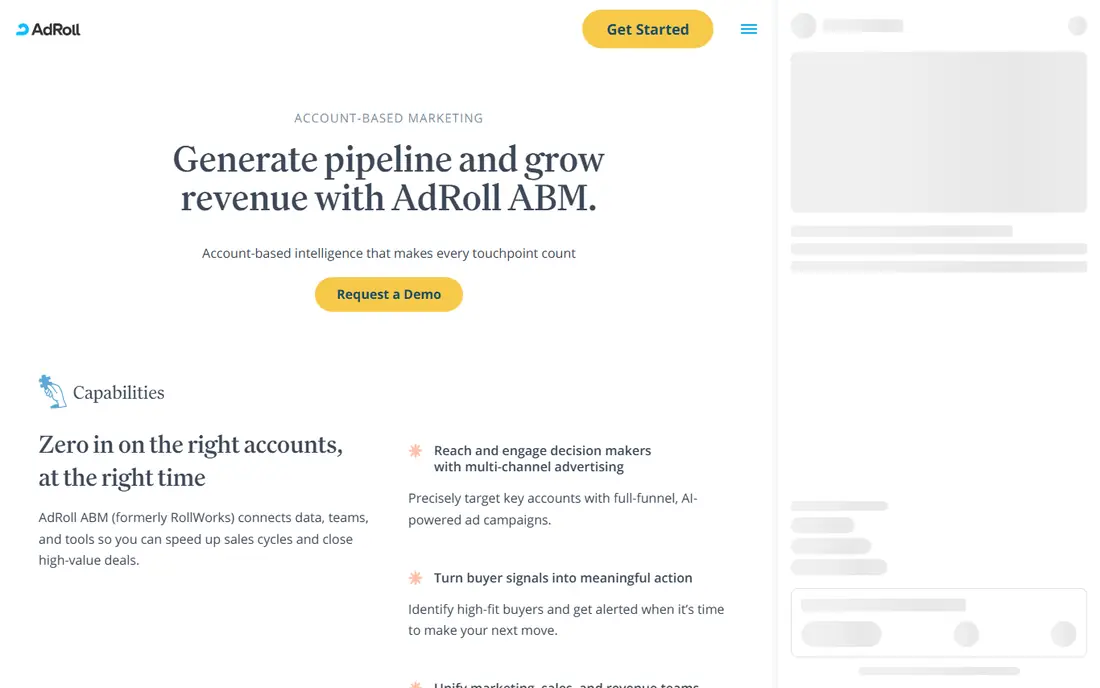
RollWorks, part of NextRoll, is the most accessible entry point for mid-market account-based marketing. It helps teams build target account lists, run account-based display ads, and alert sales when accounts engage. Integrations with HubSpot and Salesforce keep account activity visible to both marketing and sales, without a full enterprise rollout.
It does not match 6sense or Demandbase on predictive depth, and ad spend sits on top of platform fees. For a mid-market team testing ABM, or a company that wants ad-led warming before sales outreach, RollWorks offers a practical starting point with room to grow.
- Accessible entry point for mid-market ABM
- Account-based ads tied to engagement signals
- HubSpot and Salesforce integrations
- Less depth than 6sense or Demandbase on predictive scoring
- Ad spend is extra
Terminus is known for multi-channel ABM, coordinating display ads, email, chat and web experiences around the same target accounts. That coordination helps a buying committee see consistent messages across channels, rather than isolated ads or emails. Its account view helps teams track engagement across those touches in one place.
Pricing is custom, and buyers should confirm current packaging, since Terminus ownership and product lines have changed in recent years. Teams that need a full predictive suite may prefer 6sense or Demandbase. For coordinated multi-channel plays, Terminus remains a relevant name to evaluate.
- Coordinated ads, email, chat and web plays
- Account view across channels
- Useful for multi-channel campaigns
- Pricing is custom and needs a sales conversation
- Product ownership has changed, so check current plans carefully
Madison Logic suits B2B teams whose ABM motion is content led, using whitepapers, guides and research to engage target accounts. It syndicates content to relevant accounts, captures intent signals from that engagement, and passes qualified leads to sales. That model works well for companies with strong content and a clear ideal customer profile.
It is less of a complete orchestration suite than Demandbase or 6sense, since its strength is content and lead generation rather than full cross-channel automation. Results also depend on content quality. For a content-rich B2B team, Madison Logic is a strong, focused choice.
- Content syndication to target accounts
- B2B intent signals
- Lead generation tied to account engagement
- Less of a full orchestration suite than Demandbase
- Content quality drives results
Influ2 takes a person-based approach to ABM, targeting specific contacts inside target accounts across LinkedIn, Meta, Google and other ad channels. That precision helps when a buying committee includes several roles, and you want each person to see relevant ads rather than only account-level display. Reporting ties ad engagement to pipeline and revenue influence, which helps justify spend.
Pricing is custom, and results depend on contact data quality, so a clean CRM matters. Teams that want account-level ads only may find Influ2 more precise than they need. For complex B2B sales with multi-person committees, its contact-level focus is a real differentiator.
- Contact-level targeting across social and search ads
- Pipeline and revenue reporting
- Useful for complex buying committees
- Custom pricing
- Needs accurate contact data to work well
Mutiny personalizes website experiences for target accounts, segments or intent groups, without requiring engineers for every change. Marketers can tailor headlines, case studies and calls to action for a visiting account, which can lift conversion from ABM traffic that would otherwise see a generic homepage. That makes it a useful layer on top of ads and intent platforms.
Mutiny is not a full ABM suite on its own, since it needs traffic and account signals from other tools to reach its potential. Pricing is sales-led. For a team already driving account traffic that wants to convert more of it, Mutiny is a strong addition.
- Personalizes website content by account, segment or intent
- No-code editing for marketers
- Strong for conversion lifts
- Sales-led pricing
- Works best when paired with traffic and intent tools
HubSpot ABM tools suit teams already running sales and marketing in HubSpot. Target account lists, company scoring, workflows and reporting live inside the CRM, so sales and marketing work from the same records without learning a new platform. That simplicity helps smaller ABM programs start fast and stay consistent.
Predictive intent depth is thinner than with 6sense or Demandbase, and advanced ABM features need higher HubSpot tiers. For a HubSpot-centered team with a focused account list, HubSpot ABM is often enough. For a large enterprise needing deep intent modeling, a dedicated platform may still be needed alongside it.
- ABM tools inside a familiar CRM
- Target account lists, workflows and reporting without a new system
- Good for HubSpot teams
- Less predictive depth than dedicated ABM platforms
- Advanced ABM needs higher HubSpot tiers
ZoomInfo fuels ABM with contact and company data, intent signals and website visitor identification, which teams can use to build account lists and prioritize outreach. Its integrations with Salesforce and HubSpot push that data into sales workflows, so reps can act on new signals quickly. For many teams, ZoomInfo is the data layer underneath an orchestration platform, rather than the orchestrator itself.
Pricing is custom and can be high, and data accuracy varies by industry and region, so test it on your target accounts before committing. Used well, ZoomInfo sharpens every other ABM tool on this list. Used alone, it will not run multi-channel plays for you.
- Large B2B contact and company database
- Intent signals and website visitor data
- Strong CRM integrations
- Pricing is custom and can be high
- Data quality varies by segment and region
How we picked these
We compared official product pages, intent and scoring models, advertising and personalization features, CRM integrations and pricing models. We favored platforms that are live in 2026, support coordinated plays across channels, and serve a distinct team size or motion, from mid-market ads to enterprise orchestration. We left out single-channel ad tools with no account orchestration.
How to run account-based orchestration without wasting budget
Start with a tight account list, not a large one. Pick 50 to 200 accounts that fit your ideal customer profile, have a real buying need and can be reached by sales. Agree on what counts as engagement, who owns each account, and how sales will follow up within a set time after a signal.
Next, run one coordinated play at a time. Pair ads with a personalized web experience and a sales sequence, measure account progression and meetings, not just clicks, and review weekly with both sales and marketing in the room. If accounts are not progressing, fix targeting or messaging before adding more accounts or more channels.
FAQ
What is the best account-based orchestration platform?
6sense and Demandbase suit large enterprises with full-funnel ABM, while RollWorks suits mid-market teams starting with account-based ads. Terminus suits multi-channel plays, and HubSpot suits teams already on HubSpot. Pick by team size, budget and whether you need predictive intent or mainly ad coordination.
What is account-based orchestration?
Account-based orchestration means coordinating marketing and sales actions around a target account list, so ads, website content, email and sales outreach work together for the same accounts. It replaces separate campaigns with shared account goals, signals and timing.
How much do ABM platforms cost?
Most dedicated ABM platforms price by quote, with enterprise contracts often running tens of thousands of dollars per year, plus ad spend and implementation. RollWorks offers a lower entry point for mid-market teams, while HubSpot ABM costs depend on HubSpot tier. Always ask for total cost including implementation.
Do small companies need an ABM platform?
Not always. A small company with a focused account list can run ABM with HubSpot, RollWorks or even CRM workflows and targeted ads. A full enterprise platform makes sense once you have enough accounts, sales capacity and budget to act on intent signals daily.
What is the difference between ABM and lead generation?
Lead generation focuses on individual leads from many companies, while ABM focuses on a defined list of target accounts and the buying committee inside each one. ABM measures account engagement, pipeline and revenue from those accounts, rather than only lead volume.