Best Account Based Execution Software in 2026: 8 Tools Compared
Compare the best account-based execution software for targeting, intent, advertising and sales outreach, with pricing notes and honest trade-offs in 2026.
- Editor's choice
 Demandbase
Enterprise orchestration
Starts atSee websiteVisit demandbase.comFull review - Great alternative
 6sense
Predictive intent and scoring
Starts atSee websiteVisit 6sense.comFull review - Also consider
 Terminus
Mid-market ABM campaigns
Starts atSee websiteVisit terminus.comFull review
TL;DR:
- Demandbase and 6sense are our picks for large teams running full account-based programs across marketing and sales.
- RollWorks and Terminus are easier entry points for mid-market teams that want account advertising and orchestration without enterprise complexity.
- Data quality matters more than dashboard polish, so test contact and account matching with your own target list before buying.
- Most enterprise tools are quote only, so compare total annual cost, onboarding fees and ad spend separately.
Quick comparison
| Tool | Best for | Starts at | Free plan? | |
|---|---|---|---|---|
| Demandbase | Enterprise orchestration | See website | No | Visit |
| 6sense | Predictive intent and scoring | See website | Free tier | Visit |
| Terminus | Mid-market ABM campaigns | See website | No | Visit |
 RollWorks | Mid-market account advertising | See website | No | Visit |
 Madison Logic | Content syndication and leads | See website | No | Visit |
 Influ2 | Person-based advertising | See website | No | Visit |
 Jabmo | Manufacturing and industrial ABM | See website | No | Visit |
 D&B Rev.Up ABX | Data-driven account programs | See website | No | Visit |
The best account based execution software
Account-based execution means picking a defined list of target accounts and then coordinating ads, outreach, content and sales follow-up around those accounts. It is different from broad lead generation, because success is measured at the account level, not by raw lead volume. We compared official feature pages, pricing information and public reviews to build this list.
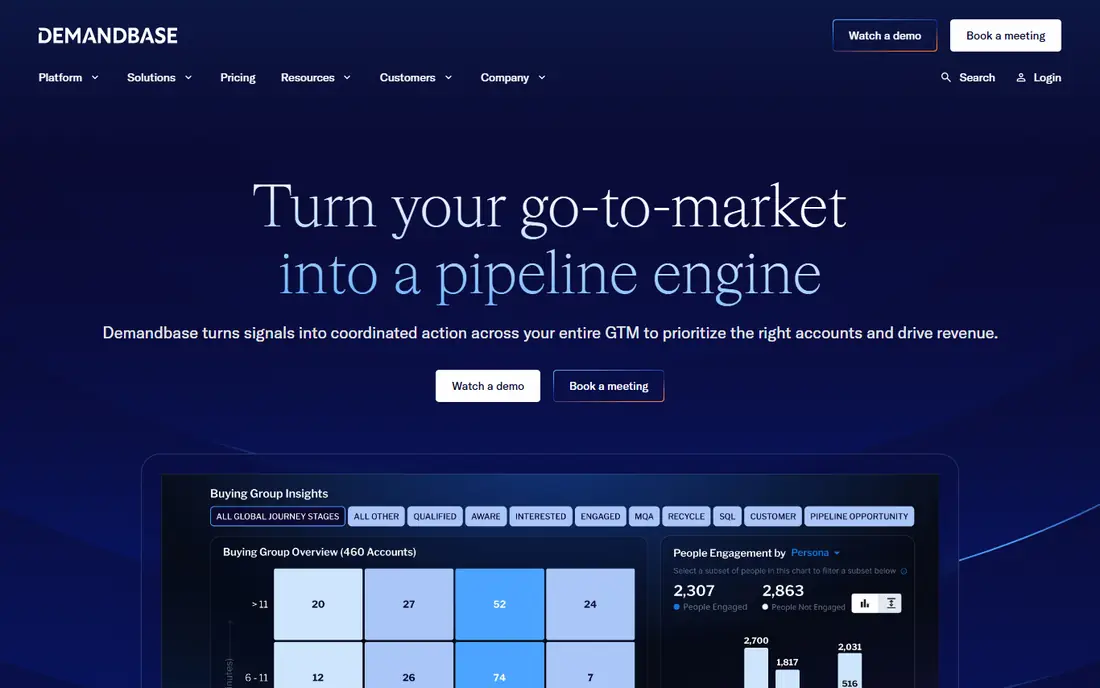
Demandbase is the full-stack choice for large teams that run account-based programs at scale. It identifies target accounts visiting your site, serves account-based ads, personalizes web content and helps sales teams work buying groups inside the same platform. That breadth is why enterprise marketing and sales teams often treat it as their central account system.
The honest catch is cost and effort. Demandbase pricing is quote only, and published comparisons often place entry deals in the tens of thousands of dollars per year, with onboarding on top. Smaller teams will struggle to justify that spend or staff it well. Choose Demandbase when you have hundreds or thousands of target accounts, a dedicated account-based team and a budget that matches enterprise software.
- Account identification, advertising, web personalization and sales orchestration in one platform
- Buying-group focus
- Large integration options
- Pricing is quote only and often high
- Implementation takes weeks and dedicated staff

6sense is best known for predictive analytics that rank accounts by buying intent before they fill out a form. That early signal helps sales teams focus on accounts that are already researching a solution, rather than working through a cold list in order. The free sales intelligence tier, with limited credits, gives small teams a way to test company and contact search before committing to a paid plan.
The drawback is transparency and price. Paid deployments are quote only and can run well into five figures per year, and some users say the AI scoring feels like a black box. That makes it harder to explain to a sales leader why one account ranks above another. Pick 6sense when your sales cycles are long, your deal sizes are large and early intent signals are worth a premium price.
- Predictive intent and account scoring
- Identifies in-market accounts early
- Free sales intelligence tier for testing
- Paid pricing is quote only and high
- Scoring logic can feel hard to explain to stakeholders
Terminus is a mid-market account-based platform that covers advertising, web chat and campaign orchestration around a target account list. It is a practical choice for teams that want to run account-based campaigns without buying the full enterprise stack on day one. Its CRM connections help marketing and sales share the same account view, which is the point of account-based work.
The catch is packaging. Terminus pricing is quote only, and the features you need may sit in a higher package, so a demo alone will not tell you the total cost. Ask for a written quote that lists advertising, chat and reporting separately. Choose Terminus when your team is ready for structured account campaigns but not yet ready for a large enterprise platform.
- Account advertising, chat and orchestration for mid-market teams
- Easier to scope than enterprise suites
- Good CRM links
- Pricing is quote only
- Feature depth varies by package
RollWorks is often recommended as the mid-market alternative to Demandbase and 6sense, because it focuses on account-based advertising, intent data and playbooks that a smaller marketing team can actually run. Setup is faster, and the platform is built around clear use cases such as account targeting, display ads and sales alerts, rather than a long list of enterprise modules.
The trade-off is depth. RollWorks will not match the largest platforms on cross-channel orchestration, buying-group analytics or custom data work. Pricing is also quote only, so you still need a sales conversation to get a firm number. Pick RollWorks when you want a working account-based advertising program quickly, with a budget below enterprise levels.
- Faster setup than enterprise platforms
- Account advertising and intent signals
- Good fit for mid-market budgets
- Pricing is quote only
- Less depth on enterprise orchestration and analytics
Madison Logic focuses on reaching target accounts through content syndication and account-based media, then delivering leads that match your account list. That focus makes it a good fit for teams whose main gap is getting quality engagement from named accounts, rather than building a full orchestration system. It works well alongside a CRM and a separate advertising tool.
The limit is scope. Madison Logic is not a single platform for advertising, personalization, sales orchestration and analytics in the way Demandbase is. You will still need other tools for parts of the program. Choose it when content-led account engagement and lead quality are your main goals, and pair it with a CRM workflow for follow-up.
- Content syndication to target accounts
- Lead quality focus
- Account-based media expertise
- Pricing is quote only
- Narrower than a full orchestration platform
Influ2 takes a different angle from most account-based tools. Instead of targeting a company as a whole, it serves ads to specific people on the buying committee and reports back on exactly who engaged. That person-level detail helps sales teams follow up with the right contact, rather than guessing which stakeholder saw an ad.
The catch is that Influ2 is a focused tool, not a full account-based suite. It does not replace intent data, web personalization or sales sequencing on its own. Pricing is also quote only. Use Influ2 when your team already has a target account list and wants precise, person-level advertising and reporting to support sales outreach.
- Targets named people inside accounts, not just companies
- Clear reporting on who saw and clicked ads
- Good for sales alignment
- Pricing is quote only
- Best as a complement to a wider ABM platform
Jabmo specializes in account-based advertising for manufacturers and industrial companies, including firms whose buyers are hard to reach through ordinary business data. Its account identification and omnichannel advertising are built for global industrial audiences, with attention to privacy rules for European markets. For a manufacturer, that sector focus can matter more than a generic platform's feature count.
The drawback is ecosystem size. Jabmo has fewer integrations than Demandbase or 6sense, so check its links to your CRM and marketing automation tools before buying. Pricing is quote only. Choose Jabmo when your target accounts are industrial or manufacturing firms and a generalist platform has struggled to identify or reach them.
- Strong fit for manufacturing and industrial sectors
- Account identification for hard-to-reach sites
- GDPR-aware targeting
- Narrower integrations than the largest platforms
- Smaller market presence
D&B Rev.Up ABX, from Dun and Bradstreet, builds account-based execution on top of a large business data set. That data foundation helps teams build accurate target lists, enrich accounts and run advertising and analytics around them. For companies that already trust Dun and Bradstreet data, the combined data and execution offer is a clear advantage.
The catch is packaging and price. Rev.Up ABX is sold as part of a wider Dun and Bradstreet offering, so the total cost and feature set depend on what you already buy. Pricing is quote only, and implementation may need data work to match your CRM records. Pick it when data accuracy and account list quality are your main problems, and you want one vendor for both.
- Dun and Bradstreet business data behind account targeting
- Account-based advertising and analytics
- Strong data quality story
- Pricing is quote only
- Platform depth depends on the Dun and Bradstreet stack you buy
How we picked these
We compared official vendor pages, category reports and public pricing comparisons, and we kept only tools that support account-based execution rather than generic advertising or lead lists. We favored platforms that cover targeting, intent or advertising, sales alignment and account-level measurement, and we wrote See website where pricing was not published. We also included focused tools such as Influ2 and Jabmo, because a narrow tool can be the right execution choice for a specific team.
What to check before you buy
Start with your account list, not the vendor demo. Write down how many accounts you will target, how many contacts sit on each buying committee, and what a good outcome looks like for one account. A platform built for thousands of enterprise accounts will be wasted on a list of 50, while a light tool will break down once you pass a few hundred accounts with complex buying groups.
Next, test data quality with your own list. Upload a sample of target accounts, check how many match, how many contacts are found, and how fresh those contacts look. Then run a small campaign and watch how sales follows up. The best execution tool is the one your sales team actually uses, so involve sales in the trial from day one and agree on who owns each account.
Finally, price the full program. Ask for the platform fee, onboarding cost, data costs and ad spend as separate lines, and confirm contract length and renewal terms. Many account-based deals look reasonable until ad spend and onboarding are added. Compare two vendors on the same account list and the same success measure, such as meetings booked with target accounts, before you sign.
FAQ
What is account-based execution software?
Account-based execution software helps marketing and sales teams target a defined list of accounts with coordinated ads, content and outreach, then measure results at the account level. It differs from broad lead generation, which chases individual leads without regard to the account they belong to. The goal is to win specific high-value accounts, not to collect the most leads.
How is account-based execution different from account-based marketing?
Account-based marketing is the strategy, while account-based execution software is the set of tools that puts that strategy into action. Execution tools handle targeting, intent signals, advertising, personalization and sales follow-up for named accounts. A team can run a basic account-based strategy with a CRM and a data tool, but execution platforms automate and measure it at scale.
How much does account-based execution software cost?
Enterprise platforms such as Demandbase and 6sense often run into tens of thousands of dollars per year, with onboarding and ad spend on top. Mid-market tools such as RollWorks and Terminus are usually cheaper, but pricing is still quote only for most vendors on this list. Small teams should test a free tier or a light data tool before committing to an enterprise contract.
Do small teams need account-based execution software?
Not always. A small team with fewer than 50 target accounts can often run account-based work with a CRM, a data provider and manual outreach. Dedicated software becomes worth it when the account list grows, buying committees get larger, or marketing and sales need shared account reporting. Start with a focused pilot and a clear success measure.
What should I test in a trial or demo?
Test account matching, contact quality, intent accuracy and sales follow-up with your own target list. Run a small campaign, check who engaged, and see how easily sales can act on that signal. Also confirm integrations with your CRM, reporting at the account level and the full cost, including onboarding and ad spend.