Best 3PL Warehouse Management Software in 2026: 8 Tools Compared
best 3pl warehouse management software compared for multi-client fulfilment, with client billing, inventory separation, picking and shipping tools in 2026.
- Editor's choice
 Extensiv
Multi-client 3PLs
Starts atSee websiteVisit extensiv.comFull review - Great alternative
 ShipHero
Ecommerce-heavy 3PLs
Starts atSee websiteVisit shiphero.comFull review - Also consider
 Logiwa
Growing ecommerce 3PLs
Starts atSee websiteVisit logiwa.comFull review
TL;DR:
- Extensiv leads for multi-client 3PLs, thanks to client billing, inventory separation and a large integration list.
- ShipHero suits ecommerce-heavy 3PLs and DTC brands, with strong Shopify links and picking workflows.
- A true 3PL system must separate inventory, rates and reporting by client, and bill from actual warehouse activity.
- Most pricing is quote-based, so compare total cost by orders, clients, users and integrations, not just a headline rate.
- Smaller 3PLs should weigh CartonCloud and Logiwa before committing to an enterprise suite.
Quick comparison
| Tool | Best for | Starts at | Free plan? | |
|---|---|---|---|---|
| Extensiv | Multi-client 3PLs | See website | No | Visit |
| ShipHero | Ecommerce-heavy 3PLs | See website | No | Visit |
| Logiwa | Growing ecommerce 3PLs | See website | No | Visit |
 CartonCloud | Smaller warehouse and transport teams | See website | No | Visit |
 Deposco | Larger supply chain operations | See website | No | Visit |
 ShipBob | Brands using a 3PL network | See website | No | Visit |
 Flowspace | Flexible fulfilment network | See website | No | Visit |
 Oracle NetSuite | Enterprise ERP with WMS | See website | No | Visit |
The best 3PL warehouse management software
3PL warehouse management software runs many clients in one warehouse, with separate inventory, rates, billing and reporting for each client. The tools below differ in client billing depth, ecommerce links, scale and price.
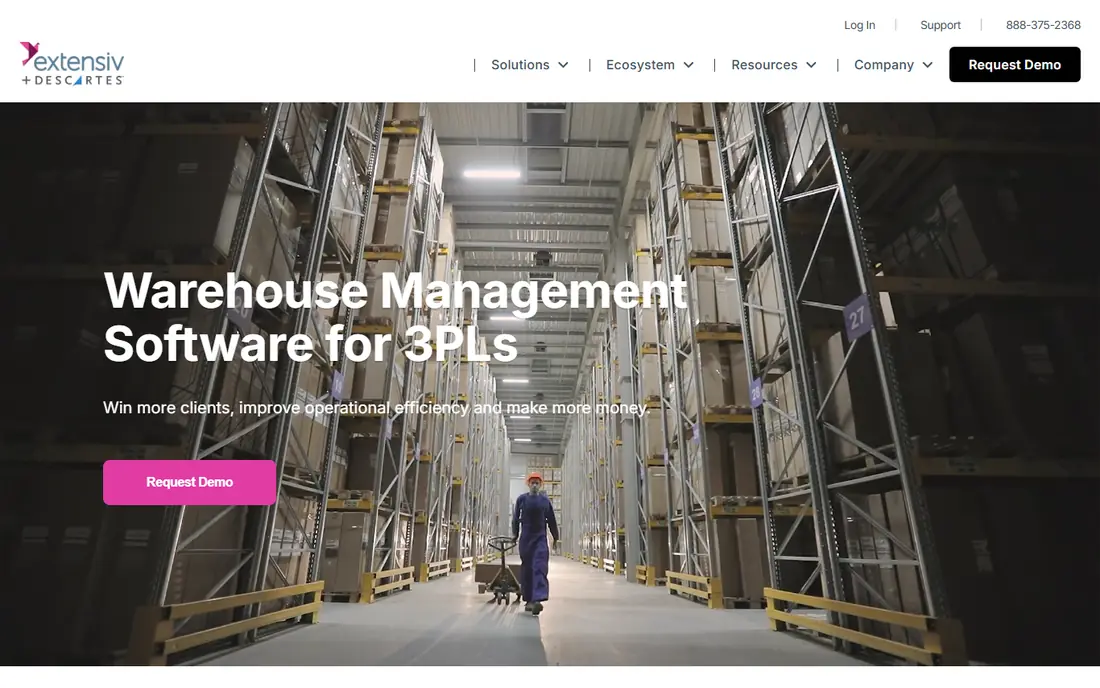
Extensiv, formerly 3PL Central, is warehouse management software built only for third-party logistics providers, with receiving, barcode scanning, putaway, picking, packing and shipping for many clients in one building. Its Billing Manager captures billable events and sends automated invoices from rate cards set per client, while a client portal lets clients see rates, charges and inventory. Integration Manager connects carts, marketplaces, carriers and EDI systems, which helps 3PLs onboard new clients without custom code for every channel.
Pricing is a custom quote after a demo, and reviewers note add-on charges for custom reports and some integrations, so buyers should ask for a full first-year figure. Implementation still needs data, rate card and workflow planning, especially for multi-warehouse operations. For a multi-client 3PL that needs billing accuracy and client separation as core features, Extensiv is our pick for most people to evaluate first.
- Built for 3PLs only
- Strong client billing
- 150 plus integrations
- Quote-based pricing
- Add-ons can raise cost
- Implementation needs planning
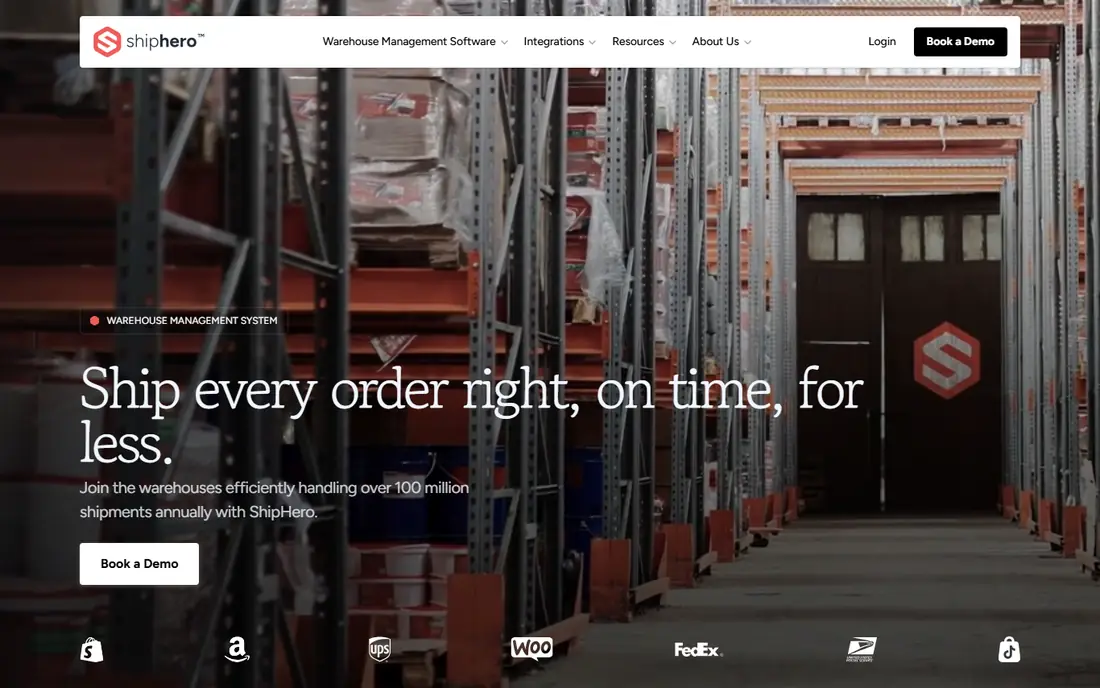
ShipHero is a warehouse management platform for ecommerce brands and 3PLs, with pick, pack and ship workflows, inventory control, client billing and marketplace links. Its Shopify roots show in deep store, order and inventory sync, plus picking tools such as suggested batches, item images and path optimisation. Third-party guides cite starting prices around $1,850 per month for brand WMS and around $1,995 to $2,145 per month for the 3PL edition, though buyers should confirm current pricing, since plans change.
ShipHero is not a low-cost starter tool, and small brands or new 3PLs may find the price and implementation effort hard to justify. It also offers a 3PL edition with lighter client billing customisation than Extensiv, according to vendor comparisons. For an ecommerce-heavy 3PL or a scaling DTC brand where warehouse speed directly affects profit, ShipHero offers a focused, proven workflow.
- Strong Shopify and ecommerce links
- Smart picking and batching
- 3PL edition available
- High starting cost
- No trial
- Implementation is a serious project
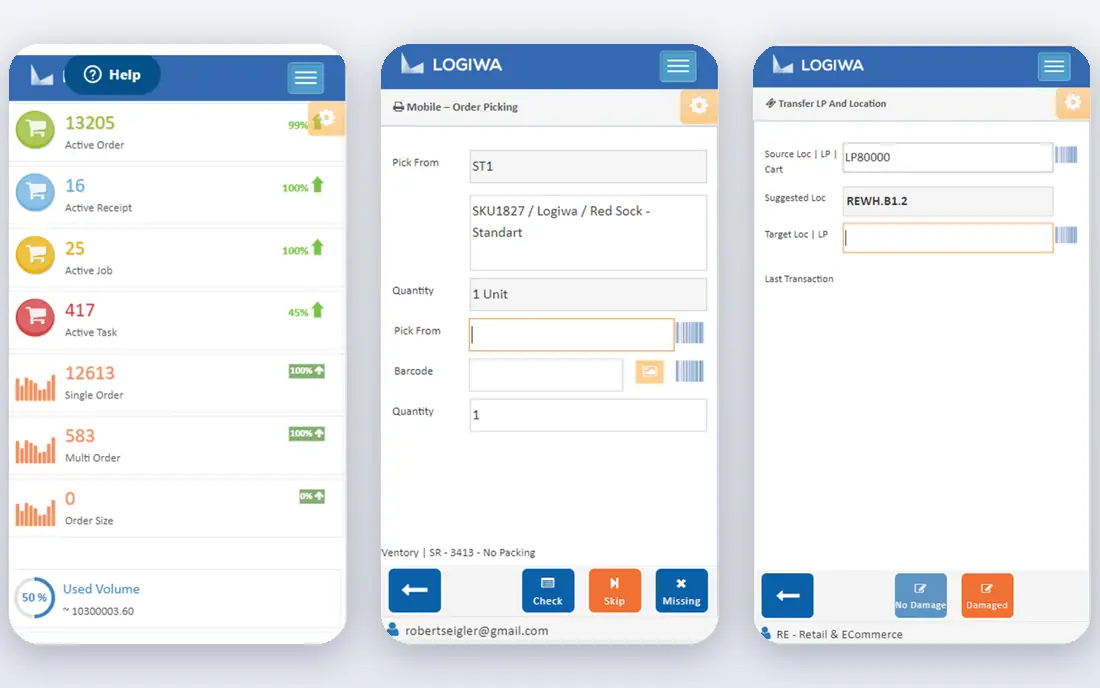
Logiwa provides cloud warehouse management for ecommerce fulfilment and 3PL operations, covering receiving, inventory, picking, packing, shipping and client management. Its multi-client support helps 3PLs keep inventory, orders and billing separate by client, while integrations with carts, marketplaces and carriers support high-volume online fulfilment. Reporting covers inventory accuracy, order throughput and warehouse performance, which helps managers staff and price work correctly.
Pricing is quote-based, and larger or more complex operations may need higher tiers for advanced automation and integrations. Implementation also takes planning for rate cards, client onboarding and carrier setup. For a growing ecommerce 3PL that wants cloud WMS depth without the largest enterprise price tag, Logiwa is a strong middle-ground pick, especially for teams with steady online order growth.
- Cloud WMS for ecommerce fulfilment
- Multi-client support
- Strong order and inventory tools
- Quote-based pricing
- Enterprise features need higher tiers
- Setup takes time
CartonCloud combines warehouse management with transport management, which suits smaller 3PLs that run both storage and delivery work. Its WMS covers inventory, picking, packing and client billing, while transport tools cover jobs, routes and proof of delivery, so a small operator can run warehouse and fleet work from one system. That combination is rare in this list, and it helps teams that would otherwise stitch a WMS to a separate transport tool.
CartonCloud is less suited to very large enterprise warehouses with deep automation, robotics or complex supply chain suites, where Deposco or Oracle NetSuite may fit better. Pricing is quote-based, so smaller teams should ask for a total based on users, clients and order volume. For a smaller 3PL that handles warehousing plus transport, CartonCloud offers a practical, integrated starting point.
- Warehouse plus transport in one system
- Multi-client billing
- Approachable for smaller teams
- Less depth for very large enterprise WMS
- Pricing needs a quote
- Automation depth varies
Deposco provides a supply chain platform with warehouse management, order management, inventory planning and related tools for larger brands, retailers and 3PLs. Its WMS covers receiving, putaway, picking, packing and shipping at scale, with order orchestration across channels and warehouses. That breadth suits operations that need more than a standalone WMS, such as demand planning, allocation and multi-warehouse fulfilment in one suite.
Deposco pricing and implementation are enterprise-scale, so small and new 3PLs will find it costly and heavy. Buyers should scope which modules they actually need, since the full suite covers far more than warehouse work alone. For a larger 3PL or brand with complex supply chain needs and high order volumes, Deposco offers depth and scale that smaller WMS tools cannot match.
- Broad supply chain suite
- WMS, order and inventory depth
- Strong for larger operations
- Enterprise pricing and scope
- Implementation is a large project
- Heavy for small 3PLs
ShipBob is a fulfilment provider with a large warehouse network, plus software that gives brands inventory, order and shipment visibility across its network. It suits brands that want to outsource fulfilment rather than run their own warehouse, with integrations for Shopify, Amazon and other channels. Pricing depends on receiving, storage, picking, packing and shipping volume, rather than a simple software subscription, so brands should model total fulfilment cost.
ShipBob is not a pure WMS for a 3PL that runs its own warehouses. A 3PL buyer that needs multi-client billing, rate cards and warehouse control for its own sites should choose Extensiv, ShipHero or Logiwa instead. For a brand that wants 3PL fulfilment without building warehouse operations, ShipBob offers a network, software visibility and ecommerce links in one service.
- Large fulfilment network
- Ecommerce integrations
- Inventory and order visibility
- Service plus software, not pure WMS
- Pricing depends on fulfilment volume
- Less control than own WMS
Flowspace provides fulfilment through a network of warehouses, with software for orders, inventory and shipment tracking across sites. It suits brands and sellers that need flexible storage and fulfilment capacity without signing a long warehouse lease or building their own WMS operation. Its integrations cover major ecommerce platforms and marketplaces, which helps brands sell across channels while Flowspace handles storage and shipping.
Flowspace is a network fulfilment model, not a WMS that a 3PL installs in its own warehouse, so independent 3PLs should not judge it as a direct Extensiv replacement. Pricing depends on storage, handling and shipping volume, and control over processes varies by network site. For a brand that needs flexible fulfilment capacity and clear order visibility, Flowspace is a practical alternative to a fixed 3PL contract.
- Flexible warehouse network
- Ecommerce and retail fulfilment
- Order and inventory visibility
- Network model, not own-warehouse WMS
- Pricing depends on volume
- Control varies by site
Oracle NetSuite combines ERP, finance, inventory and warehouse management in one cloud suite, with WMS features for receiving, putaway, picking, packing and shipping. Its strength for 3PL-related work is the ERP link: inventory, orders, billing and finance share one system, which helps large enterprises with multi-subsidiary, multi-currency and complex reporting needs. Advanced warehouse features support barcode scanning, wave picking and bin management for larger operations.
NetSuite is an enterprise ERP purchase, with quote-based pricing, specialist implementation and a long timeline, so it is far too heavy for a small 3PL. Its WMS also needs configuration to match 3PL-specific client billing and rate card workflows that Extensiv handles natively. For a large enterprise that already runs, or plans to run, NetSuite for finance and inventory, adding its WMS can make sense. For a standalone 3PL, a dedicated WMS will usually move faster.
- ERP, finance and WMS in one suite
- Strong for large enterprises
- Global and multi-subsidiary support
- Enterprise cost and complexity
- WMS depth needs configuration
- Implementation is lengthy
How we picked these
We compared official product pages, pricing pages, public documentation and third-party pricing guides for 3PL warehouse tools in October 2026. We kept only tools that still support multi-client, warehouse or fulfilment work today, and we balanced dedicated 3PL WMS, ecommerce WMS, network fulfilment and enterprise ERP options. Where a vendor does not publish a price, we wrote See website rather than guessing.
How to choose a 3PL WMS without stalling growth
Start with client separation. Ask each vendor to show two clients in one warehouse, with separate inventory, rate cards, invoices and reports, using your own product examples. If stock, billing or reporting mixes clients, the tool is not a true 3PL system, no matter how good its picking looks.
Next, test onboarding, integrations and billing end to end. Bring a new client example, connect one cart and one carrier, receive stock, pick and pack an order, then generate an invoice from warehouse activity. Check rate card flexibility for storage, handling, pick and pack, and value-added work, plus how disputes and credits are handled. Finally, model total cost by orders, clients and warehouses, including integrations, support and implementation, and compare that figure across vendors.
Questions to ask vendors
Ask how long client onboarding takes, how rate changes apply to open orders, and how inventory accuracy is reported. Ask for reference 3PLs of similar size and order profile, and speak to them about support, billing accuracy and upgrade disruption.
FAQ
What is the difference between a 3PL WMS and a regular WMS?
A regular WMS runs one company inventory, while a 3PL WMS runs many clients inventory in one building, with separate stock, rates, billing and reporting by client. Without native client separation and per-client billing, 3PLs end up reconciling invoices in spreadsheets.
How much does 3PL warehouse software cost?
Most dedicated tools use quote-based pricing, while ShipHero third-party guides cite around $1,995 to $2,145 per month for its 3PL edition. Total cost depends on orders, clients, users, warehouses and integrations, so ask for a written quote for your volume.
Is Extensiv or ShipHero better for a 3PL?
Extensiv is better for multi-client 3PLs that need deep client billing and configurability, while ShipHero is better for ecommerce-heavy 3PLs and DTC brands with strong Shopify workflows. Choose by whether client billing depth or ecommerce picking speed matters more.
Can a small 3PL start with a cheaper WMS?
Yes, CartonCloud and Logiwa suit smaller and growing 3PLs better than enterprise suites, though pricing is still quote-based. Start with a tool that handles client separation and billing well, and avoid a generic WMS that will need spreadsheet billing later.
Do I need EDI and marketplace integrations?
Most 3PLs do, because clients sell across carts, marketplaces and retail channels that each send orders differently. Check that your WMS connects to your clients main channels, plus carriers and accounting, before you sign.
How long does 3PL WMS implementation take?
Timelines vary from weeks for a small, single-warehouse setup to many months for multi-warehouse, multi-client operations. Rate cards, client onboarding, carrier setup and data migration are the usual drivers, so ask for a timeline based on a 3PL like yours.