Best Arize AI Alternatives in 2026: 8 Tools Compared
Looking for Arize AI alternatives? We compare 8 ML and LLM observability tools for tracing, evals, and drift checks, with free tiers and prices in 2026.
- Editor's choice
 Langfuse
Open-source LLM tracing and evals
Starts at$29 per monthVisit langfuse.comFull review - Great alternative
 LangSmith
LangChain and LangGraph teams
Starts at$39 per seat per monthVisit smith.langchain.comFull review - Also consider
 WhyLabs
Drift and data quality monitoring
Starts atSee websiteVisit whylabs.aiFull review
TL;DR:
- Langfuse is the best low-cost starting point, with open-source self-hosting and cloud plans from $29 per month.
- LangSmith suits teams building on LangChain or LangGraph, where deep tracing and prompt tools matter most.
- WhyLabs, Fiddler AI, and Evidently AI suit teams that need drift, data quality, and governance checks on classic ML models.
- Datadog LLM Observability suits teams already running Datadog for infrastructure and application monitoring.
- Braintrust and Weights and Biases Weave suit teams that treat evals as a release gate rather than an afterthought.
Quick comparison
| Tool | Best for | Starts at | Free plan? | |
|---|---|---|---|---|
| Langfuse | Open-source LLM tracing and evals | $29 per month | Yes | Visit |
| LangSmith | LangChain and LangGraph teams | $39 per seat per month | Yes | Visit |
| WhyLabs | Drift and data quality monitoring | See website | Free trial | Visit |
 Fiddler AI | Governance and trust scoring | See website | Free trial | Visit |
 Evidently AI | Open-source drift and eval reports | Free | Yes | Visit |
 Datadog LLM Observability | Existing Datadog teams | See website | Free trial | Visit |
 Weights and Biases Weave | Experiment and trace tracking | $60 per month | Yes | Visit |
 Braintrust | Eval-first product teams | $249 per month | Yes | Visit |
The best Arize AI alternatives
These alternatives to Arize AI cover LLM tracing, evals, and classic ML monitoring, so you can pick by whether you ship prompts, agents, or traditional models.
Langfuse is our pick for most teams leaving Arize AI. It captures LLM traces, token costs, and latency, adds dataset-based evals and human feedback, and lets you version prompts in the same system. The open-source core means you can self-host for full data control, or start on the cloud plan at $29 per month and scale from there.
The trade-off is volume pricing. Cloud plans bill on units, so a high-traffic app can outgrow the entry plan faster than a flat per-seat plan would suggest. Self-hosting avoids that bill but adds database, storage, and upgrade work. If you want a capable, open tool with a low entry price, Langfuse is hard to beat.
- Open-source core with self-hosting
- Traces, evals, and prompt management in one place
- OpenTelemetry support
- Cloud unit pricing can grow with trace volume
- Self-hosting needs ops effort
LangSmith is the natural choice if your app already runs on LangChain or LangGraph. Traces map cleanly to chains, agents, and retrievers, which makes debugging a failed agent run far easier than reading raw logs. Datasets and evals let you test prompt changes before release, and the prompt hub keeps versions in one place.
The cost model needs care. Plus pricing is listed at $39 per seat per month, with trace overages on top, so a large team with heavy traffic should model the full bill. Self-hosting is an enterprise feature, not a standard option. If you are committed to the LangChain stack, LangSmith's depth is worth it. If you use many frameworks, a framework-neutral tool like Langfuse may fit better.
- Deep tracing for LangChain and LangGraph
- Datasets, evals, and prompt hub
- Strong debugging views
- Per-seat pricing adds up for large teams
- Self-hosting needs an enterprise plan
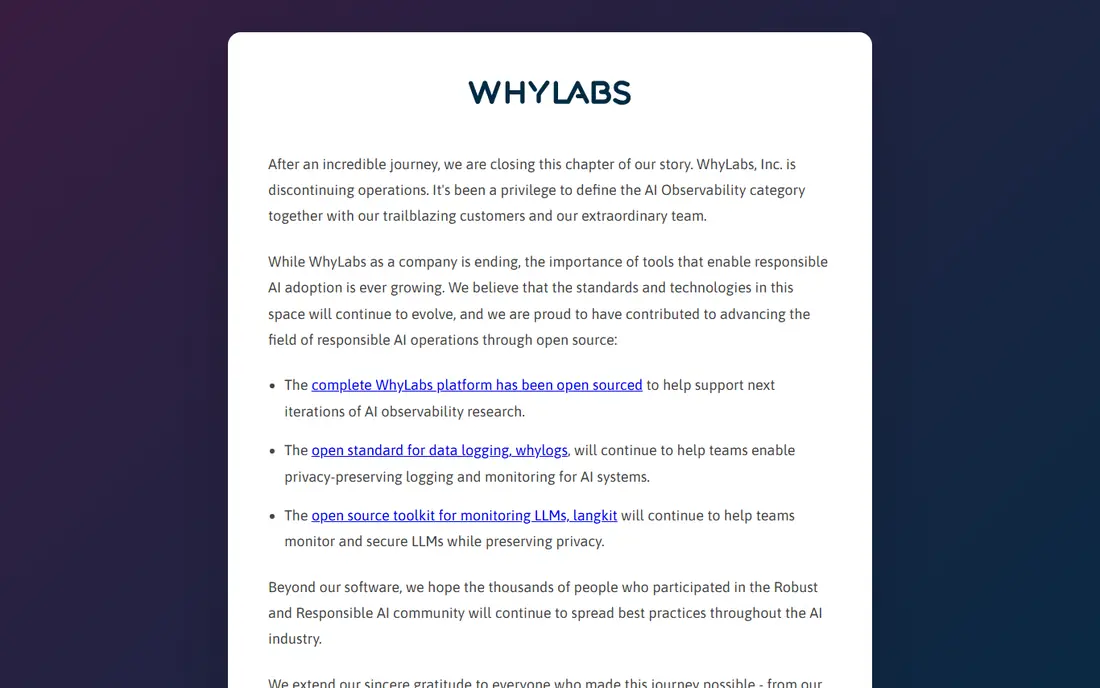
WhyLabs suits teams that run classic ML models in production and worry about data drift. It profiles incoming data, compares it with a reference, and flags shifts in distributions, missing values, and data quality problems before they hurt model accuracy. Privacy-aware summaries also help teams that cannot send raw data to a vendor.
WhyLabs is less of a direct LLM eval tool than Langfuse or LangSmith. It covers LLM monitoring in newer products, but its core strength remains data and model monitoring. If your main risk is drifting input data, WhyLabs is a strong pick. If your main risk is bad prompt output, start with an LLM-first tool.
- Strong drift and data quality profiles
- Privacy-aware summaries
- Integrations with common data stacks
- Less focused on LLM prompt evals
- Enterprise pricing is not published
Fiddler AI focuses on trust and governance for AI in production. It scores outputs for hallucination, toxicity, bias, and prompt injection risks, and it offers guardrails that can block or flag risky output before it reaches users. For regulated firms, that audit trail and reporting matter as much as a trace view.
The drawback is access. Pricing is custom, which usually means Fiddler suits mid-size and enterprise teams rather than solo developers. Small teams may find the setup and contract process heavy for a first observability tool. If compliance and model risk are your top concerns, Fiddler is worth the conversation.
- Trust scores for hallucination, toxicity, and injection risks
- Guardrails for production
- Compliance-friendly reporting
- Pricing is custom and not published
- Setup takes more work for small teams
Evidently AI is a good open-source starting point for drift and eval checks. You can generate reports on data drift, data quality, and model performance, and run LLM evals in your own environment without sending data to a vendor. For teams with Python skills and a modest budget, that control is valuable.
Evidently is a library and platform, not a fully managed tracing service out of the box. You will need engineering time to wire it into pipelines, store reports, and set alerts. The hosted platform adds convenience at a price. If you want a free, code-first way to check drift and evals, Evidently is a solid pick.
- Free open-source reports for drift and data quality
- LLM eval support
- Runs in your own environment
- Cloud platform and support cost extra
- Needs engineering time to run well
Datadog LLM Observability makes sense if your team already lives in Datadog. LLM traces sit next to application traces, logs, and infrastructure metrics, so an on-call engineer can follow a bad model response back to a slow service or a failing dependency in one place. Auto-instrumentation lowers setup work for common frameworks.
The limit is eval depth. Datadog covers tracing, cost, and latency well, but eval-first tools like Braintrust or LangSmith offer richer dataset and scoring workflows. Span-based pricing also needs modelling for high-traffic apps. If unified observability matters more than deep evals, Datadog is the pragmatic choice.
- LLM spans tied to APM and infrastructure
- Familiar Datadog dashboards and alerts
- Auto-instrumentation options
- Pricing depends on span volume and Datadog plan
- Less eval depth than eval-first tools
Weights and Biases, known for ML experiment tracking, offers Weave for LLM tracing and evals. Teams that already track training runs in Weights and Biases can keep model work and LLM work in one system, with shared projects, reports, and access controls. Weave adds trace views, eval scoring, and cost tracking for production apps.
The entry price is higher than Langfuse, at $60 per month in published comparisons, and costs can grow with trace volume. If you already use Weights and Biases, Weave is a natural extension. If you are starting fresh and cost matters most, Langfuse gives you similar tracing at a lower entry price.
- Strong experiment tracking heritage
- LLM traces and evals in Weave
- Good team collaboration
- Entry price is higher than Langfuse
- Tracing and eval pricing can grow with use
Braintrust treats evals as a release gate. You build datasets, run evals on every prompt change, score production output, and only ship when quality holds. That discipline suits product teams where a bad model answer reaches customers directly, such as support, search, or content tools.
The price reflects that focus. The free Starter tier covers small use, but Pro starts at $249 per month, which is steep for a solo developer. Braintrust is less of a general tracing tool and more of a quality system. If evals decide your releases, it is worth the cost. If you only need traces and cost tracking, a cheaper tool will do.
- Structured eval pipelines with dataset versioning
- Production scoring
- Strong prompt workflow
- Pro plan starts at $249 per month
- Less suited to tiny teams on a tight budget
How we picked these
We compared official pricing pages, documentation, and product descriptions for ML and LLM observability tools that cover tracing, evals, drift, or governance in 2026. We kept tools with a free tier, open-source option, or published entry price where possible, and we noted where pricing is custom. We did not claim hands-on testing, and we treated vendor pages as the source for prices and limits.
How to choose an observability tool
Start with the failure you fear most. If bad prompt output reaches users, pick an eval-first tool. If input data shifts quietly, pick a drift tool. If you need to debug agents, pick a tracing tool with framework support for your stack. That single choice narrows the list faster than any feature table.
Then check data control and cost together. Decide whether traces can leave your environment, whether you can self-host, and how long traces are retained on each plan. Model the bill at your real trace volume, not at the free tier, and run a two-week trial on production traffic before you commit. A tool that looks cheap at 10,000 traces can surprise you at 2 million.
FAQ
What is the best alternative to Arize AI?
Langfuse is the best overall alternative for most teams, thanks to open-source self-hosting, tracing, evals, and a $29 per month cloud entry plan. LangSmith is best for LangChain teams, and Braintrust is best for eval-first product teams.
Is there a free alternative to Arize AI?
Yes. Langfuse, Evidently AI, and the open-source parts of Weights and Biases offer free tiers or free self-hosting. Free tiers usually limit trace volume or retention, so check those limits against your traffic.
Do I need both tracing and evals?
Tracing shows what happened in a single run, while evals show whether quality holds across many runs. Most production teams need both: tracing to debug failures, and evals to catch regressions before release.
Can I self-host an Arize AI alternative?
Yes, with Langfuse and Evidently AI, which offer open-source self-hosting. LangSmith self-hosting needs an enterprise plan, and some tools in this list are cloud only, so check hosting before you buy.
What is the difference between drift monitoring and LLM evals?
Drift monitoring checks whether input data or model behaviour shifts over time, while LLM evals score output quality against datasets and rules. Classic ML teams need drift checks most, while LLM teams need both drift and evals.
How much does LLM observability cost?
Entry prices here range from free to $249 per month, but the real cost depends on trace volume, retention, and seats. Model your bill at production volume, and watch overage rates for traces and scores.